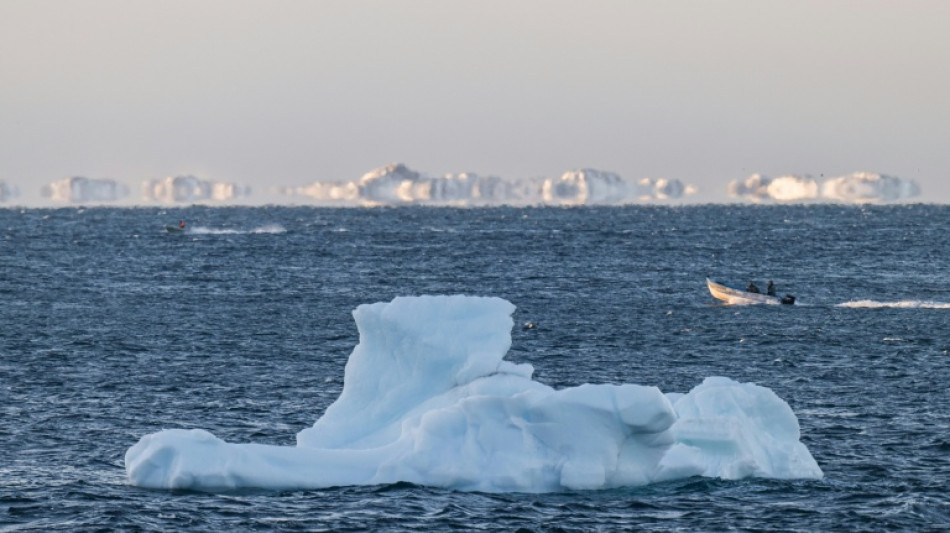
AI to track icebergs adrift at sea in boon for science / Photo: Jonathan NACKSTRAND - AFP

 Stocks move lower despite oil prices dropping

 AI driving up innovation investment: UN

 UN Security Council extends Haiti mission by 6 months

 Man Utd do not deserve medals if Man City stripped of titles: Rooney

 Vana Completes Expanded Staking as Part of the Vega Upgrade, Publishes Expanded VANA Token Economics

 Spain to cap gas price hikes, extend fuel discounts

 'We just need rain': Germany's Rhine river hits new low

 Yemen health system at 'breaking point': WHO

 Ireland undecided on second Israel match: coach

 France's Le Pen defiant after top ally hit by antisemitism claims

 Tom Cruise trades stunts for satire as toxic tycoon 'Digger'

 MEXC Unveils "WE SEE YOU" Brand Visual Refresh, Putting People Behind Every Trade in Focus

 Thai capital cleans up after deadly floods

 NATO, EU allies rally to Estonia after 'sabotage' blamed on Russia
 Families demand justice for Cameroon's 'nightmare' wave of murdered women

 Tebas says Man City should face 'most severe' sanctions if guilty of rule breaches

 Pochettino calls Man City success 'a period of deception'

 Settler attack on West Bank village injures Israeli forces, drawing rare rebuke

 Mystery over UK airbase scare after reports no explosives found

 Spanish govt races to adopt housing law under protest pressure

 Estonia slams Russian 'sabotage' after arson attack on defence company

 Slovenia sees surge in '.si' sites after Trump hypes 'super intelligence'

 'Like a dream' for An as Games organisers 'sorry' for latest mix-up

 Tokyo suffers longest streak of rainy days on record

 Indonesia charges train driver over crash that killed 16 women
British scientists said Thursday that a world-first AI tool to catalogue and track icebergs as they break apart into smaller chunks could fill a "major blind spot" in predicting climate change.
Icebergs release enormous volumes of freshwater when they melt on the open water, affecting global climate patterns and altering ocean currents and ecosystems.
But scientists have long struggled to keep track of these floating behemoths once they break into thousands of smaller chunks, their fate and impact on the climate largely lost to the seas.
To fill in the gap, the British Antarctic Survey has developed an AI system that automatically identifies and names individual icebergs at birth and tracks their sometimes decades-long journey to a watery grave.
Using satellite images, the tool captures the distinct shape of icebergs as they break off -- or calve -- from glaciers and ice sheets on land.
As they disintegrate over time, the machine performs a giant puzzle problem, linking the smaller "child" fragments back to the "parent" and creating detailed family trees never before possible at this scale.
It represents a huge improvement on existing methods, where scientists pore over satellite images to visually identify and track only the largest icebergs one by one.
The AI system, which was tested using satellite observations over Greenland, provides "vital new information" for scientists and improves predictions about the future climate, said the British Antarctic Survey.
Knowing where these giant slabs of freshwater were melting into the ocean was especially crucial with ice loss expected to increase in a warming world, it added.
"What's exciting is that this finally gives us the observations we've been missing," Ben Evans, a machine learning expert at the British Antarctic Survey, said in a statement.
"We've gone from tracking a few famous icebergs to building full family trees. For the first time, we can see where each fragment came from, where it goes and why that matters for the climate."
This use of AI could also be adapted to aid safe passage for navigators through treacherous polar regions littered by icebergs.
Iceberg calving is a natural process. But scientists say the rate at which they were being lost from Antarctica is increasing, probably because of human-induced climate change.
P.Smith--AT