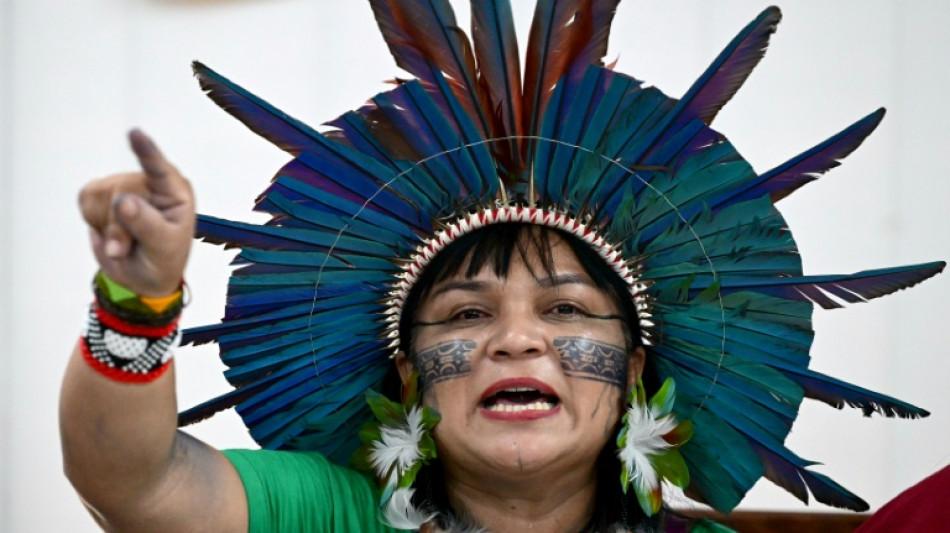
Indigenous Brazilians protest Amazon river dredging for grain exports / Photo: Pablo PORCIUNCULA - AFP

 France's debt climbs to highest since 1978: ministry

 McIlroy two shots off the lead at Wentworth after eagle on 18
 Martinez brace saves Inter in Serie A top-two clash with Roma
 Rosenior abused but guides Paris FC past old club Strasbourg
 Seven-try Lyon beat Pau, climb to Top 14 summit
 Brighton defeat a 'big lesson' against complacency for Arsenal, says Arteta

 Thousands protest inaction over climate crisis in Switzerland

 Carapaz out of cycling world championships

 'Fragile' Tottenham beaten by Aston Villa despite late rally

 Mourinho hails Real Madrid grit before Atletico derby clash

 Martin wins Austrian MotoGP sprint after Acosta crash

 Japan edge Fiji to win Pacific Nations Cup
 Black smoke, flames rising near Riyadh airport: residents to AFP

 UK actor Naomi Watts honoured at Spain film festival
 Japan emperor declares Asian Games open after turbulent build-up

 Asian Games open with unity message after troubled build-up
 Denmark hails 'binding' Greenland deal with Trump
 We don't want Games host Japan losing money, says Asian Olympic official
 Ed Sheeran returns to stage after Palestinian controversy

 Asian Games to open in Japan after troubled build-up
 Drone owners rush to offload devices ahead of Beijing ban

 Trump's beef policies irk Texas ranchers, testing their loyalty

 New to The Street Broadcasts Tonight at 6:30 PM ET Across the United States, Latin America and MENA, Featuring BioVie, Acurx Pharmaceuticals, Lantern Pharma and SafeSpace Global
 Nvidia, OpenAI CEOs to attend Xi dinner at White House

 Anthropic picks Accenture for in-house AI safety evaluation
Hundreds of Indigenous people have been protesting in northern Brazil for two weeks outside the port terminal of US agribusiness giant Cargill, angered over the dredging and development of Amazonian rivers for grain exports.
Brazil's Indigenous communities have raised the alarm for months about port expansion on rivers they see as vital to their way of life, a grievance they protested at COP30 climate talks last November.
"The government is opening up our territories to many projects ... to boost agribusiness," Indigenous leader Auricelia Arapiuns told AFP in a video message from the Amazon port city of Santarem, in the same state that hosted COP30 in Belem.
"We have been here for 14 days, but this struggle didn't start now. We occupied Cargill to draw attention so that the government would come up with a proposal."
By Wednesday, some 700 Indigenous people from 14 communities were taking part in the demonstration, according to the Amazon Watch advocacy group.
The protesters have blocked trucks from "entering and leaving the terminal," Cargill said in a statement sent to AFP, adding it has "no authority or control" over their complaints.
The Minnesota-based multinational has agricultural logistics operations across Brazil, where it employs 11,000 people.
Protesters on Wednesday demanded the cancellation of a decree signed by President Luiz Inacio Lula da Silva in August which designates major Amazonian rivers as priorities for cargo navigation and private port expansion.
They also want the cancellation of a federal tender issued in December worth 74.8 million reais ($14.2 million) to manage and dredge the Tapajos River -- a major Amazon tributary.
"This infrastructure that is coming is not a space for us, and it never will be. It is a project of death to kill our river and our sacred places," Indigenous leader Alessandra Korap of the Munduruku people said in a statement.
The ports ministry said earlier in January that the contract of a company for maintenance dredging was necessary to "increase navigation safety... and ensure greater predictability for cargo and passenger transport operations."
- 'Serious environmental risks' -
The protesters criticized the government for only sending mid-level officials to meet with them and breaking a COP30 promise not to carry out projects on Amazonian rivers "without prior consultation."
Brazil's Ministry of Indigenous Peoples said in a statement Monday it recognizes the "legitimacy of the concerns raised" and that no dredging or other projects can take place on the Tapajos river without the consent of those affected.
Fed up, the protesters were no longer in the mood to negotiate.
"We don't want a consultation. We want this decree revoked," Indigenous leader Gilson Tupinamba, wearing a large headdress of blue and orange feathers, told a meeting with government representatives on Wednesday.
Brazil is the world's largest exporter of soybeans and corn, and in recent years has switched to northern river ports to export grains more cheaply.
Critics see plans to boost barge traffic on Amazonian rivers as yet another project where economic development is clashing with Lula's much vaunted commitment to the environment.
"What did the government do after the COP? They launched the dredging tender," Arapiuns told the government representatives.
After the meeting, the protesters blocked the road leading to the Santarem international airport -- a popular hub for tourists.
Brazil's Federal Public Prosecutor's Office (MPF) -- which has taken legal action against the dredging efforts -- on Tuesday pointed to "serious environmental risks" for the river.
In a statement, the MPF referred to the release of heavy metals such as mercury into the water, and destruction of crucial habitats for threatened species of dolphins, turtles and aquatic birds.
N.Walker--AT



