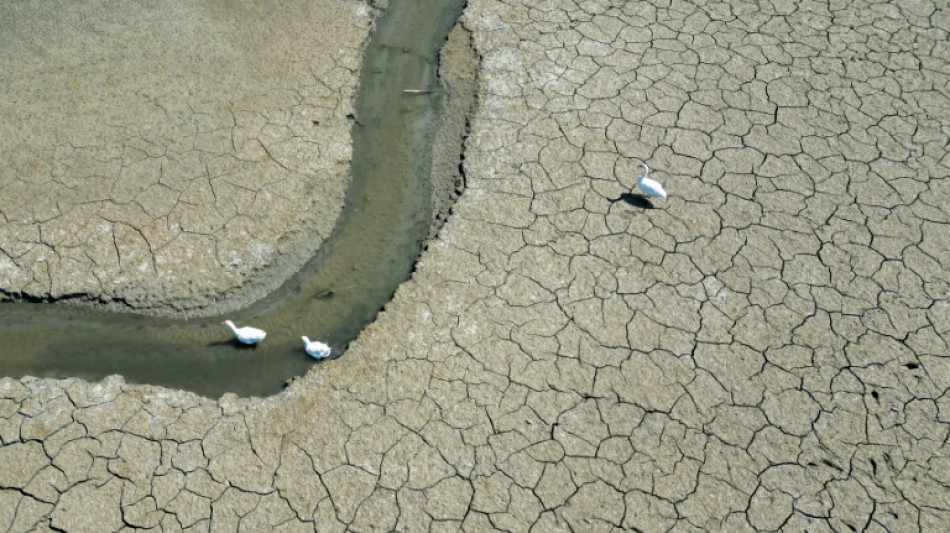
2025 on track to tie second hottest year on record: EU monitor / Photo: Nicolas TUCAT - AFP/File

 Alleged Rihanna mansion shooter mentally fit for trial, says judge

 Mystery over UK airbase scare as police find petrol not explosives

 OpenAI unveils low-cost AI model, a day after shelving Astra upgrade

 Premier League confirms Man City guilty of serious financial breaches

 Brazil's Lula turns to Bad Bunny tune to criticise Trump ahead of polls

 Nigerian dancer eyes world record after seven-day marathon

 Swiss regulator concludes Julius Baer bank probe
 Brazil's patron saint pulled into latest election scrap

 Football overload leaves players near 'breaking point', warns Tebas

 Paris Eiffel Tower says chief to step down after uproar over removing women staff

 Amaze Holdings (NYSE: AMZE) Executes Binding LOI to Acquire BullionFX | Alchemy, a Decentralized Gold-Backed Financial Ecosystem for Valued at US$155 Million

 Clashes between French teens, police as school blockades intensify

 Stocks move sideways despite oil moving lower

 African leaders to gather in Egypt for business summit

 UK decides against charging foreign visitors for museums

 Dallaglio to sell England World Cup winners' medal

 Brazil come from behind to beat Australia 4-2 in friendly

 Ruthless An retains Asian Games badminton crown as Kunlavut triumphs

 Alonso to stay with F1 team Aston Martin in 2027

 China badminton 'still strong' despite Asian Games slump

 'Exceptional' Turner painting shown in Rome before sale

 European stocks climb as oil dips

 Spain aims to ban evictions until 2030 amid housing protests

 Kunlavut first Thai man to win Asian Games badminton singles gold

 French far right says antisemitism claims part of 'total war' to derail presidency bid

The planet is on track to log its second hottest year on record in 2025, tied with 2023 after a historic high in 2024, Europe's global warming monitor said Tuesday.
The data from the Copernicus Climate Change Service reaffirms that global temperatures are on course to exceed 1.5C above pre-industrial levels -- the threshold considered safer in the 2015 Paris Agreement.
Temperatures rose by 1.48C on average between January and November, or "currently tied with 2023 to be the second-warmest year on record", according to the service's monthly update.
"The three-year average for 2023–2025 is on track to exceed 1.5C for the first time," Samantha Burgess, strategic lead for climate at Copernicus, said in a statement.
"These milestones are not abstract –- they reflect the accelerating pace of climate change and the only way to mitigate future rising temperatures is to rapidly reduce greenhouse gas emissions," Burgess said.
UN Secretary-General Antonio Guterres warned in October that the world would not be able to contain global warming below 1.5C in the next few years.
Last month was the third warmest November on record at 1.54C above pre-industrial levels, according to Copernicus, with the average surface air temperature reaching 14.02C.
Such incremental rises may appear small but scientists warn that is already destabilising the climate and making storms, floods and other disasters fiercer and more frequent.
"The month was marked by a number of extreme weather events, including tropical cyclones in Southeast Asia, causing widespread, catastrophic flooding and loss of life," the monitor said.
- Fossil fuel fight -
The Philippines were ravaged by back-to-back typhoons that killed some 260 people in November, while Indonesia, Malaysia and Thailand were hit by massive floods.
The global average temperature for the northern hemisphere autumn, from September to November, was also the third highest on record after 2023 and 2024.
"Temperatures were mostly above average across the world and especially in northern Canada, over the Arctic Ocean, and across Antarctica," the monitor said, adding that there were notable cold anomalies in northeastern Russia.
Copernicus takes its measurements using billions of satellite and weather readings, both on land and at sea, and their data extends back to 1940.
Global temperatures have been stoked ever higher by humanity's emissions of planet-heating gases, largely from fossil fuels burned on a massive scale since the industrial revolution.
Nations agreed to transition away from fossil fuels at the UN's COP28 climate summit in Dubai in 2023 but ambitions have stalled since then.
The COP30 climate conference in Belem, Brazil, concluded last month with a deal that avoided a new, explicit call to phase out oil, gas and coal following objections from fossil fuel-producing countries.
R.Garcia--AT