
SCEMFIS-Supported Menhaden Research Advances Work Toward a Scientifically Based Chesapeake Bay Harvest Cap

 Trump's new press secretary says China lacked 'proper' toilets

 India closes down New Delhi park ahead of 'cockroach' movement rally
 'Let us build': World Bank chief outlines jobs-led development agenda

 Broncos top Super Bowl champion Seahawks in overtime

 Brilliant Brewers sweep Dodgers to reach World Series

 Brewers complete Dodgers sweep to reach World Series

 High-flying Freiburg try to shut out the noise as fairytale run continues

 Flamengo secure 0-0 draw in La Plata in Copa Libertadores semi

 The final lap? Two days on the campaign trail with Trump

 Asian stocks rise as tech bounces from rout, eyes on Warsh

 Saudi organisers say 2027 Asian Cup 'on schedule' after attacks
 Right-wing Brazil influencers on 'mission' to seal Bolsonaro win

 Using AI to help find Mexico's legions of missing children

 Fiji to deploy solar-powered Australian military drones at sea

 InterContinental Hotels Group PLC Announces Transaction in Own Shares - October 16

 Lawmakers Demand Menhaden Cuts Before Chesapeake Bay Science Is Complete, Ignoring Already Struggling Workers

 Wallabies coach has 'faith' as All Blacks juggernaut awaits

 Ailing UK director Mike Leigh wishes he could make '100 more films'

 Pixagram Announces Free Account Creation for 250 New Users Daily Through 2026

 Macron warns urgent to strike EU budget deal before French vote runup

 Zelensky rallies European allies as Trump ties slump

 Guardians edge Rays to seize MLB playoff series lead

 Trump scraps plan to livestream execution after fierce backlash

 Martinez apologises for outburst at Man Utd hierarchy

 Houthis launch deadly attack on presidential palace in Yemen's Aden

Research team is evaluating the data, methods, and feasibility studies needed to support future Bay-specific management decisions
GLOUCESTER POINT, VA / ACCESS Newswire / May 3, 2026 / Last October, the Science Center for Marine Fisheries (SCEMFIS) funded a team of leading Atlantic menhaden researchers to develop a roadmap identifying the research needed to develop a scientifically defensible and ecologically meaningful Chesapeake Bay harvest cap.
The project brings together experts from the Batten School of Coastal and Marine Sciences & VIMS at William & Mary, the Chesapeake Biological Laboratory (CBL) at the University of Maryland Center for Environmental Science (UMCES), and NOAA, combining decades of experience in peer-reviewed menhaden research, stock assessments, ecological modeling, and survey design.
SCEMFIS, a member of the National Science Foundation's Industry-University Cooperative Research Program, brings scientists and industry together to fund and conduct applied marine fisheries research. Since the project began, the research team has worked collaboratively online and met in person in February in Solomons Island, Maryland, to review progress and plan next steps.
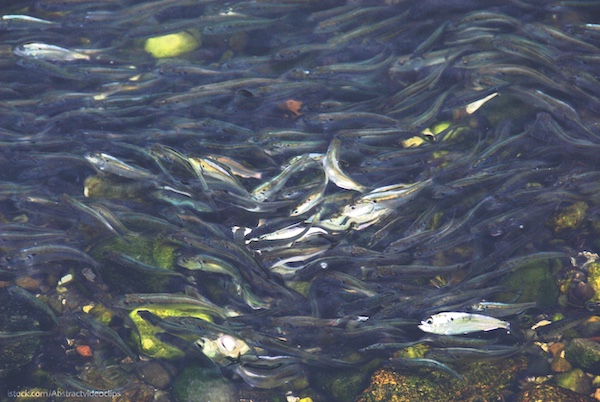
The roadmap project will produce final recommendations by the end of the year. Those recommendations are expected to include proposed methodologies, timelines, and costs for additional research needed to support development of a scientifically based Chesapeake Bay harvest cap.
At the SCEMFIS spring 2026 meeting in Nashville, Dr. Robert J. Latour, Professor at the Batten School of Coastal and Marine Sciences & VIMS, outlined the work completed so far and described how the team is evaluating potential methods to generate the Bay-specific data needed to support future management decisions for Atlantic menhaden.
Dr. Latour explained that Atlantic menhaden have been the focus of significant scientific and management attention because of their dual role as an important forage species and the basis for a long-standing commercial fishery. In the Chesapeake Bay, managers have sought to balance fishery removals with menhaden's ecological role, including through the existing Bay landings cap. However, Dr. Latour noted that the current cap is not a scientifically derived biological reference point, but rather a precautionary limit based on average historical catch.
The research team's work is intended to help identify what information would be needed to move from a precautionary cap toward a biologically-based management framework. That includes determining how to estimate local menhaden abundance, fishing mortality, movement between the Bay and coastal waters, and menhaden availability to predators.
As part of that effort, the team will begin a pilot study to test whether Passive Integrated Transponder, or PIT, tagging can be used to generate information that existing historical datasets cannot provide. PIT tags are small tags that are injected into fish and can be detected later if the fish pass through a receiver system.
"Tagging is one potentially promising option available to us to establish a Bay cap that is grounded in the best available science," said Dr. Genny Nesslage, Associate Research Professor at the Chesapeake Biological Laboratory and leader of the menhaden roadmap project. "We are ultimately looking for research recommendations that prioritize accuracy, timeliness, and efficiency."
The team is building on historic menhaden tagging work, including large-scale tagging efforts from the 1960s, while adapting modern technology to address current management questions. This type of tagging data can potentially help estimate exploitation and total abundance, two of the central questions surrounding Chesapeake Bay menhaden management.
The proposed tagging pilot project will include two major components.
First, researchers will conduct controlled holding studies at VIMS to evaluate whether the tagging process affects menhaden survival. Fish will be collected from the field, acclimated to captivity, and placed into trials in which all fish are handled the same way, except that some receive PIT tags and others do not. These trials will help determine whether the act of tagging itself affects survival and whether the method can produce reliable data.
Second, on May 12, the research team will visit Ocean Harvesters to begin planning field trials designed to determine whether tagged menhaden can be reliably detected during commercial fishing operations. Ocean Harvesters, which supplies menhaden to Omega Protein, has agreed to open its doors to the research team and work with them to determine how PIT tags could be retrieved on an ongoing basis while the fishery is underway. Researchers will evaluate whether receivers can be placed in the pump hose, on the chute where fish enter the vessel holds, or at Omega Protein's processing facility as menhaden are processed. The field trials will involve placing known numbers of tagged fish into catches and measuring whether detection systems can reliably identify them under real-world harvesting and processing conditions.
The tagging concept is one piece of the broader SCEMFIS-supported roadmap project. The team is also considering other potential methods for generating Bay-specific data, including acoustic and LiDAR surveys, environmental DNA, stable isotope analysis, and other approaches that could help measure local abundance, movement, and predator consumption.
The tagging feasibility study, if successful, would provide an important early test of whether modern tagging technology can help answer some of the most challenging questions facing Atlantic menhaden management in the Chesapeake Bay.
Project Team
Selected qualifications in Atlantic menhaden and Chesapeake Bay
Robert J. Latour, Ph.D., Professor, Batten School of Coastal and Marine Sciences & VIMS, William & Mary
Quantitative fisheries ecologist focusing on predator-prey interactions, population dynamics, and habitat modeling. Lead/co-author of the 2023 study on female Atlantic menhaden reproductive biology and fecundity and co-author, with Gartland, of Virginia's 2023 Atlantic Menhaden Research Planning report to the General Assembly and Secretary of Natural and Historic Resources.
James Gartland, Ph.D., Senior Research Scientist, Batten School of Coastal and Marine Sciences & VIMS, William & Mary
Quantitative fisheries scientist with extensive experience in the development of fisheries monitoring surveys, prey consumption models, and ecological indicators, including in Chesapeake Bay. Co-author of the 2023 menhaden fecundity study with Latour and Schueller and co-author of Virginia's 2023 Atlantic Menhaden Research Planning report guiding Bay-specific research priorities.
Genevieve M. Nesslage, Ph.D., Associate Research Professor, CBL, UMCES
Quantitative fisheries scientist with research focusing on Atlantic menhaden spawning locations and larval dispersal, fishery sampling, survey design, overwintering habitat use, and predator-prey modeling. Former Senior Stock Assessment Scientist at the Atlantic States Marine Fisheries Commission.
Michael J. Wilberg, Ph.D., Professor of Fisheries Science, CBL, UMCES
Fisheries stock assessment and management strategy evaluation specialist with research focused on Atlantic menhaden movement, mortality, growth, and predator-prey modeling. Lead author of the 2020 survey design for Atlantic menhaden in Chesapeake Bay.
Amy M. Schueller, Ph.D., Research Fish Biologist, NOAA Southeast Fisheries Science Center
Lead assessment analyst for Atlantic and Gulf menhaden and key contributor to the working group on ecological reference points, or ERPs, that underpin Atlantic menhaden management.
About SCEMFIS
The Science Center for Marine Fisheries (SCEMFIS) brings together academic and industry expertise to address urgent scientific challenges facing sustainable fisheries. Through advanced methods, analytical tools, and collaborative research, SCEMFIS works to reduce uncertainty in stock assessments and improve the long-term sustainability of key marine resources.
SCEMFIS is an Industry-University Cooperative Research Center supported by the National Science Foundation. Industry organizations join SCEMFIS through an Industry Membership Agreement with one of the center's site universities and contribute both financial support and valuable expertise to help shape research priorities.
Its university partners include the University of Southern Mississippi (lead institution) and the Batten School of Coastal and Marine Sciences & VIMS at William & Mary. The center also collaborates with scientists from a broad network of institutions, including Old Dominion University, Rutgers University, the University of Massachusetts-Dartmouth, the University of Maryland, and the University of Rhode Island. These researchers bring deep expertise in finfish, shellfish, and marine mammal science.
Demand for SCEMFIS's services continues to grow, driven by the fishing industry's need for responsive, science-based support. The center provides timely access to expert input on stock assessment issues, participates in working groups, and conducts targeted studies that lead to better data collection, improved survey design, and more accurate modeling-all in service of sustainable, science-driven fishery management.
PRESS CONTACT:
Stove Boat Communications
[email protected]
SOURCE: Science Center for Marine Fisheries
View the original press release on ACCESS Newswire
O.Ortiz--AT