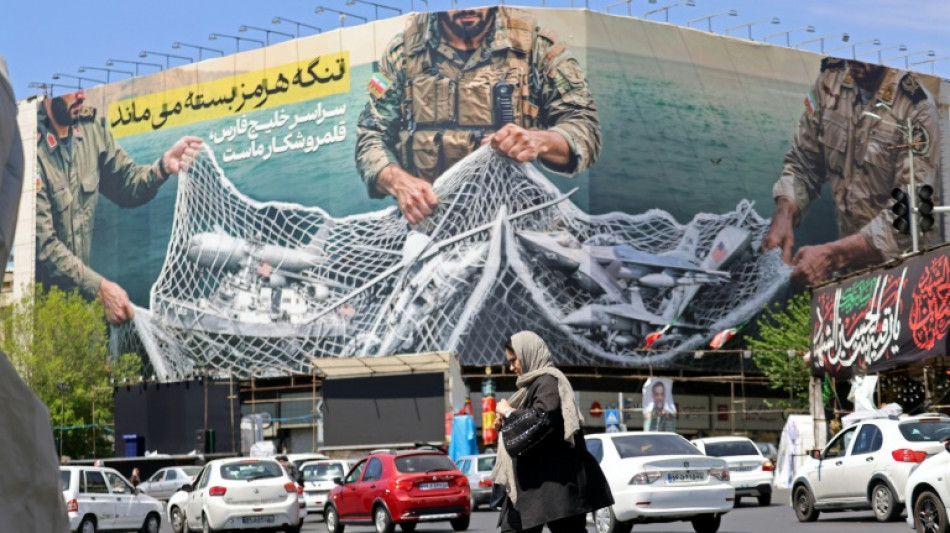
'No other way': Mideast prepares for more fighting as talks fail / Photo: ATTA KENARE - AFP

 Breytenbach confirms recommending Sibiya for Johannesburg post

 Celebrities mark Thanksgiving in turkey-themed photo gallery

 German fashion model Veruschka dies in Berlin at 87

 Thanksgiving storms disrupt thousands of US flights

 T.J. Lang criticises Aaron Rodgers over comments about Mike McCarthy

 Black Friday beauty offers span skincare, fragrance and wellness devices

 U2 pays tribute to Dolly Parton during Thanksgiving Eve NFL show

 Toyota Innova Hycross and Kia Sorento hybrids compared in top trims

 President Trump to Attend TSMC Groundbreaking in Phoenix Next Week

 Gauteng Health Department Warns of Rising Antibiotic Resistance Threat

 Bishop Museum Races to Save Rare Megamouth Shark Specimen

A sense of dread spread across the Middle East after talks between the US and Iran collapsed, as fears of renewed fighting rattled an already tense region with Donald Trump ordering a naval blockade of the Strait of Hormuz.
Following more than 20 hours of talks in the Pakistani capital Islamabad, US Vice President JD Vance admitted the yawning differences between the US and Iran proved to be insurmountable for the moment.
Questions about what would come next and whether the two sides would continue to respect a two-week ceasefire was anybody's guess as both the Iranian and American delegations departed Pakistan without a deal.
"Things could change at any moment," said Aishah, a 32-year-old economic consultant based in Doha.
"It's more about taking each day as it comes."
The failure of the talks however did not surprise many in the region.
"I didn't have a lot of hope for them going in, because the two sides want completely opposite things," Laura Kaufman, a 38-year-old school teacher in Tel Aviv, told AFP.
“There didn't seem to be anyone willing to actually negotiate."
A recent poll found that only 10 percent of the Israeli public believe the war against Iran had constituted a "significant success, compared to 32 percent who view it as a failure".
In Iran, a brief spell of hope that talks would end the hostilities between the long-time foes were quickly dashed.
"I really wanted them to make peace," said Mahsa, a 30-year-old employee of an export company in the Iranian capital.
"It's been almost 45 days now that I've seen everyone stressed. It's a bad situation."
- 'Worried' -
Elsewhere in the Middle East, the negotiations' failure only seemed to guarantee more uncertainty.
"I am worried about the continuation of the situation and the return of attacks again, because they were causing me tension," said Imam, an Egyptian housewife living in the UAE capital of Abu Dhabi.
"I was making a great effort not to pass my tension on to the children."
With nerves already battered, President Trump on Sunday ordered an immediate naval blockade of the Strait of Hormuz, vowing to intercept any ship that pays tolls to Tehran while also preventing Iran from earning future oil revenues.
"Any Iranian who fires at us, or at peaceful vessels, will be BLOWN TO HELL!" he wrote.
The news came as many in the region were hoping for a return to normality.
Earlier Sunday, Saudi Arabia's energy ministry said its key east-west oil pipeline and other major energy facilities had been restored following attacks by Iran on targets across the Gulf.
"Of course I am worried that the war will return again," said Amin, a pharmacist living in Saudi Arabia's eastern province, who asked to use a pseudonym for security reasons.
Back in Iran, a sense of the inevitable had begun to sink in for many there.
"I would have preferred peace, but I think there is no other way but war and confrontation," said Hamed, 37.
"Based on what I see and hear, unfortunately we are going to war again and it seems like we will have a long war."
burs-ds/ser
R.Chavez--AT