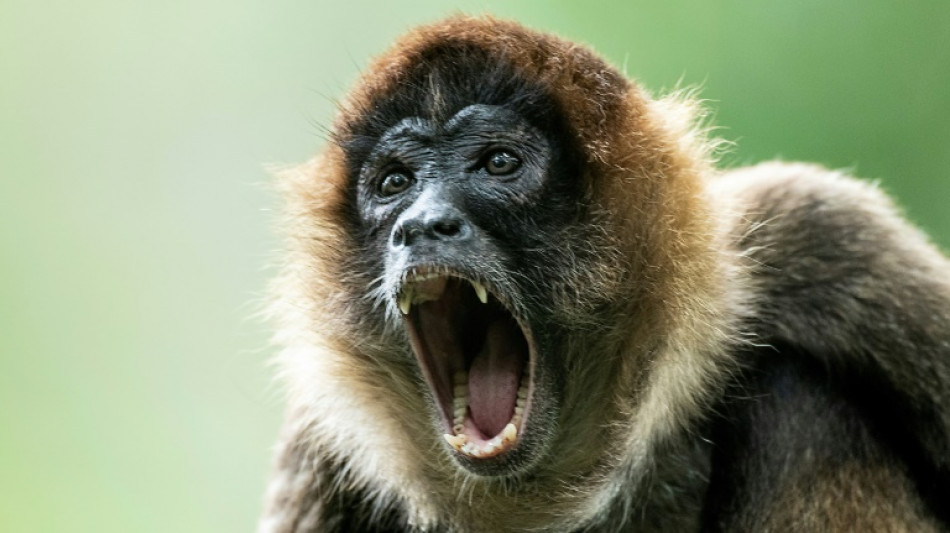
Revealed: Why monkeys are better at yodelling than humans / Photo: Ezequiel BECERRA - AFP/File

 Magnificent Mandhana's 79 helps India to Asian Games cricket gold

 Marchand 'stressed' about racing Japanese rivals at LA Olympics

 Mobile boat clinics bring healthcare to India's remote islands

 Former India paceman Zaheer Khan named Chennai coach in IPL

 Six-year-old Chinese girl sets world record with Rubik's Cube

 Swimming prodigy Yu, 13, says 'interviews way harder than racing'

 Star coaches make their bows as Nations League returns

 Rams bounce back as Giants reel from Dart injury

 In Bangladesh, Pakistan's Jinnah photo stirs anger

 Two New Zealand naval ships transit Taiwan Strait

 Zidane gets down to work as France start new era

 Inside the Venezuelan prison meant to 'drive you insane'

 UK king braces as memoir by Diana's brother goes on sale

 GFS Chemicals Partners With Bioz to Turn Data Into Deeper Product Engagement

 Coretura Selects Alloy Kore to Advance a Unique Software-Defined Vehicle Platform for Its Commercial Vehicle Customers

 Akkodis and Hamburg Public Transport Association Showcase hvv mia at InnoTrans 2026, Demonstrating the Future of AI-Powered Mobility

 Macron says talks with Trump on Red Sea, Ukraine 'constructive'

 Green policies just good politics, says UK minister

 Bardot auction in Paris fetches nearly one million euros

 No timeline on Daniels injury return, says Commanders coach

 British Columbia sues OpenAI in US court over Canada school shooting
 French star Batum retires after 18-year NBA career

 Zidane leads first France training session

 Man shot by ICE agent in Texas detained with bullet inside him: lawyer

 California declares state of emergency ahead of El Nino
Yodellers of the world, you never stood a chance: Monkeys will always be better at yodelling than humans because they have a "cheap trick" hidden in their voice box, scientists revealed Thursday.
When monkeys howl -- or yodellers yodel -- they rapidly switch back and forth between low and high frequency sounds.
This is in contrast to opera singers, who are trained to precisely control how they gradually move from note to note, in a way that is pleasing to listen to.
Yodellers and monkeys, however, make bigger jumps far more abruptly, creating vocal breaks that sound like Tarzan's yell.
When yodelling, a human might be able to jump an octave, which doubles the frequency.
Monkeys can manage three and half octaves, according to a new study.
A "cheap trick" in their larynx means these monkeys will always beat humans, senior study author Jacob Dunn of the UK's Anglia Ruskin University told AFP.
Both humans and monkeys have a pair of vocal folds in their larynx which vibrate to create sound.
But monkeys have an additional pair of membranes that gives them a far wider pitch range, the international team of researchers discovered.
This is thought to give monkeys, which are social creatures, a more complex way of communicating with each other.
All other primates, and even ancient human ancestors, appear to have this special tissue, Dunn said.
At some during our evolution, humans seem to have lost these membranes, he added.
But the shame of being inferior yodellers may have been worth the trade-off.
To be able to speak clearly, humans needed a "streamlined" larynx -- and these membranes would have gotten in the way, Dunn explained.
"If you put a human brain on the primate larynx" it would struggle to speak intelligibly because of the membranes and other things like air sacs, he said.
For the study, the researchers put sensors on the necks of some monkeys at Bolivia's La Senda Verde Wildlife Sanctuary.
This allowed them to see what was going on in the larynx of black and gold howler monkeys, tufted capuchins, black-capped squirrel monkeys and Peruvian spider monkeys.
The spider monkey was the best yodeller, managing around four octaves, Dunn said.
The researchers also studied the larynges of dead monkeys and used computer modelling to analyse the frequencies.
The study was published in the journal Philosophical Transactions of the Royal Society B.
R.Garcia--AT