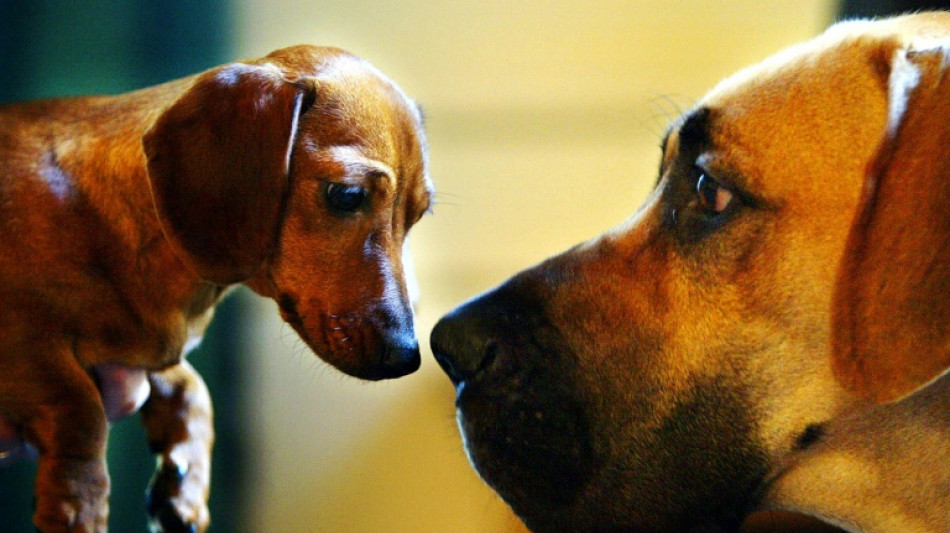
Oldest dog DNA suggests 16,000 years of human companionship / Photo: ADRIAN DENNIS - AFP/File

 Amaze Holdings (NYSE: AMZE) Executes Binding LOI to Acquire BullionFX | Alchemy, a Decentralized Gold-Backed Financial Ecosystem for Valued at US$155 Million

 Clashes between French teens, police as school blockades intensify

 Stocks move sideways despite oil moving lower

 African leaders to gather in Egypt for business summit

 UK decides against charging foreign visitors for museums

 Dallaglio to sell England World Cup winners' medal

 Brazil come from behind to beat Australia 4-2 in friendly

 Ruthless An retains Asian Games badminton crown as Kunlavut triumphs

 Alonso to stay with F1 team Aston Martin in 2027

 China badminton 'still strong' despite Asian Games slump

 'Exceptional' Turner painting shown in Rome before sale

 European stocks climb as oil dips

 Spain aims to ban evictions until 2030 amid housing protests

 Kunlavut first Thai man to win Asian Games badminton singles gold

 French far right says antisemitism claims part of 'total war' to derail presidency bid

 'Gift from God': Rain brings relief from Indonesia toxic haze

 Ex-world snooker champion jailed for 7 years for child sex crimes

 French teens clash with police as school blockades intensify

 FIFA accuses UEFA of 'misinformation campaign' in bid for World Cup papers

 Myanmar airstrike toll hits 50 as families gather dead

 STARTRADER Raises Lloyd's of London Client Fund Insurance to USD 30 Million in Aggregate

 North Korean DMZ landmine blasts 'violation of armistice': Seoul

 Sabalenka 'fresh' for first tournament since losing No.1 spot

 Myanmar airstrike death toll rises to 50: aid workers

 North Korean DMZ landmine blast 'violation of armistice'

The discovery of the oldest ever dog DNA suggests they have been our best friends for nearly 16,000 years -- 5,000 years earlier than had previously been thought, new research said Wednesday.
Despite being ubiquitous in the homes, backyards and hearts of people across the world, surprisingly little is known about where dogs come from.
"It's just an interesting mystery," Swedish geneticist Pontus Skoglund of the UK's Francis Crick Institute told reporters.
Dogs are most likely a mix of two types of grey wolves, he said. However exactly when dogs diverged from wolves has been difficult to trace, partly because their ancient bones are tricky to tell apart.
That is why scientists behind two new studies published in the journal Nature sequenced the genomes from archaeological remains, shedding light on the elusive origins of our furry friends.
The first study revealed that the world's oldest canine DNA was discovered in a piece of a skull in Pinarbasi in what is now Turkey.
The female puppy, which was perhaps "a few months old", probably looked like a small wolf when it lived roughly 15,800 years ago, according to study co-author Laurent Frantz of the Ludwig Maximilian University of Munich.
Before Wednesday, the oldest-known dog DNA was from 10,900 years ago.
Also breaking that record was genetic evidence the team found in southwest England dating back 14,300 years, which illustrated how early dogs had spread across Europe.
Frantz said scientists could not prove exactly what role these dogs had among humans living during the last Ice Age.
"But I think we can assume that they must have played a role because they would have been expensive to feed," he said.
Perhaps the dogs were used for hunting or protection, he speculated.
Even if these dogs were not treated the same as pets are today, there was likely still a strong bond, he said, adding that "kids will still have played with puppies".
Another sign of a close relationship was that puppies had been found buried above human graves in Pinarbasi.
- 'Search for the missing link' -
For the other study, a large team of researchers compared the genomes of 216 dog and wolf remains from across Europe.
This allowed them to chart how dogs evolved on the continent.
Starting around 10,000 years ago, there was a huge migration of people from southwest Asia to Europe during what is known as the Neolithic agricultural revolution.
This mass arrival of farmers resulted in human genetic mixing as people from different areas met and had children.
However, this genetic mixing did not happen at the same time with dogs, the researchers were surprised to find.
It seems the hunter-gatherers who had been living in Europe before the farmers arrived had already been keeping dogs.
"Dogs were clearly important to our ancestors, as the first farmers seem to have adopted previous hunter-gatherer dogs into their groups as they moved into Europe," said study co-author Skoglund.
This suggests that dogs must have been domesticated well before that point.
And there is still a "genetic abyss between dogs and wolves", Skoglund added.
"The search for the missing link continues."
T.Sanchez--AT