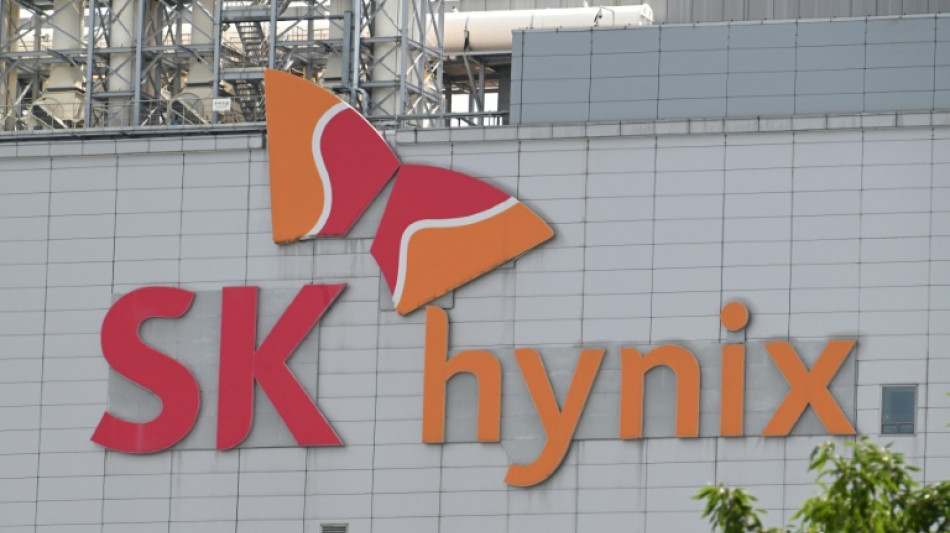
AI chip giant SK hynix posts seven-fold surge in quarterly operating profit / Photo: Jung Yeon-je - AFP

 Two hundred 'Cruise for life' passengers stranded in Cambodia

 Pierce Brosnan and Helen Mirren on the joys of filming 'MobLand'

 S.African activists push back on data centre rush

 Judges set to rule on Australian mushroom killer's appeal

 Syria reopens Jordan border crossing after mending ties

 Cyclone Arnab lashes India coast, no deaths reported

 Trump tamed after US midterms? Europe doubts it

 Tech stocks soar as SK hynix adds to rising AI confidence

 Sri Lanka's Tamil farmers fight to reclaim land after civil war

 Afghans compete for jobs, homes as millions return

 'They don't care about us': Trump food aid cuts leave Americans struggling and angry

 Meta, Snap head to trial in another case about social media's harms

 French Senate passes bill to make protesters pay for unrest damage

 India evacuates tens of thousands as Cyclone Arnab makes landfall

 In tight Israel vote, both camps hold out cautious hope

 AI chip giant SK hynix says quarterly operating profit soars 630%

 Youths testify about 'despair' in unprecedented Canadian climate trial

 Algo Grande Copper Makes New Skarn Discovery at Adelita; Step-Out Hole AG-CG-PH2-003 Returns a Combined 139.81 Metres of 1.3% CuEq from Cerro Grande and the New Margarita Skarn

 6 Weekend Upgrades That Increase Your Property Value

 Syria, Jordan agree to mend ties after deadly strike

 Arsenal stunned by fourth-tier Fleetwood in League Cup

 Last-gasp Sabitzer strike sends Dortmund past Bremen in German Cup

 Rights groups reject Emirati diplomat for UN top job

 Flavio Bolsonaro headed to US after Brazil election defeat: US media

 Alcaraz and Zverev win Vienna openers

South Korean chip giant SK hynix on Wednesday reported a 632 percent surge in third-quarter operating profit, fuelled by booming demand for AI semiconductors, and unveiled plans to return an additional $45 billion to shareholders.
The company is a specialist supplier of high-bandwidth memory (HBM) chips to US industry behemoth Nvidia, and a pillar of South Korea's tech-led economy.
Operating profit for its July-September period reached 83.33 trillion won ($62.8 billion), about seven times the year-ago level, the company said.
Net profit jumped 215.7 percent on-year to 39.77 trillion won, while sales reached 104.61 trillion won.
The firm said it had posted record revenue and operating profit for six straight quarters since April-June last year.
However, the net profit reading fell short of market expectations, with the average analyst estimate at 59.67 trillion won, according to South Korea's Yonhap news agency, citing its own data firm.
"SK hynix analysed that a virtuous cycle has taken hold in which AI-driven productivity gains and new revenue generation in areas such as software development, customer service, and search lead to greater AI adoption," the chipmaker said in a statement.
SK hynix also announced Wednesday an additional plan to return 60 trillion won to shareholders, following the completion of a 40 trillion-won shareholder return programme.
Record profits from booming AI memory demand have fuelled calls for greater shareholder returns, especially since the company's stock sank significantly from its June record high on concerns over US tech firms' AI spending.
The announcement also came after the company last week said it would discontinue a planned US listing of its Solidigm unit, citing market volatility -- after South Korean authorities raised concerns over shareholder interests.
The company also said it planned to return most of the gains from its investment in Japan's Kioxia through special dividends in the third quarter and at fiscal year-end.
- Not yet peaked -
The global race to build AI data centres has transformed the company's fortunes, despite concerns that the sector may be overvalued.
Demand is surging for chips known as DRAM and storage components called NAND, which are found in everyday gadgets but are also needed to help process the vast amounts of data crunched by generative AI.
Analysts say soaring DRAM prices amid a global shortage and stronger sales of high-margin high-bandwidth memory (HBM) have driven earnings, while the AI boom has also lifted prices and shipments of conventional NAND chips.
Long-term agreements established with major customers, including Nvidia, signal "another phase of price increase across both conventional DRAM, NAND and HBM", MS Hwang, an analyst at market research firm Counterpoint, told AFP.
"This indicates that quarterly earnings have not yet reached their peak and that the upward trajectory will likely sustain at least through 2027."
- Contrasting risks -
Sheng Win Chow, an analyst at Omdia, said SK hynix could now face contrasting risks across its conventional memory and HBM businesses.
Omdia estimates global smartphone shipments fell 20 percent on-year in the third quarter, as production capacity shifted toward HBM and conventional memory prices rose.
Conventional DRAM used in smartphones, PCs and tablets offers lower margins but more predictable cash flow, while higher-margin HBM is increasingly tied to a debt-funded AI infrastructure boom, Chow said.
"With credit now tightening around that buildout, the balance between dependable, lower-margin conventional memory and higher-margin but credit-dependent HBM becomes less a margin question than a risk-management one, a dynamic I'd watch," he told AFP.
South Korea's AI chip boom has sparked debate over how to spend surging tax revenue from SK hynix and its domestic rival Samsung Electronics.
SK hynix's shares soared 10.9 percent Wednesday, dragging the Kospi index up more than six percent and providing a healthy boost to other regional AI-linked firms.
But they have been under pressure since June as investors largely shrugged off record quarterly earnings that had already been priced in.
"Stock prices tend to anticipate future conditions rather than simply reflect current earnings," Kim Dae-jong, a professor of business administration at Sejong University, told AFP.
"The concern is that the extraordinary level of earnings the company is generating today may not be sustainable one or two years from now, and I believe that concern is already being reflected in the share price."
A.Anderson--AT