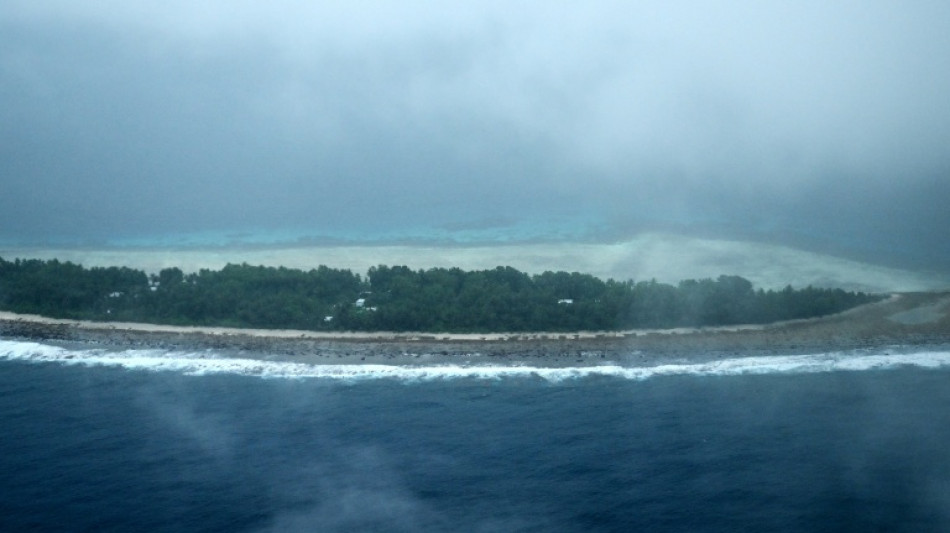
Tuvalu has 'limited' power to halt its fossil fuel investments: NZ govt papers seen by AFP / Photo: Saeed KHAN - AFP

 Tuvalu has 'limited' power to halt its fossil fuel investments: NZ govt papers seen by AFP
 Palestinian activist Khalil returns to Columbia after US detention

 Trump drastically loosens oil and gas methane rules

 French Senate weighs bill to make protesters pay for unrest damage
 'A very sad day': Arteta despair as Arsenal stunned by Fleetwood
 Charles tackles thorny legacy of slavery on Caribbean trip

 Former Grand Slam winner Wawrinka ends tennis career

 Brazil's Flavio Bolsonaro flees to US after election loss
 'Faerie' nights: 'ACOTAR' fans finally get their book

 American woman convicted of getting military training from Islamic State

 Israel opposition holds narrow edge over Netanyahu in first projections

 Floriani hits maiden goal as Lazio go top
 Trump set to drastically loosen oil and gas sector's methane rules

 Storied Paris department store seeks bankruptcy protection
 Xhaka, Embolo can return to Swiss squad after fake Covid docs affair
 Allegri suspended for two Serie A games after red card
 Flight data, satellite images reveal growing US role at Ecuador base
 McInnes feels 'guilt' ahead of Hearts return with Rangers

 Brazil's Lula turns 81, vows to work '24 hours a day'

 Boeing releases cautious growth plan as shares fall sharply

 Exiled Russian dissident Navalnaya warns dictators becoming 'more cunning'
 Bayern 'risk' reaps huge reward for Ballon d'Or winner Kane
 Record turnout as Israeli voters deliver verdict on Netanyahu
 Iraola says Isak 'feels the trust' after Liverpool scoring streak

 French media protest manhandling of journalists at far-right party rally

A low-lying Pacific nation urging drastic climate action has "limited ability" to halt its own government investments in fossil fuel companies, external advisers wrote in internal documents obtained by AFP.
Few countries are more exposed to climate change than Tuvalu in the South Pacific, an atoll chain reckoning with rising seas, acidifying oceans and outbreaks of tropical disease.
Tuvalu has in recent years emerged as one of the world's most vocal champions for climate action, condemning new coal and gas projects as a "death sentence" for its 10,000 people.
Australia-based wealth managers have been investing on Tuvalu's behalf in funds holding stakes in coal, gas and oil, a previous investigation by AFP found.
New documents obtained by AFP suggest Tuvalu will find it hard to pivot away from fossil fuels, despite the prime minister himself deriding such investments as "not a good look".
Officials from New Zealand, which sits on the board of the $200 million Tuvalu Trust Fund, discussed investment strategy in internal documents released under freedom of information laws.
Because the trust fund was small by global standards, Tuvalu had "limited ability to tailor specific investment preferences", read a briefing released by New Zealand's foreign affairs department.
Rather, Tuvalu's money was invested in funds that offered broad exposure to scores of different companies.
Some of these funds would include "significant greenhouse gases emitters", the New Zealand officials noted.
Tuvalu has promoted the trust fund to foreign donors as a way to channel money into urgently needed climate projects.
It was singled out as a leading example of a "national climate fund" in a 2013 study by the United Nations Development Programme.
Tuvalu has the smallest national economy in the world, according to recent World Bank figures.
It relies on profits from the Tuvalu Trust Fund to prop up the government budget.
Tuvalu has invested in a string of fossil fuel companies under the guidance of wealth manager Mercer, an AFP investigation revealed in May this year.
This included funds holding stakes in Indian energy giant Reliance Industries, which owns the largest oil refinery in the world, and The Southern Company, one of the biggest greenhouse gas emitters in the United States.
- 'Climate exposed' -
The Tuvalu Trust Fund is governed by a three-member board with representatives from Tuvalu, New Zealand and Australia.
Its investment objectives state it must minimise its exposure to "fossil fuel reserves and carbon emissions" where possible.
Climate finance expert Sebastian Gehricke said there was little evidence this had been done.
For example, Tuvalu's money had not been invested in any "sustainable" funds.
"Tuvalu is arguably the most climate-exposed nation in the world," Gehricke, from New Zealand's Otago University, told AFP.
"So receiving revenue from a fund that generates its returns from many companies directly contributing to the climate crisis is not in their best interest."
Tuvalu Prime Minister Feleti Teo told AFP in June that fossil fuel investments were "not a good look" given the nation's climate advocacy.
The Tuvalu Trust Fund said it had achieved "substantial progress in reducing portfolio carbon emissions".
Between 2020 and 2025, the carbon footprint of its investments had dropped 42 per cent, the fund said.
But it was not clear if this was due to decisions the fund had made or simply part of a broader trend that has seen many companies strive to slash their own emissions.
New Zealand's foreign affairs department said it would work with Tuvalu to make sure investment priorities were aligned with "long-term resilience".
Australia said it was "supporting Tuvalu's strong approach to environmental and social governance issues".
P.Smith--AT