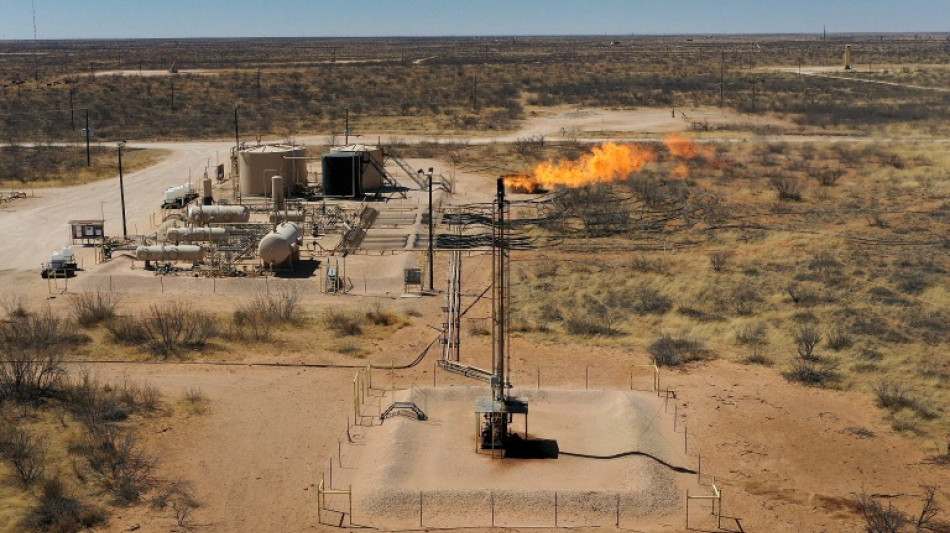
Trump drastically loosens oil and gas methane rules / Photo: JOE RAEDLE - GETTY IMAGES NORTH AMERICA/AFP/File

 Tuvalu has 'limited' power to halt its fossil fuel investments: NZ govt papers seen by AFP
 Palestinian activist Khalil returns to Columbia after US detention

 Trump drastically loosens oil and gas methane rules
 French Senate weighs bill to make protesters pay for unrest damage
 'A very sad day': Arteta despair as Arsenal stunned by Fleetwood
 Charles tackles thorny legacy of slavery on Caribbean trip

 Former Grand Slam winner Wawrinka ends tennis career

 Brazil's Flavio Bolsonaro flees to US after election loss
 'Faerie' nights: 'ACOTAR' fans finally get their book

 American woman convicted of getting military training from Islamic State

 Israel opposition holds narrow edge over Netanyahu in first projections

 Floriani hits maiden goal as Lazio go top
 Trump set to drastically loosen oil and gas sector's methane rules

 Storied Paris department store seeks bankruptcy protection
 Xhaka, Embolo can return to Swiss squad after fake Covid docs affair
 Allegri suspended for two Serie A games after red card
 Flight data, satellite images reveal growing US role at Ecuador base
 McInnes feels 'guilt' ahead of Hearts return with Rangers

 Brazil's Lula turns 81, vows to work '24 hours a day'

 Boeing releases cautious growth plan as shares fall sharply

 Exiled Russian dissident Navalnaya warns dictators becoming 'more cunning'
 Bayern 'risk' reaps huge reward for Ballon d'Or winner Kane
 Record turnout as Israeli voters deliver verdict on Netanyahu
 Iraola says Isak 'feels the trust' after Liverpool scoring streak

 French media protest manhandling of journalists at far-right party rally

US President Donald Trump announced Tuesday a sweeping rollback of rules that stop oil and gas producers from emitting methane, a greenhouse gas super pollutant.
Trump made the announcement at a rally in support of Texas Attorney General Ken Paxton, who faces a tough battle for a US Senate seat in November 3 midterm elections.
The regulations were put in place by Republican Trump's Democratic predecessor Joe Biden.
"Tonight, I'm officially terminating Biden's expensive and unnecessary methane regulations to save consumers and energy producers $45 billion," Trump said at the rally in Lubbock, Texas.
To cheers from the crowd, Trump added that the move would "unlock vast quantities of Texas natural gas." Texas is by far the country's leading fossil-fuel-producing state.
An Environmental Protection Agency statement earlier this month gave the same $45 billion figure in cost savings, without offering a detailed breakdown of the savings.
"Americans must be able to afford to heat their homes in the winter and fill up their car and drive to work," said EPA administrator Lee Zeldin. "They can't do that when the people producing the energy are weighed down by unnecessary burdens."
Trump is pushing ways of bringing down energy costs ahead of the midterms, amid voter anger over soaring oil costs caused by his war on Iran.
Polls show Republicans could lose control of Congress to the Democrats in next week's vote.
Methane, the main component of natural gas, is the second-largest cause of global warming behind carbon dioxide -- responsible for about a third, or 0.5C, of total planetary heating since the pre-industrial era.
A molecule of methane traps far more heat than carbon dioxide, but persists in the atmosphere for only seven to 12 years, whereas carbon dioxide can last for hundreds of years.
- 'Toothless' -
The changes take aim at rules to curb methane emissions from oil and gas operations. Emissions occur at every stage, from extracting gas held underground, to processing, transmission and distribution.
"Lee Zeldin's EPA is giving oil and gas corporations exactly what they've long wanted: a toothless methane standard they can use to pretend they're well-regulated, all while they continue to knowingly leak and flare dangerous amounts of the heat-trapping gas," said Julia Kane, a researcher at oil and gas watchdog Fieldnotes.
The United States is the world's leading emitter of methane from its oil and gas sector, followed by Russia, according to the International Energy Agency.
The new changes include proposing to kill off the "Super Emitter Program," a provision that allows EPA-approved observers to report major leaks with a rate of over 100 kilograms (220 pounds) per hour.
Another will weaken regulation against so-called "marginal wells" that produce 15 barrels or less of oil equivalent a day.
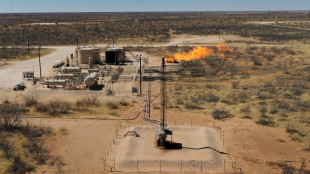
Yet another will relax rules around the routine flaring of "associated gas."
In places like the Permian Basin where oil is the main product, the associated gas that comes up is considered a byproduct, with the cost of capture exceeding its market value, leading operators to often burn it off, or flare it.
Ch.P.Lewis--AT