
Key Atlantic current could weaken more than expected: study / Photo: Florent VERGNES - AFP/File

 Morikawa says LIV players face 'business decision' after Rahm exit
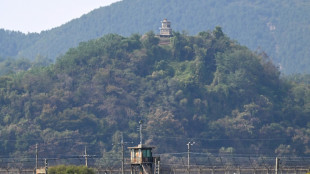
 Tenzing Norgay's son says Himalayas sending climate warning

 On your bike! Bottas opts for two wheels to reach Singapore GP

 Alcaraz, Sinner, Osaka commit to Australian Open '1 Point Slam'

 Dodgers beat Braves to advance in MLB playoffs, Rays oust Yankees

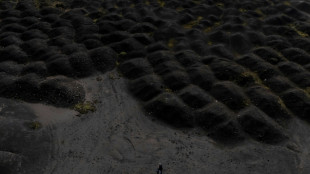 'A sun as black as my lungs': how corruption crucified a polluted Albania city

 The British historian helping the French rediscover de Gaulle
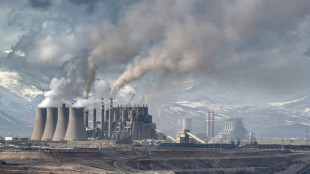
 Dodgers beat Braves to advance, Guardians survive in MLB playoffs

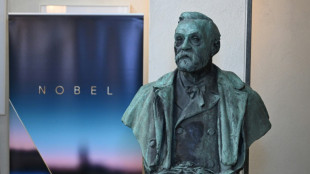 Latin American, Caribbean women top Nobel literature buzz

 US says Fiji-based Chinese official paid bribes for Beijing

 After botched US execution, Christa Pike was nearly taken off life support

 Guinea-Bissau junta urges military unit loyal to ex-president to disarm

 InterContinental Hotels Group PLC Announces Transaction in Own Shares - October 08

 Guardians survive with 9-3 win over White Sox

 Saudi Arabia says 3 dead at airports after Houthis claim attacks
 Stocks slide as oil sees volatile trading day over Iran war fears

 Microsoft pushes AI vision with new, expensive Surface laptop

 Five children among 28 killed in Russian strikes on Ukraine

 Odell Beckham Jr signs with Minnesota Vikings

 Saudi Arabia says three dead at airports after Houthis claim attacks

 Trump plans to turn Florida golf course into presidential retreat

 WHO says cannot conduct full risk assessment on Russia plague reports

 After botched execution, US woman is awake and shackled to bed

 New Zealand fly-half Mo'unga ruled out of Australia Tests

 Protests in major Turkish city after mayor defects to Erdogan party

A key Atlantic Ocean current system that helps regulate the planet's climate could weaken more than expected by 2100, with potentially devastating consequences worldwide, a new study has found.
Known as Atlantic Meridional Overturning Circulation (AMOC), this conveyor belt of currents plays a crucial role in redistributing heat by transporting warmer waters from the tropics northward.
An AMOC collapse could lead to harsher winters in northern Europe, droughts in South Asia and the Sahel region in Africa, and higher sea levels in North America, among other consequences.
Previous climate model projections have estimated an average slowdown of around 32 percent by the end of the century due to climate change.
The latest study, published Wednesday in the journal Science Advances, estimates that the system could slow by 51 percent by 2100 under a mid-range scenario for greenhouse gas emissions, with a margin of error of plus or minus eight percentage points.
"We obtained an estimate of a future AMOC slowdown that is more severe than we expected," climate scientist Valentin Portmann, the paper's lead author, told AFP.
"We are closer to a critical state that is worrying," Portmann said.
Predicting what will happen to AMOC in the future is a topic of debate in the scientific community.
"There is a kind of consensus on the fact that this circulation will slow down. But there is still quite a bit of debate about the intensity of this slowdown," said Florian Sevellec, research director at the French National Centre for Scientific Research (CNRS) in Brest, France.
- Refining predictions -
In its 2021 report, the UN's Intergovernmental Panel on Climate Change said AMOC will "very likely decline" over this century.
But the panel of international experts also expressed "medium confidence" that a collapse of AMOC would not take place before 2100.
The latest study, conducted by researchers from the CNRS and the University of Bordeaux in southwest France, seeks to "refine this estimate of the future slowdown" and "reduce uncertainty", Sevellec said.
While nearly all climate models predict an AMOC slowdown by 2100, the projections range widely: from as little as three percent to as much as 72 percent, depending on varying emissions scenarios.
Portmann said the new study seeks to narrow that uncertainty using "observational constraints" -- a statistical approach that combines real-world observations with results from climate models.
- 'The debate is not over' -
Stefan Rahmstorf, an oceanographer at the Potsdam Institute for Climate Impact Research (PIK), said the paper showed that pessimistic models "are unfortunately the realistic ones, in that they agree better with observational data".
Rahmstorf, who who was not involved in the study, said that this means AMOC would be so weak by 2100 that it would "very likely" be "on the way to full shutdown".
Fabien Roquet, a physical oceanography professor at the University of Gothenburg in Sweden, said the study was interesting but he cautioned that another team using a similar method reached opposite conclusions last year.
"What is certain, however, is that the climate is warming rapidly," Roquet said.
"Whether the AMOC weakens or not, large-scale changes are already underway... and should intensify in the coming decades."
"The debate is not over," said Sevellec, who was also not part of the research team but whose thesis on AMOC was used for the study. "One paper does not settle a scientific debate."
D.Johnson--AT