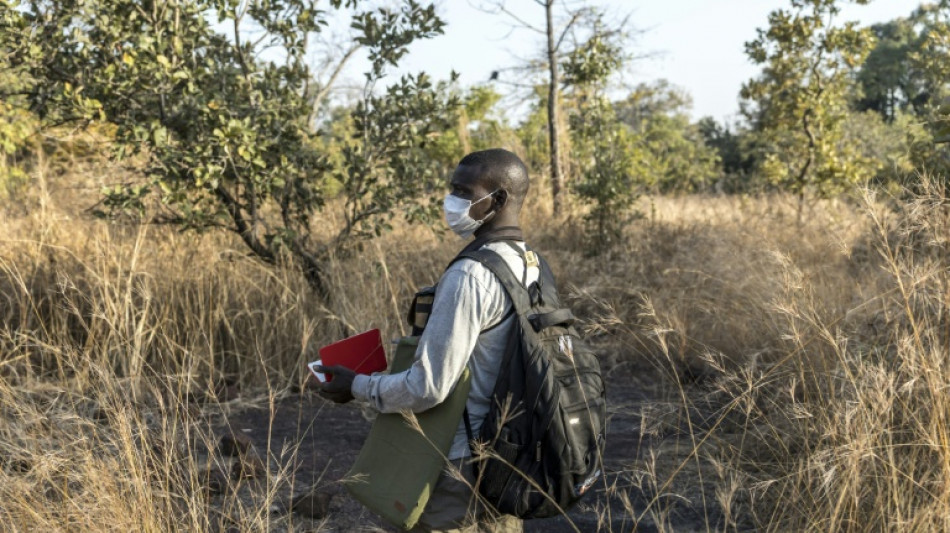
In remote Senegal, chimp researchers escape gold mines' perils / Photo: PATRICK MEINHARDT - AFP

 Indonesia releases eight orangutans rescued from fires to protected forest

 Russian Yandex data centre operations disrupted after drone strike

 Architect fights to save India's past, built on 'stone, tears and sweat'

 Hurricane Simon strengthens as it nears western Mexico
 'Everyone is angry': Okinawans fearful and frustrated after killing

 Trump's trade wars sting US manufacturers ahead of midterms

 Kenyan great Kipchoge wins first marathon in three years

 Barca extend perfect streak, Real Madrid survive Vinicius red

 PSG ease to Ligue 1 win before Manchester City test

 Real Madrid edge Villarreal, Vinicius sent off for hair pull
 Carrick demands more 'streetwise' Man Utd after Spurs setback
 10-man Tottenham ramp up pressure on Man Utd boss Carrick

 India 'cockroach' movement says thousands detained in Delhi protest

 Injury ends season for NHL Rangers star goalie Shesterkin

 Ten-man Spurs rescue draw at Man Utd, Arsenal survive Leeds scare

 Inter Milan dominate Parma to go top in Serie A

 Abbas postpones Palestinian legislative elections to September 2027

 'I don't feel fear': Fulham boss Arbeloa hits back as pressure mounts

 Hurricane Simon strengthens to category 4 as it nears western Mexico

 Alonso hails Henderson 'beauties' as Chelsea star rolls back the years

 Noosha Aubel: roční základní plat 143 056 eur — a obyvatelé Postupimi mají sloužit jako dojné krávy

 Romero claims Atletico late win at Alaves

 Zelensky blasts diesel deal as Russian strikes kill 16

 Arsenal back on track after Leeds scare, five-star Chelsea run riot

 Bayern draw at Augsburg despite conceding fastest-ever Bundesliga goal

Michel Tama Sadiakhou's future dramatically changed course some 15 years ago thanks to a clan of spear-wielding apes: instead of the dangerous work in informal gold mines that is the fate of many in Senegal’s far southeast, he now researches rare chimpanzees.
He is among five people from local villages, all but one without a high school diploma, working on a project focused on the area's highly unusual savannah-dwelling chimpanzees.
Not only has it proven a deep dive into science, but for several of them, it has also offered an escape from the mines.
"It's really a stroke of luck," Sadiakhou told AFP of his involvement in the Fongoli Savanna Chimpanzee Project, which was founded by US primatologist Jill Pruetz in 2001.
Pruetz has made a number of discoveries while studying a community of about three dozen West African chimpanzees, which she dubbed the Fongoli chimps.
The group lives in the bush -- rather than the forest as is more common -- alongside other similar chimp communities in Senegal's Kedougou region on the border with Mali and Guinea.
The Fongoli females are the only documented animals in the world to regularly hunt with tools, fashioning branches into spears for killing smaller primates known as a bush babies.
On a recent morning, Mike, a charismatic, middle-aged chimp, ambled along the savannah floor, baobab fruit dangling by a stem from his mouth -- a snack for later -- as Sadiakhou watched.
Every five minutes, he and his fellow researchers take notes, singling out one of the group's 10 adult males to follow each day.
From vocalisations to food intake, social interactions to rhythmic beating on trees, known as buttress drumming, they note down everything.
The four researchers and project manager are from the region's Bedik and Bassari ethnic groups.
After leaving high school, Sadiakhou, a 37-year-old Bedik father of four, worked in the gold mines, known locally as the dioura.
Seeing Pruetz and others repeatedly driving past his village he decided to apply for work and was hired to the project in 2009, having never seen a chimp in his life.
Now head researcher, he describes the apes as a "second family".
"When I'm with the chimpanzees, even if I'm alone, it's like I'm with other people," Sadiakhou told AFP reporters, who spent two days with the researchers at the primates' home range.
- 'Dioura' boom -
Fellow researcher Nazaire Bonnag, 31, also put the dioura behind him.
One day "I saw someone go down there (into the mines) and he never came back up", Bonnag told AFP from the study's permanent camp -- a cluster of thatched roof huts inside the Fongoli range.
When the man was determined to have suffocated from gas and his body pulled out by a rope, Bonnag decided "no, I can't continue like this".
The Kedougou region, where the Fongoli range is located, accounts for 98 percent of Senegal's gold mining sites, a 2018 government study said.
It is also one of its poorest regions, with a poverty rate of more than 65 percent, according to statistics from 2021-2022.
At one of several dioura sites on the Fongoli chimps' range, a gaping hole in the ground leads to a deep tunnel where tired, dirt-covered men entered and exited.
More than 30,000 people work in Senegal's traditional gold mining sector, according to the 2018 study.
Aliou Bakhoum, head of the NGO La Lumiere in the regional capital of Kedougou, said the number had only increased in the last few years.
The dioura can be lucrative for those who find gold but it is down to "luck", Bakhoum told AFP, saying the work is dangerous, with long tunnels that are far too deep and subject to cave-ins.
- Adaptations to extreme heat -
A gold mining boom since the 2010s has lured not just locals but people from neighbouring west African countries too and presents new hurdles for the chimps such as increased water pollution, deforestation and the spread of human diseases.
The Fongoli chimps, who today number 35, were the first and for a long time only group of savannah chimpanzees to be acclimated to the presence of researchers.
Pruetz's findings have been startling: Living in the extreme savannah heat, the Fongoli apes have learned to soak in natural pools, rest in cool caves and are calm in the presence of fire.
Their adaptations to a landscape at the edge of what is possible for their species can help shed light on human evolution and the early hominins living in similar climates millions of years ago, according to Pruetz.
Dondo "Johnny" Kante, the study's project manager, comes from a nearby Bedik village and believes that including local workers helps the wider community take "interest in the project".
With any luck, he said, the researchers' involvement will inspire other locals to "continue to support, protect and truly work for the well-being" of the Fongoli chimps.
H.Gonzales--AT