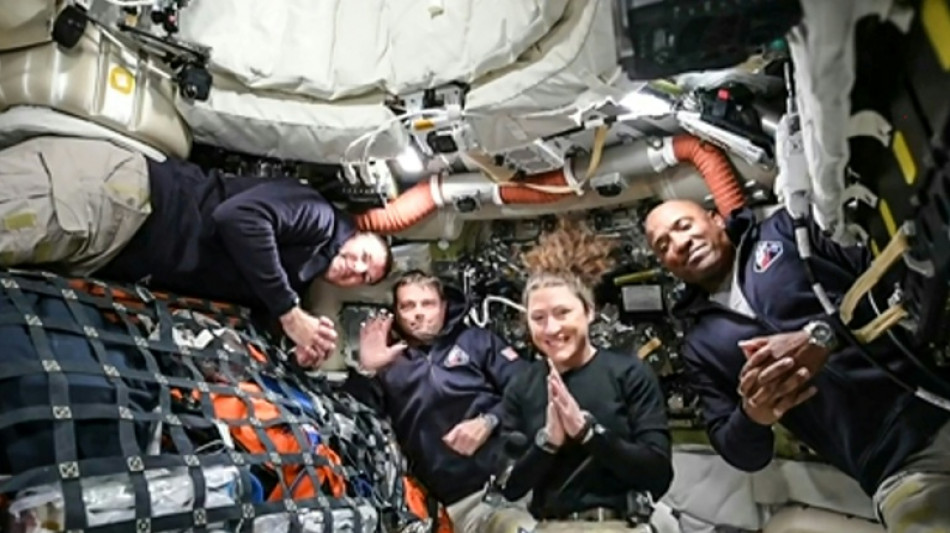
Artemis mission headed for first lunar flyby since 1972 / Photo: Handout - NASA TV/AFP

 Gauteng Health Department Warns of Rising Antibiotic Resistance Threat

 Bishop Museum Races to Save Rare Megamouth Shark Specimen

 Impauer Technologies Inc. Announces Third Quarter 2026 Financial Results and Equity Compensation Grants

 NiobiumX Mining Explains How it Will Hunt for Niobium at Shipshaw: Magnetic Lows, Thorium Highs, and Machine Learning Built for a District With One Producing Mine

 InterContinental Hotels Group PLC Announces Transaction in Own Shares - November 26

 Black Friday Discounts Cut Prices on Two Top-Rated Wiper Blades

 Luxembourg Pay Rise Delayed as Regional and World Headlines Develop

 Audience to Choose the Set List at Luxembourg's First FAMIL Jukebox Night

 Raheem Sterling Receives Suspended Sentence After Lamborghini Crash

 Luxembourg Housing Petition Passes Threshold for Parliamentary Consideration

The Artemis astronauts on Sunday were approaching a key milestone in their journey to slingshot around the Moon, a historic NASA mission that will see the first woman and first person of color perform a lunar flyby.
The crew of three Americans and one Canadian will soon hit a tipping point of sorts when the Moon's gravity takes over the spacecraft's trajectory, whipping the Orion capsule on the first lunar loop in more than half-a-century.
The astronauts are set to travel farther from Earth than any human before.
That historic occasion comes alongside a constellation of firsts: Victor Glover will go down in the books as the first person of color to ever fly around the Moon, while Christina Koch will be the first woman.
Canadian Jeremy Hansen will meanwhile become the first non-American to accomplish the feat.
Those three along with mission commander Reid Wiseman will spend much of their lunar flyby that's expected Monday documenting the Moon.
- 'The far side of the Moon' -
The astronauts have already started seeing features of the celestial body never before viewed with a naked human eye.
In the wee hours of Sunday, NASA published an image taken by the Artemis crew that showed a distant Moon with the Orientale basin visible.
"This mission marks the first time the entire basin has been seen with human eyes," the US space agency said.
The massive crater, which resembles a bullseye, had been photographed before by orbiting cameras.
Koch, speaking to Canadian children live from space, said the crew was most excited to see the basin -- sometimes known as the Moon's "Grand Canyon."
"It's very distinctive and no human eyes previously had seen this crater until today, really, when we were privileged enough to see it," Koch said during the question-and-answer session hosted by the Canadian Space Agency.
Near the end of their flyby, the astronauts will have the privilege of witnessing a solar eclipse, when the Sun will be behind the Moon and hidden from view aside from its outermost atmosphere, the solar corona.
The four astronauts will also spend some time testing their "Orion crew survival system" spacesuits.
The orange suits protect the crewmembers during launch and reentry, but are also available for emergency use -- they can provide up to six days of breathable air.
The astronauts are the first to ever wear the OCSS suits in space, and will test their functions, including how quickly they can put them on and pressurize them.
While the four astronauts will not touch down on the lunar surface, they are expected to break the record for the farthest distance from Earth during their pass around the Moon.
Over the next day, "they will be on the far side of the Moon, they will eclipse that record, and we're going to learn an awful lot about the spacecraft," said NASA administrator Jared Isaacman Sunday during a televised interview with CNN.
The information will be "pretty paramount to set up for subsequent missions like Artemis 3 in 2027 and, of course, the lunar landing itself on Artemis 4 in 2028."
NASA said the Artemis crew has completed a manual piloting demonstration and reviewed their lunar flyby plan, including reviewing the surface features they must analyze and photograph during their time circling the Moon.
"We're focusing very much on the ecosystem, the life support system of the spacecraft," NASA chief Jared Isaacman said Sunday in a televised interview with CNN.
"This is the first time astronauts have ever flown on this spacecraft before," he said. "That's what we're most interested in getting data from."
Ch.P.Lewis--AT