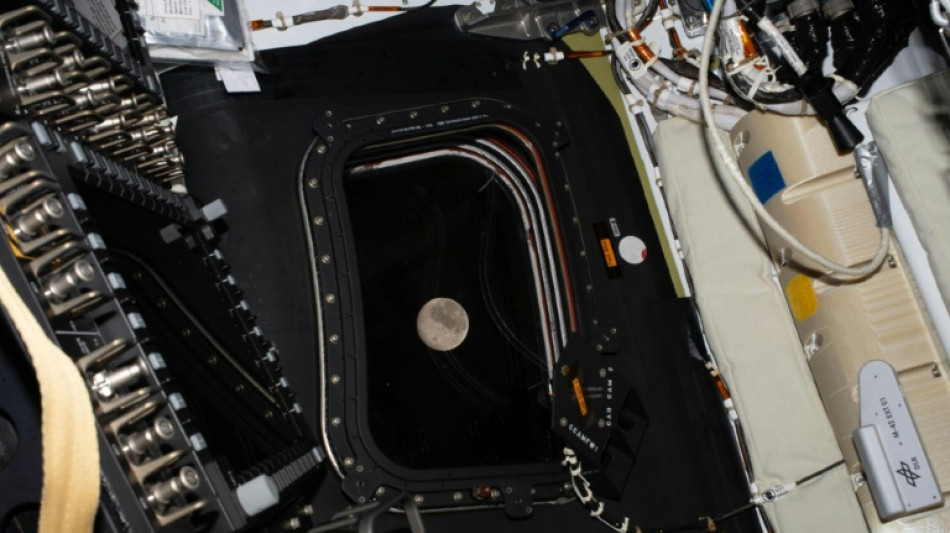
'Historic day': Artemis astronauts break space distance record / Photo: Handout - NASA/AFP

 WhiteBIT Launches Bitcoin Lightning Network Support, Powered by Voltage

 Oil surges, stocks sink as US reportedly eyes fresh Iran strikes

 Anne Carson: modern takes on Greek classics

 Canada's Anne Carson wins Nobel literature prize

 Ethiopia drones hit Eritrean troops in Tigray

 Russian strike on buses kills 30 in frontline Ukrainian city

 Thailand begins extradition process against Chinese journalist

 Quarantine, unease and rumours: Russian city grapples with plague scare

 Taiwan says exports hit record in September on AI demand

 Marc Marquez vows to 'attack' Martin's lead at Indonesian MotoGP

 Diplomats, schools in Saudi take safety measures after blasts heard: sources to AFP

 In Beijing, EU trade envoy says deficit with China 'unsustainable'

 Sri Lanka's de Silva quits as Test captain

 Alcaraz feeling 'mentally fresh' ahead of Shanghai return

 Israel drastically reduces British diplomatic presence in Jerusalem

 Stocks fall further as oil surge fans fresh inflation worries

 North Korea demands South show 'utmost respect' to restore relations

 Saudi says three dead in airport attacks claimed by Houthis

 'Mad dream': New showcase for African film opens in London

 All Blacks coach Rennie says Wallabies exit 'part of the game'

 The growing protests against India's poll body - and PM Modi
 Stocks fall further as oil spike fans fresh inflation worries

 Bad COP, worse COP? EU tempers hopes for UN climate summit

 Rookie Henry named in Wallabies midfield to face All Blacks

 Housing crisis set to dominate Spain's snap election

The four astronauts embarking on NASA's lunar flyby became on Monday the humans to travel furthest from our planet, as they get set to view areas of the Moon never before seen by the naked eye.
The Artemis II team broke the previous record set by 1970's Apollo 13 mission, which they are expected to surpass by approximately 4,105 miles (6,606 kilometers) when they reach this journey's furthest distance from Earth -- 252,760 miles (406,778 kilometers) -- later today.
The astronauts are journeying around the Moon for a monumental flyby, in which they'll spend more than six hours analyzing and documenting lunar surface features.
The NASA mission had swept earlier into the Moon's gravitational sphere of influence, meaning their spacecraft is in the natural satellite's neighborhood, with lunar gravity outmuscling Earth's pull.
The Orion capsule is zipping around the Moon before U-turning and heading back to Earth in a so-called "free-return trajectory," a return-trip that will take about four days.
The astronauts began their landmark day with a message from the late Jim Lovell, who took part in the Apollo 8 and 13 missions and recorded the message shortly before his death.
"It's a historic day, and I know how busy you'll be, but don't forget to enjoy the view," the Artemis astronauts heard from Lovell.
"Welcome to my old neighborhood," he said. "I'm proud to pass that torch on to you as you swing around the Moon."
Swooping around the far side of the Moon, the crew of four will witness previously hidden lunar territory -- the sphere looming large through their capsule windows.
The Moon will appear to the astronauts "about the size of a basketball held at arm's length," Noah Petro, head of the US space agency's planetary geology lab, told AFP.
Adding to the historic nature of the mission led by Reid Wiseman, the Artemis II crew includes several firsts.
Victor Glover will be the first person of color to fly around the Moon, Christina Koch will be the first woman, and Canadian Jeremy Hansen the first non-American.
There will be a period of around 40 minutes during the flyby where all communication with Artemis II will be cut off as the astronauts pass behind the Moon.
"It'll be exciting, you know, in a slightly scary way, when they go behind the moon," Derek Buzasi, a professor of astronomy and astrophysics at the University of Chicago, told AFP.
- Human eye vs camera -
The astronauts have already started seeing features never previously glimpsed directly.
An image sent back by the crew showed the Moon's Orientale basin visible, a massive crater that before had only been viewed by orbiting, uncrewed cameras.
Near the end of their flyby, the astronauts will witness a solar eclipse, when the Sun will be behind the Moon.
Despite the technological advancements since the Apollo era, NASA still relies on the eyesight of its astronauts to learn more about the Moon.
"The human eye is basically the best camera that could ever or will ever exist," Kelsey Young, the lead scientist for the Artemis II mission, told AFP. "The number of receptors in the human eye far outweighs what a camera is able to do."
And while the Orion crew will still be at a substantial distance from the Moon, their flyby is key to preparing for a later crewed mission to the planet's surface itself.
"We're going to learn an awful lot about the spacecraft," NASA administrator Jared Isaacman told CNN on Sunday.
The information will be "pretty paramount to set up for subsequent missions like Artemis III in 2027 and, of course, the lunar landing itself on Artemis IV in 2028," he added.
A.Williams--AT