AI tool helps researchers treat child epilepsy / Photo: John SAEKI, Laurence CHU, Nicholas SHEARMAN - AFP

 Alcaraz exits Shanghai Masters in straight-sets loss
 Pope to enter hospital on Tuesday for lung operation

 Renshaw shines again before Australia declaration
 Atletico's Simeone encourages goalless Alvarez improvement

 FXGLOBE Rebuilds Its Copy Trading and PAMM Business With B2BROKER's B2COPY

 Nepal rescuers search for missing after flash flood

 Oil rises as Trump comments roil energy markets

 Premier League in limbo as Manchester City soar

 Zelensky vows to respond as Moscow silent on 'energy ceasefire'

 Thousands march in India's capital to demand election chief resign

 African players in Europe: Mbeumo ends goal drought as United draw

 France's high school students plan fresh protests

 NZ bank in free speech row over 'explicit' sheep memes

 China Open champ Zheng withdraws from Wuhan citing fatigue

 Brewers edge Dodgers 2-1 in National League Championship Series opener

 Pope to have surgery to remove lung nodule

 Stocks rise as oil prices tumble after Trump hails 'energy ceasefire'

 Man City charges cloud hangs over Premier League season
 Top NATO commander set to issue warning to Russia over any attack

 Software, sprints, trolls: Singapore Grand Prix talking points

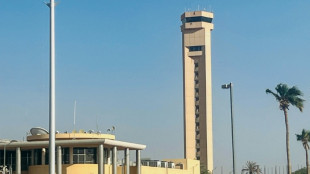 Riyadh airport hit by fresh Houthi strike day after deadly attack

 Great Western Mining Corporation PLC Announces Exercise of Warrants and Issue of Equity

 Yokogawa Brings Publication-Backed Validation from More Than 60,000 Scientific Publications to Its CSU Spinning Disk Confocal Systems with Bioz
 U.S. Energy Secretary Chris Wright, EXIM Chairman John Jovanovic, Nebraska Governor Jim Pillen, Senators Deb Fischer and Pete Ricketts, and Congressman Adrian Smith to Visit NioCorp's Critical Minerals Mine Site
 Brightline Interactive to Attend the 2026 Maxim Growth Summit
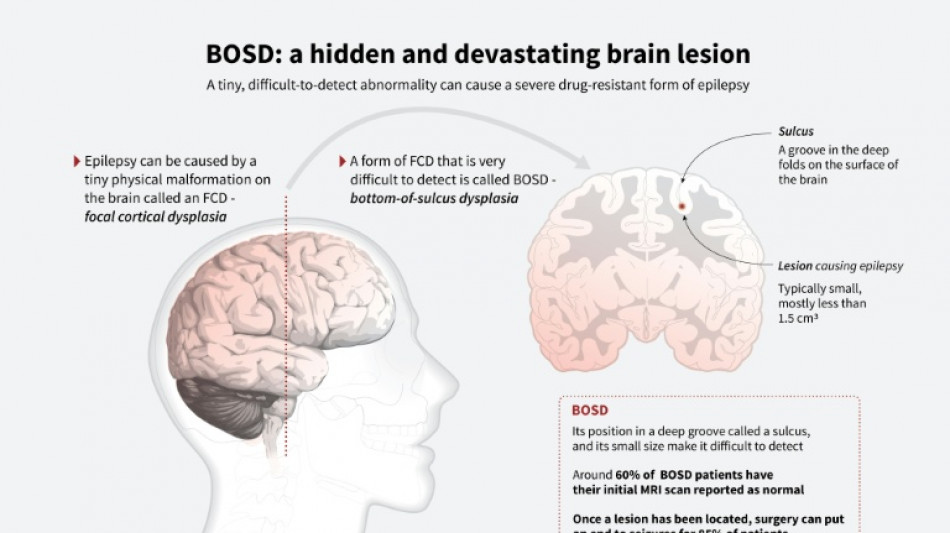
An artificial intelligence tool that can detect tiny, hard-to-spot brain malformations in children with epilepsy could help patients access life-changing surgery quicker, Australian researchers said on Wednesday.
It is the latest example of how AI, which can crunch vast amounts of data, is changing healthcare by assisting doctors with diagnoses.
Epilepsy has several different causes, and overall around three in 10 cases are down to structural abnormalities in the brain, experts say.
These are often missed on MRI scans -- especially the smallest lesions, sometimes hidden at the bottom of a brain fold.
A team led by Emma Macdonald-Laurs, a paediatric neurologist at the Royal Children's Hospital in Melbourne, trained an AI tool on child brain images to find lesions the size of a blueberry or smaller.
"They're frequently missed and many children are not considered as surgical candidates," Macdonald-Laurs told a briefing ahead of the publication of her team's study in the journal Epilepsia.
"The tool doesn't replace radiologists or epilepsy doctors, but it's like a detective that helps us put the puzzle pieces together quicker so we can offer potentially life-changing surgery," she said.
Of the patients who took part, with conditions known as cortical dysplasia and focal epilepsy, 80 percent had previously had an MRI scan come back as normal.
When the researchers used the AI tool to analyse both MRI and another type of medical scan called a PET, its success rate was 94 percent for one test group and 91 percent for another.
Out of 17 children in the first group, 12 had surgery to remove their brain lesions, and 11 are now seizure-free, said Macdonald-Laurs's team at the Murdoch Children's Research Institute.
"Our next plans are to test this detector in more real-life hospital settings on new undiagnosed patients," she said.
Epilepsy, which causes recurrent seizures, affects about one in 200 children, and about a third of cases are drug-resistent.
"This work is really exciting" as a proof of concept and the results are "really impressive", Konrad Wagstyl, a biomedical computing expert at King's College London (KCL), told AFP.
Similar research published in February by a KCL team using AI on MRI data spotted 64 percent of epilepsy-linked brain lesions that were missed by radiologists.
The Australian researchers used MRI with PET, "but some caveats are that PET is expensive, it's not as widely available as MRI, and there is a dose of radiation like a CT scan or an X-ray associated with it," Wagstyl noted.
M.White--AT