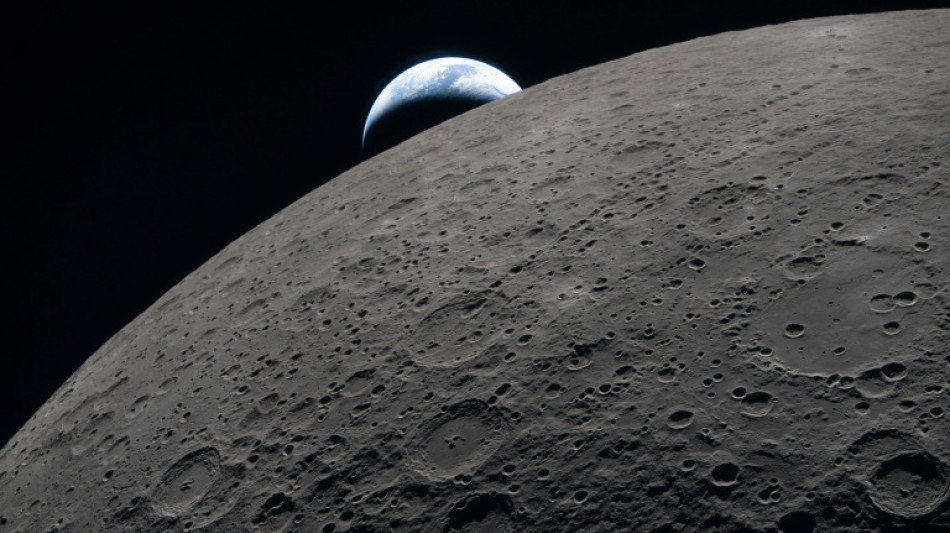
Houston, we have a problem ... with the toilet / Photo: Handout - NASA/AFP

 Thailand begins extradition process against Chinese journalist

 Quarantine, unease and rumours: Russian city grapples with plague scare

 Taiwan says exports hit record in September on AI demand

 Marc Marquez vows to 'attack' Martin's lead at Indonesian MotoGP

 Diplomats, schools in Saudi take safety measures after blasts heard: sources to AFP

 In Beijing, EU trade envoy says deficit with China 'unsustainable'

 Sri Lanka's de Silva quits as Test captain

 Alcaraz feeling 'mentally fresh' ahead of Shanghai return

 Israel drastically reduces British diplomatic presence in Jerusalem

 Stocks fall further as oil surge fans fresh inflation worries

 North Korea demands South show 'utmost respect' to restore relations

 Saudi says three dead in airport attacks claimed by Houthis

 'Mad dream': New showcase for African film opens in London

 All Blacks coach Rennie says Wallabies exit 'part of the game'

 The growing protests against India's poll body - and PM Modi
 Stocks fall further as oil spike fans fresh inflation worries

 Bad COP, worse COP? EU tempers hopes for UN climate summit

 Rookie Henry named in Wallabies midfield to face All Blacks

 Housing crisis set to dominate Spain's snap election

 Gas, health care, utilities: high costs squeeze US midterm voters

 New Zealand Rugby seeks injunction over PNG Chiefs name

 Samsung expects 780% quarterly operating profit jump on AI boom

 Zomedica Announces "Fourth Friday at Four" Webinar on October 23, 2026: Zomedica's Clinical Program: How Evidence Drives Adoption

 Silver Range Resources Ltd. Options Alamo and Sand Springs to Resilience Minerals Limited

 Housing Innovation Alliance and HUD Partner to Advance Housing Innovation Through National Design-Build Challenge

After a successful trip around the Moon, everything has been going smoothly on the Orion spacecraft’s journey back to Earth – except for the $23 million toilet, which has gotten clogged.
The system designed to flush wastewater into space is malfunctioning, and NASA believes that a chemical reaction in the urine treatment system is the culprit.
The fecal disposal system, in a separate conduit, is working properly.
Astronaut Christina Koch said the so-called Universal Waste Management System was giving off "a burning heater smell."
Rick Henfling, flight director for the Artemis II mission, stressed Tuesday that "the toilet remains operational. The challenge that we're working through is evacuating the wastewater tank," he said. "So we're having to fall back to some other alternate means."
Under Plan B, the four astronauts are using personal reusable containers called "collapsible contingency urine disposal devices."
The toilet problem was reported just hours after liftoff from Cape Canaveral, Florida. Koch adjusted the system's controls, restarted them with the help of mission control, and that appeared to resolve the issue.
"I'm proud to call myself a space plumber,” Koch said in her first briefing from the spacecraft, which is to splash down in the Pacific Ocean on Friday. She called the toilet “probably the most important piece of equipment on board."
However, the problem has persisted. The astronauts are unable to flush the wastewater into space.
The issue has been a constant topic of discussion at press conferences held at the Johnson Space Center in Houston, Texas.
This is the same center that in 1970 received astronaut Jack Swigert's message: "Houston, we've had a problem," after an oxygen tank explosion aborted Apollo 13’s Moon landing, starting a harrowing emergency that eventually brought those three astronauts back to Earth safely.
- Chemicals, not ice -
NASA initially thought the toilet problem might be due to freezing in the filters.
But Henfling said that the problem was not ice. The spacecraft has been rotated to face the sun to "bake off any ice" and heaters have been activated, "and we still see blockage," he said.
"The latest theory is related to some of the chemistry that goes into ensuring that the wastewater doesn't develop any biofilms," or microorganisms, he said. The chemical reaction may be generating some debris that's "getting clogged in a filter.”
The toilet on board Orion is similar to the one on the International Space Station, but this is the first time it has been used on a crewed deep-space mission.
The Apollo astronauts didn't have a toilet and used special bags for waste.
On the Orion spacecraft, which is five meters in diameter and a little over three meters high, the toilet is located beneath the floor – the only place on board where the astronauts can be alone.
The cramped toilet space is very noisy inside, so they must protect their ears. It has suction systems to compensate for microgravity.
Feces are placed in disposable bags that compact and will be brought back to Earth.
Lori Glaze, associate administrator of NASA's Exploration Systems Development Mission Directorate, said that "as soon as we get this down on the ground, we'll be able to get inside and we will get to the root" of the problem.
H.Gonzales--AT