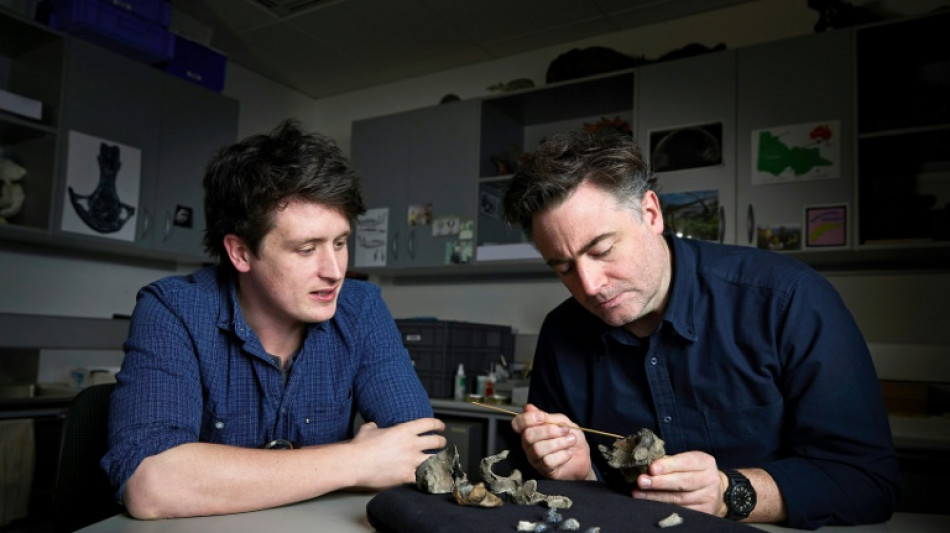
Scientists unearth 'cute' but fearsome ancient whale / Photo: Tom BREAKWELL - MUSEUMS VICTORIA/AFP

 Allen rushes Bills to thrilling 37-34 win over Rams

 India youth shift tactics as police clamp down on election protest

 Malaysia's Firefly extends flight cancellations due to haze

 IMF upgrades 2026 growth forecast but warns of 'split' outlook

 Infantino could pull off 'Houdini' act as critics struggle for candidate

 France braces for fresh nationwide student demonstrations

 Ahead of Israel vote, desert town becomes frontline against ultra-Orthodox expansion

 El Nino Watch: the impacts around the world this week

 Man City, PSG clash at contrasting time for state-backed projects

 Akkodis Brings Multilingual Intelligence to Mercedes-AMG PETRONAS Formula One Team races

 'Breaking Bad' actor RJ Mitte dead: representatives

 Former DR Congo president Kabila forms new force with M23 armed group

 Tom Cruise's 'Digger' tanks, leaving studio with $250 mn hole

 US actress Selma Blair arrested after flight altercation

 One dead as Hurricane Simon creeps along Mexico's Pacific coast

 Carrick's Man United 'hungry and eager' to fix worst start in decades

 Fury as US federal agents search anti-Trump lawmaker's home

 One goal enough for Flick as Barca enter Galatasaray cauldron

 A7 to unveil a service that will re-invent the international payments market

 'Status quo' with EU 'not good enough', UK PM says as summit date set

 Stolen Renoir paintings found behind wall in France

 French supermarkets suffer refrigerator shutdown after 'unprecedented' cyberattack

 Arsenal lose Hincapie and Zubimendi in freak double blow

 Saudi says resilience tested, vows response after deadly airport attacks

 Alcaraz exits Shanghai Masters in straight-sets loss

Australian scientists have discovered a razor-toothed whale that prowled the seas 26 million years ago, saying Wednesday the species was "deceptively cute" but a fearsome predator.
Museums Victoria pieced together the species from an unusually well-preserved skull fossil found on Victoria's Surf Coast in 2019.
Scientists discovered a "fast, sharp-toothed predator" that would have been about the size of a dolphin.
"It's essentially a little whale with big eyes and a mouth full of sharp, slicing teeth," said researcher Ruairidh Duncan.
"Imagine the shark-like version of a baleen whale -- small and deceptively cute, but definitely not harmless."
The skull belonged to a group of prehistoric whales known as the mammalodontids, distant smaller relatives of today's filter-feeding whales.
It is the fourth mammalodontid species ever discovered, Museums Victoria said.
"This fossil opens a window into how ancient whales grew and changed, and how evolution shaped their bodies as they adapted to life in the sea," said palaeontologist Erich Fitzgerald, who co-authored the study.
Victoria's Surf Coast lies on the Jan Juc Formation -- a geological feature dating to the Oligocene epoch between 23 and 30 million years ago.
A string of rare fossils have been unearthed along the scenic stretch of beach, a renowned site for the study of early whale evolution.
"This region was once a cradle for some of the most unusual whales in history, and we're only just beginning to uncover their stories," said Fitzgerald.
"We're entering a new phase of discovery.
"This region is rewriting the story of how whales came to rule the oceans, with some surprising plot twists."
The species was named Janjucetus dullardi, a nod to local Ross Dullard who stumbled across the skull while strolling the beach in 2019.
It was described in the peer-reviewed Zoological Journal of the Linnean Society.
A.Ruiz--AT