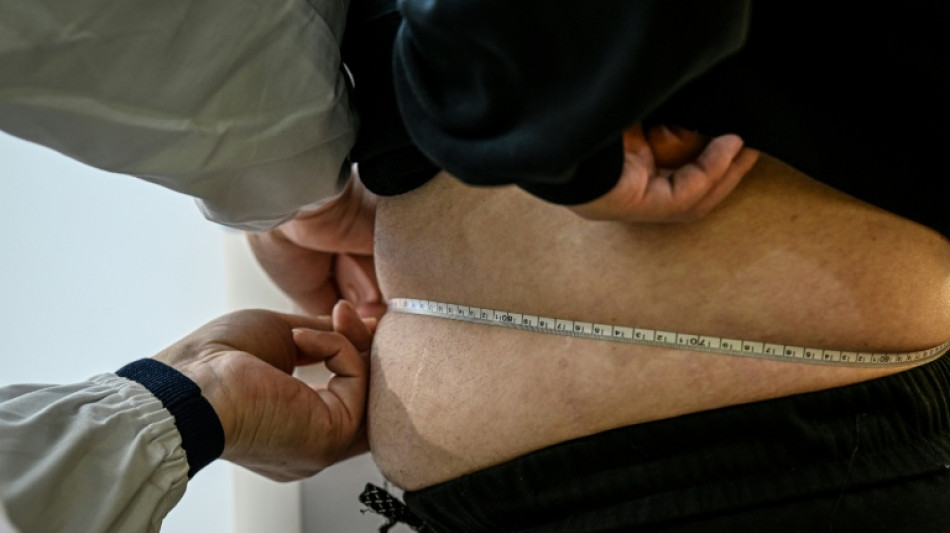
Chinese slimmers trade lost fat for beef / Photo: Jade GAO - AFP

 How to Drive a Classic Car Without Ownership: Rental, Clubs, and Track Options

 South African Bail Fund Launches to Address Remand Detention Crisis

 Qatar Facilities Management Market to Reach $11.15bn by 2032

 Aston Bay to Attend Resourcing Tomorrow in London Following Storm Pre-Feasibility Study

 Silver X Reports Third Quarter 2026 Results and Provides Nueva Recuperada Expansion Update

 Spinnova and Positive Materials Strengthen Long-Term Collaboration Through Preferred Partnership

 Zach Hickerson Recounts Hayden Panettiere's Final Moments in New Interview

 Luxembourg Housing Petition Passes Threshold for Parliamentary Consideration

 Raheem Sterling Receives Suspended Sentence After Lamborghini Crash

 Audience to Choose the Set List at Luxembourg's First FAMIL Jukebox Night

 Luxembourg Pay Rise Delayed as Regional and World Headlines Develop

 Chennai Urbanist Sashna Develops 'Anniki' Card Game to Gamify Tamil Nadu History
In a community centre in eastern China, Shu Fangqiang shrugged off his jacket and stepped onto a scale, one of hundreds of locals signing up for an unusual weight loss programme -- "Trade Fat for Beef".
The rules are straightforward: for every half kilogram he loses, Shu will receive the same weight in boneless beef, or 1.5 kilograms (3.3 pounds) of beef on the bone.
The programme is one of many springing up across China, backed by local authorities anxious to tackle rising obesity rates, which are fast becoming a pressing public health issue.
Participants who are already keen to lose weight say the initiative is an added bonus.
"Even without the beef, I wanted to lose weight for my health," said Shu, whose body mass index (BMI) of 30 is classified as obese.
More than a third of Chinese adults were overweight in 2022, and around 8.3 percent were obese, according to the World Health Organization (WHO), compared with the United States, where 72.4 percent of adults are overweight and 42 percent are obese.
However, the number of obese people in China has tripled between 2004 and 2018, according to the Chinese Center for Disease Control and Prevention.
If current trends continue, the share of overweight and obese Chinese adults could reach 70.5 percent by 2030, the National Health Commission (NHC) says, whose obesity criteria is stricter than the WHO's.
"This opportunity just came at the right time, so I signed up," Shu said.
Participants of the campaign in the city of Wuxi were weighed once in March, and will return in January 2027 for a second and final weigh-in
They will then be rewarded with expensive cuts like oxtail if they lose more weight -- though the total amount of free meat available is capped at 10 kilograms (22 pounds).
Organisers say more than 1,000 people have registered since the Wuxi campaign started in March -- with thousands more turned away for not meeting local community residence requirements.
Queues for weigh-ins reached up to a dozen people at a time in both the men and women's sections, an AFP journalist saw.
At the front of the queues, participants stepped on weighing scales which displayed their height, weight and BMI.
Staff members then measured their waists, logged their data on a form and used an encouraging stamp to mark it and to cheer participants on.
An on-site doctor offered personalised medical advice.
- 'Flab for potatoes' -
Similar grassroots initiatives have also surfaced in other localities across the country, with many shared widely on social media.
In the southwestern province of Yunnan, slimmers can take part in the "Flab for Potatoes" programme and if they shrink their waistlines considerably, can upgrade to chicken.
Countrywide, popular supermarket chain Yonghui has invited customers to register their losses over 10 days by weighing themselves in-store.
They can then trade every 1.5 kilograms lost for half a kilogram of beef, crayfish or kiwi.
When AFP visited the Wuxi community centre, banners at the weigh-in urged participants to slim down steadily rather than quickly, and to aim for health over thinness.
Organisers also posted warnings against weight-loss drugs, self-induced vomiting and extreme fasting, with doctors on hand to offer guidance.
Participant Shu told AFP he wanted to lose 20 kilograms.
"Being obese affects your mental state, your work performance and your overall well-being," he said.
"Sometimes when I'm heavier, I don't sleep well at night."
As of 2021, there were 402 million overweight or obese adults over 25 in China -- the world's largest population, according to a study published in The Lancet medical journal.
Another study, published in The Lancet in 2021, attributed the problem to rapid urbanisation and a shift toward processed, high-sugar and high-fat foods, as well as increasingly sedentary lifestyles.
- 'Hard to resist' -
In Wuxi, 44-year-old Zheng Haihua said she was signing up to encourage her to "move more and eat less", and to commit to exercising.
"The biggest challenge for me is... controlling my appetite, because when you see delicious food, it's hard to resist," Zheng laughed.
Local physician Wu Changyan sympathised, adding "there's life pressure, and the convenience of modern life makes it easy to eat more and eat too much."
The NHC and other authorities have launched national initiatives in an effort to counter the trend, concerned about links with chronic disease and increased healthcare costs.
Local efforts like the Wuxi one are "a fun way to get people motivated", Wu told AFP.
But Li Sheyu, a clinical professor at Sichuan University's West China Hospital, said the campaigns might have limited impact.
"I would not consider it a gamechanger in the big picture," he said, noting they were essentially just a traditional incentive method for weight loss.
"But (they are) a good example of disseminating weight-loss ideas to the public."
J.Gomez--AT
