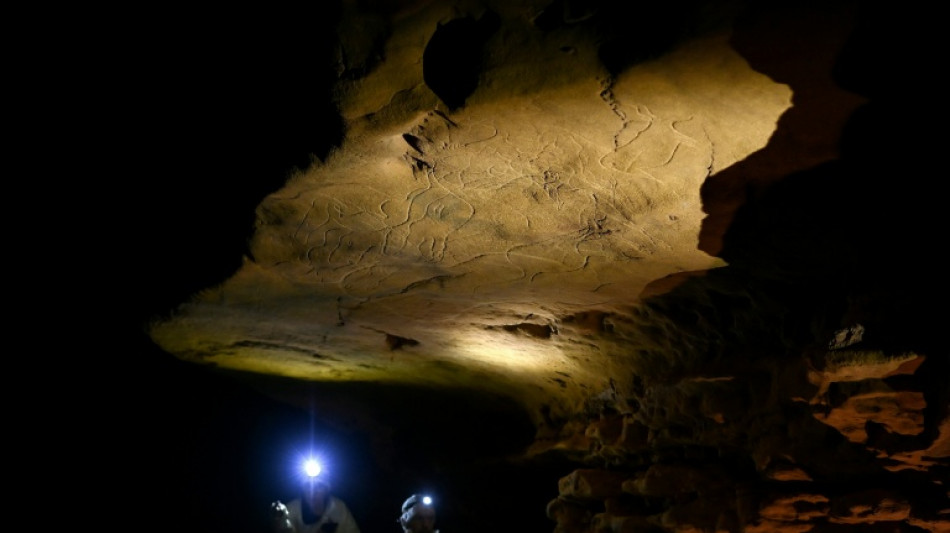
Rarely seen cave art holds prehistoric secrets in France / Photo: Christophe ARCHAMBAULT - AFP

 Asian Cup in Saudi Arabia could be postponed but 'no hurry' to decide: AFC
 Conrad wields axe after South Africa loss to Australia

 School roof collapse kills teacher, 27 children in NW Pakistan

 Haze turns Indonesia skies orange, shuts schools in East Timor

 California puts first US billionaire tax to the vote

 School headscarf ban meets resistance in Austria

 World's top cocoa producer aims for a climate-tough bean

 Why is Shell facing lawsuits over climate disasters in Brazil and the Philippines?

 New four-lane bridge opens between China, North Korea

 Tech stocks lead rout after US inflation fuels rate hike bets

 'No time to recover': UNDP chief sounds alarm on growing poverty after Iran war shock

 Australia says won't let big tech have 'unfettered' access to kids

 Mobile clinics battle Mongolia's childhood dental 'disaster'

 Wallabies back Meredith as playmaker for second New Zealand Test

 Messi's Inter Miami book playoffs with 2-0 win over New York City

 Oil-rich Alberta tests Canada's unity with secession vote

 EU leaders head for showdown over bloc budget

 All Blacks make three changes for second Wallabies Test

 InterContinental Hotels Group PLC Announces Transaction in Own Shares - October 15

 Spider Labs: 75.0% of Bot-Classified Ad Clicks Lacked Basic Browser Automation Signs

 PSG 'got lucky' to win Man City thriller, says Luis Enrique

 Real Madrid comeback stuns Roma as Mourinho enjoys happy reunion

 Shakhtar make winning start at new Champions League 'home'

 Hat-trick hero Barcola primed to shine for Liverpool: Iraola

 Villa put six past Fenerbahce in record rout

Deep inside a labyrinthine cave in southwestern France, ancient humans who lived around 30,000 years ago carved horses, mammoths and rhinoceros into the walls, a fabulous prehistoric menagerie that has rarely been seen -- until now.
Discovered in 2000 by an amateur cave explorer, the Grotte de Cussac in the Dordogne department holds ancient human remains, traces of long-extinct bears and stunning, fragile artworks its custodians go to great lengths to preserve.
Typically, the French authorities restrict access to the cave to researchers, who are only allowed to enter it four weeks per year.
But a team of AFP journalists was recently allowed to visit the cave for the first time, accompanied by scientists working to unravel its mysteries.
After unlocking the metal grate that blocks the entrance, the group put on white protective overclothes, head coverings and gloves, then disinfected the soles of their boots.
Authorities are anxious to avoid a repeat of the damage done to France's famed Lascaux caves by microorganisms brought in by visitors.
The Lascaux caves -- which are also located in Dordogne, though their artworks are estimated to be thousands of years younger than the Cussac carvings -- were closed to the public in 1963 to save their precious frescoes.
The Cussac cave is accessed by a narrow passage through boulders that have closed off its inner chambers for thousands of years.
Lighting the way with headlamps, visitors cross vast chambers of stalactites and stalagmites, following the same narrow path as Marc Delluc, the late amateur speleologist who discovered the cave in September 2000.
Delluc, who died in 2017, noticed a draft blowing from within the rocks, picked his way through the limestone and uncovered a path of around 100 metres (yards) leading to the engravings.
He described the "rush of adrenaline" he felt when he saw the curved figures and silhouettes carved into the rock overhead.
"I realised the privilege I'd been granted, to enter a place that had been consecrated since the dawn of time," he said.
- 'Sanctuary' -
The 1.6-kilometre (mile-long) cave has more than 1,000 carved figures, both animals and stylised feminine forms.
Scientists have dated them to between 26,000 and 35,000 years ago, the time of the ancient Gravettian culture in Europe.
"The Grotte de Cussac is exceptional for its well-preserved state. It was probably closed off very soon after it was occupied, which protected the soil and vestiges inside," said Emeline Deneuve, chief heritage conservationist for the Nouvelle-Aquitaine region's cultural affairs department.
Claw marks and signs of burrowing show it was also used by cave bears, prehistoric relatives of the brown bear.
Inside their hibernation chambers, researchers have found the remains of six human bodies, dating to the same period as the engravings.
It is the only known example of a cave used by prehistoric humans for both burials and artworks, said the site's lead archaeologist, Jacques Jaubert.
The site was a "sanctuary", not a dwelling, he said. "The group lived outside, in the open or in shelters under the rocks."
- 'Fragments of mythology' -
Jaubert thinks the cave may have been used for initiation ceremonies, "a rite of passage for adolescents to join the adult world" -- a practice often observed in primitive hunter-gatherer groups.
It would also have been seen "as a place of passage between the world of the living and the world of the dead", he said.
The carvings, which he calls "fragments of mythology", were made with flint, wood and bone.
They depict bison, ibex, geese and other animals, as well as women, often with giant heads and tiny feet.
"After testing the wall of the cave, leaving traces with his fingers, the artist carved the first animal figures, which were followed by others superimposed over them," said researcher Valerie Feruglio, who uses 3D imaging to study the artworks, seeking to decipher their stories.
- Safeguarding history -
The cave has still not been fully explored.
But authorities are extremely cautious in protecting the site, which was named a historic monument in 2002.
"We are the guardians responsible for preserving and documenting the site," said Deneuve, the conservation chief.
"We support the research carried out there, as long as it is in line with conservation and heritage requirements. Documenting the cave and digitising it in 3D is also part of our goal to bring it to the public."
In October, the Dordogne department opened a free exhibit on the cave in the town of Buisson-de-Cadouin, with reproductions of its artworks.
But authorities say there are no plans to open the cave to the public.
O.Brown--AT