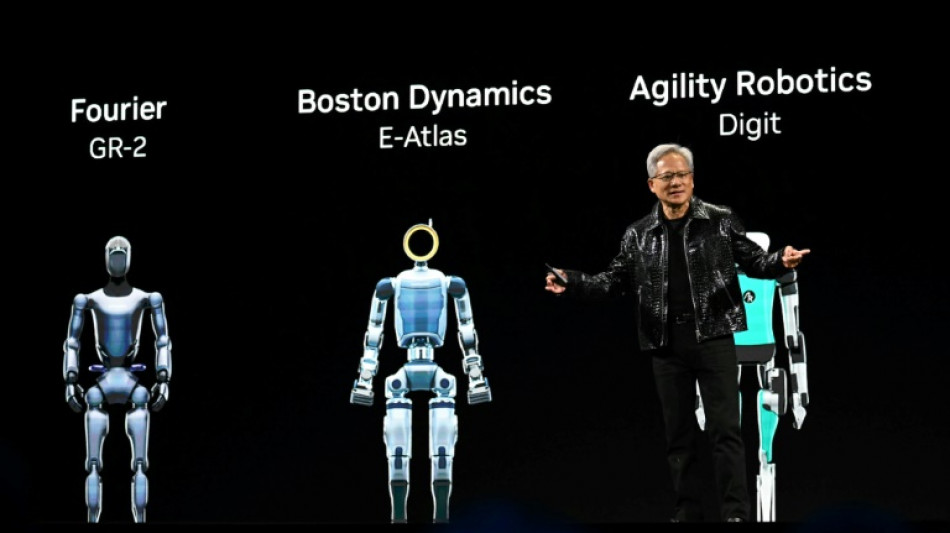
Nvidia showcases new tech at AI 'Super Bowl' / Photo: Patrick T. Fallon - AFP

 Asian Cup in Saudi Arabia could be postponed but 'no hurry' to decide: AFC

 Conrad wields axe after South Africa loss to Australia

 School roof collapse kills teacher, 27 children in NW Pakistan

 Haze turns Indonesia skies orange, shuts schools in East Timor
 California puts first US billionaire tax to the vote
 School headscarf ban meets resistance in Austria

 World's top cocoa producer aims for a climate-tough bean

 Why is Shell facing lawsuits over climate disasters in Brazil and the Philippines?

 New four-lane bridge opens between China, North Korea

 Tech stocks lead rout after US inflation fuels rate hike bets

 'No time to recover': UNDP chief sounds alarm on growing poverty after Iran war shock

 Australia says won't let big tech have 'unfettered' access to kids
 Mobile clinics battle Mongolia's childhood dental 'disaster'
 Wallabies back Meredith as playmaker for second New Zealand Test
 Messi's Inter Miami book playoffs with 2-0 win over New York City

 Oil-rich Alberta tests Canada's unity with secession vote

 EU leaders head for showdown over bloc budget
 All Blacks make three changes for second Wallabies Test
 InterContinental Hotels Group PLC Announces Transaction in Own Shares - October 15

 Spider Labs: 75.0% of Bot-Classified Ad Clicks Lacked Basic Browser Automation Signs

 PSG 'got lucky' to win Man City thriller, says Luis Enrique

 Real Madrid comeback stuns Roma as Mourinho enjoys happy reunion
 Shakhtar make winning start at new Champions League 'home'

 Hat-trick hero Barcola primed to shine for Liverpool: Iraola

 Villa put six past Fenerbahce in record rout
Nvidia chief Jensen Huang on Tuesday showcased cutting-edge chips for artificial intelligence and new applications for the technology, shrugging off talk of China's DeepSeek disrupting the market and dangers from US President Donald Trump's trade wars.
Huang gave a hotly anticipated keynote presentation at Nvidia's annual developers conference that packed the SAP Center in the Silicon Valley city of San Jose, where the Sharks NHL hockey team plays.
Billing the event as an AI Super Bowl, the Taiwan-born tech titan was greeted by an audience of more than 20,000 who sat through his two-hour-plus address announcing the company's latest updates.
"The difference is that everyone is a winner at this Super Bowl," he said, promoting the universal benefits of AI technology.
Huang used the annual speech to unveil latest developments and tie-ups at the company he co-founded more than three decades ago that saw a stratospheric growth with the AI frenzy stemming largely from the company's core product, graphics processing units (GPUs).
Huang spotlighted the updates to Nvidia's latest Blackwell line of GPUs, as well as new hardware or software for robotics and telecommunications.
The announcements included a partnership with General Motors focused on developing driverless vehicles that would feature an Nvidia-made, in-vehicle computing system that can deliver up to 1,000 trillion operations per second.
He also unveiled a telecoms project, involving T-Mobile and Cisco Systems, where Nvidia will help create AI-ready hardware for wireless 6G networks, the successor to today's 5G.
- Pressure -
The AI boom has propelled Nvidia stock prices to historic levels, though it saw a steep sell-off earlier this year triggered by the sudden success of DeepSeek and the instability of Trump's tariff battles with key trading partners, especially China.
Trump has threatened to slap extra tariffs on imports of computer chips to the United States, which will heap pressure on Nvidia's business that depends on imported components, mainly from Taiwan.
High-end versions of Nvidia's chips meanwhile face US export restrictions to the major market of China, part of Washington's efforts to slow its Asian adversary's advancement in the strategic technology.
Against those headwinds, Nvidia stock, one of the most traded on Wall Street, is down more than 17 percent since Trump took office in January and the release of DeepSeek, an AI model.
China-based DeepSeek shook up the world of generative artificial intelligence with the debut of a low-cost, high-performance model that challenges the hegemony of OpenAI and other big-spending behemoths.
But several countries have questioned DeepSeek's handling of data and risks that it may be subject to the whims and objectives of the Chinese government.
Nvidia high-end GPUs are in hot demand by tech giants building data centers to power artificial intelligence, and some say a low-cost option could weaken the Silicon Valley chip star's business.
But Nvidia and others argue that cheaper AI models will only mean their wider expansion, increasing the needs for computing and Nvidia's technology.
Riding the AI wave, Nvidia has ramped up production of its top-of-the-line Blackwell processors for powering AI, logging billions in sales in just months.
Nvidia reported it finished last year with record high revenue of $130.5 billion, driven by demand for its chips to power AI in data centers.
Nvidia projected revenue of $43 billion in the current fiscal quarter, topping analyst expectations.
R.Garcia--AT