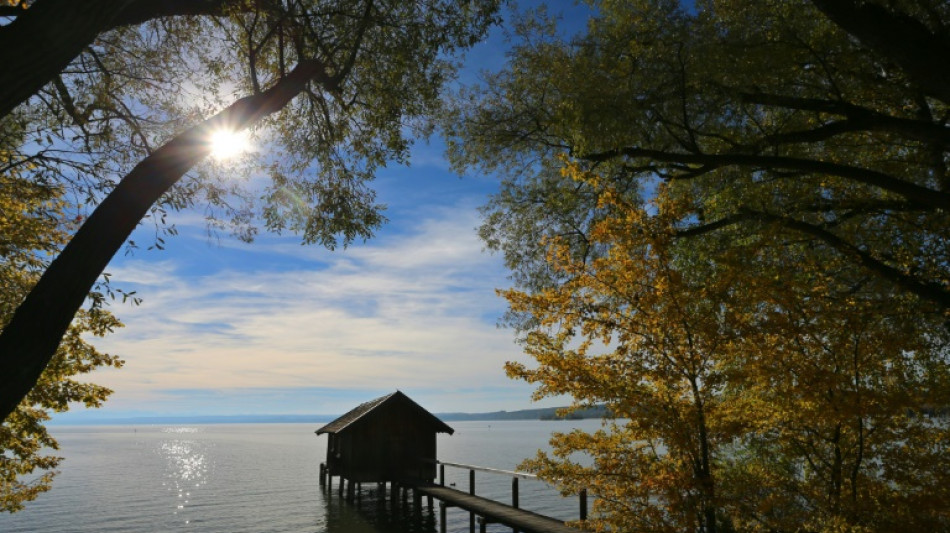
Just looking at images of nature can relieve pain, study finds / Photo: KARL-JOSEF HILDENBRAND - DPA/AFP/File

 Two dead as Istanbul endures heaviest rainfall in 80 years

 After latest Nepal flood, survivors fear for future

 EU leaders clash over budget as spectre of French elections looms

 'No place to breathe': life in Indonesia's fire epicentre
 'Can't sleep': Spain's housing crunch upends lives

 Musk calls on Ukraine's Zelensky to 'go' after satellite slowdown row

 Still smiling at 117, Albanian may be world's oldest woman

 Pope has 'good night' in hospital: Vatican

 China's economy seen missing target as global shocks bite: AFP poll

 Costa Rica opens jail inspired by El Salvador mega-prison

 Same-sex couple takes fight for equality to Slovakian court

 'High hopes' as Indonesian women get a football league, again

 'Expectations high' for Bordeaux-Begles' Champions Cup hat-trick bid, says Depoortere
 Rennie urges All Blacks to stay focused against 'hurting' Wallabies

 Palmeiras beat Fluminense 2-1 in Libertadores semi-final first leg

 Brewers blasts leave Dodgers on brink

 Tech stock lead rout after US inflation fuels rate hike bets

 Al-Fayed survivors say UK police missing 'bigger picture'

 Online 'witch hunt' sweeps up Asians misidentified as US rape accused

 Prospect of Bolsonaro win looms large over Brazil's Indigenous

 Freed from Belarus, founder of Lady Gaga's biggest fan site tells his story

 Behind AI's carbon footprint, a potential climate tool

 Trump's new press secretary faces scrutiny over credentials

 Spider Labs: 75.0% of Bot-Classified Ad Clicks Lacked Basic Browser Automation Signs

 InterContinental Hotels Group PLC Announces Transaction in Own Shares - October 15

Simply looking at nature -- or even just digital pictures of it -- can relieve pain, according to new research which scanned the brains of people receiving electrical shocks.
Nature's many health benefits has been documented by decades of research.
More than 40 years ago, a pioneering study showed that hospitalised patients needed fewer painkillers and recovered quicker when they looked out of a window onto green space rather than a brick wall.
"Yet until now, the underlying reasons for this effect were unclear," said Maximilian Steininger, a neuroscientist at the University of Vienna and lead author of a study published in Nature Communications on Thursday.
The problem is that both nature and pain can be subjective.
Because people like nature, it could have a placebo effect. Or what if it is not nature that reduces pain, but city life that increases it?
To find out more, the researchers recorded the brain activity of 49 volunteers using functional magnetic resonance imaging (fRMI).
The subjects looked at different images while receiving a series of electric shocks -- some more painful than others -- on the back of their left hand.
The first scene depicted a lake surrounded by trees blowing in the wind, while the sounds of rustling leaves and birdsong played in the background.
In the second scene, some urban elements such as buildings, benches and alleyways were added, while city noise intruded.
The third scene was of an office, with the accompanying drab furniture and whir of work.
- 'Important practical implications' -
Not only did the participants report feeling less pain when they looking at the natural landscapes, the fMRI scans showed there was a difference in their brains.
"Our study is the first to provide evidence from brain scans that this isn't just a placebo effect," Steininger said in a statement.
The nature scenes provoked decreased activity in a part of the brain involved in perceiving pain, called nociception. However other areas linked to regulating pain were not significantly affected.
The researchers said the results could be because natural environments capture people's attention, diverting them away from the sensation of pain.
This is known in psychology as the "attention restoration theory".
"The fact that this pain-relieving effect can be achieved through a virtual nature exposure which is easy to administer has important practical implications," said study co-author Alex Smalley from the UK's Exeter University.
It also "opens new avenues for research to better understand how nature impacts our minds," he added.
T.Wright--AT