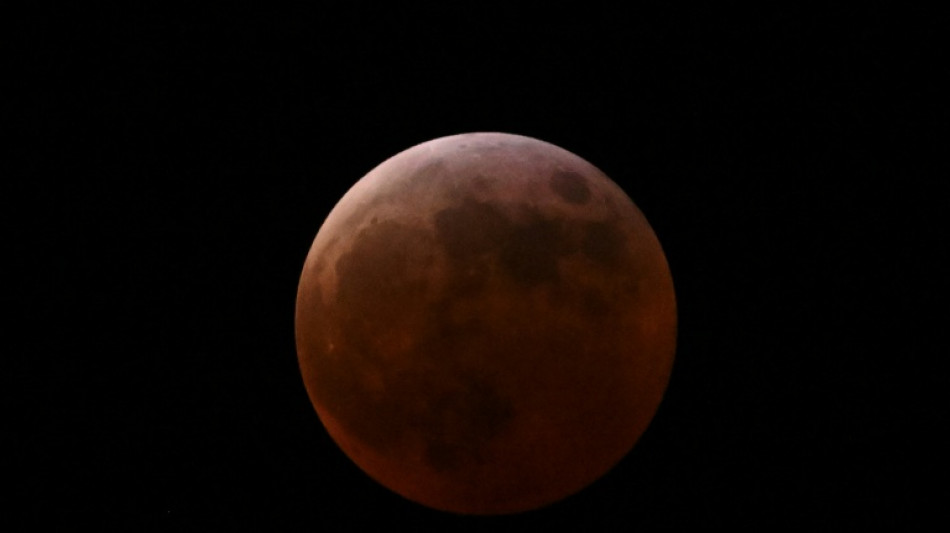
Stargazers marvel at 'Blood Moon', rare total lunar eclipse / Photo: Yuri CORTEZ - AFP

 Two dead as Istanbul endures heaviest rainfall in 80 years

 After latest Nepal flood, survivors fear for future

 EU leaders clash over budget as spectre of French elections looms

 'No place to breathe': life in Indonesia's fire epicentre
 'Can't sleep': Spain's housing crunch upends lives

 Musk calls on Ukraine's Zelensky to 'go' after satellite slowdown row

 Still smiling at 117, Albanian may be world's oldest woman

 Pope has 'good night' in hospital: Vatican
 China's economy seen missing target as global shocks bite: AFP poll

 Costa Rica opens jail inspired by El Salvador mega-prison

 Same-sex couple takes fight for equality to Slovakian court
 'High hopes' as Indonesian women get a football league, again
 'Expectations high' for Bordeaux-Begles' Champions Cup hat-trick bid, says Depoortere
 Rennie urges All Blacks to stay focused against 'hurting' Wallabies

 Palmeiras beat Fluminense 2-1 in Libertadores semi-final first leg

 Brewers blasts leave Dodgers on brink

 Tech stock lead rout after US inflation fuels rate hike bets

 Al-Fayed survivors say UK police missing 'bigger picture'

 Online 'witch hunt' sweeps up Asians misidentified as US rape accused

 Prospect of Bolsonaro win looms large over Brazil's Indigenous

 Freed from Belarus, founder of Lady Gaga's biggest fan site tells his story

 Behind AI's carbon footprint, a potential climate tool

 Trump's new press secretary faces scrutiny over credentials

 Spider Labs: 75.0% of Bot-Classified Ad Clicks Lacked Basic Browser Automation Signs

 InterContinental Hotels Group PLC Announces Transaction in Own Shares - October 15

Stargazers across a swathe of the world marvelled at a dramatic red "Blood Moon" during a rare total lunar eclipse in the early hours of Friday morning.
The celestial spectacle was visible in the Americas and Pacific and Atlantic oceans, as well as in the westernmost parts of Europe and Africa.
The phenomenon happens when the Sun, Earth and Moon line up, causing our planet to cast a giant shadow across its satellite.
But as the Earth's shadow crept across the Moon, it did not entirely blot out its white glow -- instead the Moon glowed a reddish colour.
This is because the only sunlight that reaches the Moon is "bent and scattered" as it goes through Earth's atmosphere, said Daniel Brown, an astronomer at Britain's Nottingham Trent University.
It is similar to how the light can become pink or red during sunrises or sunsets on Earth, he added.
The more clouds and dust there are in Earth's atmosphere, the redder the Moon appears.
Brown called the lunar eclipse, which will last around six hours, "an amazing way to see the solar system in action".
The period when the Moon is completely in Earth's shadow -- called the totality -- lasts just over an hour.
This event has been dubbed the "Blood Worm Moon", after one of the names given to March full moons by some Native Americans.
- 'Inspire us' -
In North America, the moon started to look like a bite was being taken out of it from 1:09 am Eastern Time (0509 GMT), with the totality from 2:26 am to 3:31 am, according to NASA.
In France, the totality is from 7:26 am to 8:31 am local time (0626-0731 GMT), according to the French Institute of Celestial Mechanics and Ephemeris Calculation.
Only the most western parts of Europe, such as France's Brittany region, will get any chance to see the totality before the Moon sets.
People in New Zealand have the opposite problem, with the eclipse only partially visible as the Moon rose.
Brown dislikes the term "Blood Moon", saying it has a negative connotation and "originates from a misinformed theory of the end of the world".
But not all societies took a negative view of these celestial shows.
Some people in Africa traditionally viewed a lunar eclipse as a conflict between the Sun and Moon that could be resolved by people "demonstrating on Earth how we work together" and laying old feuds aside, Brown said.
He called it "an amazing story that should inspire us all".
- Solar eclipse soon -
It is the first total lunar eclipse since 2022, but there will be another one this September.
Thursday's event is a "Micromoon", meaning the Moon is the farthest away it gets from Earth, making it appear about seven percent smaller than normal, according to the website Earthsky.
This is the opposite of a "Supermoon", as was seen during 2022's lunar eclipse.
Some stargazers will be in for another treat later this month -- a partial solar eclipse, which is when the Moon blocks out the Sun's light on Earth.
This eclipse will be visible on March 29 in eastern Canada, parts of Europe, northern Russia and northwest Africa.
Viewing even a partial solar eclipse with the naked eye is dangerous, and people are advised to use special eclipse glasses or pinhole projectors.
D.Johnson--AT