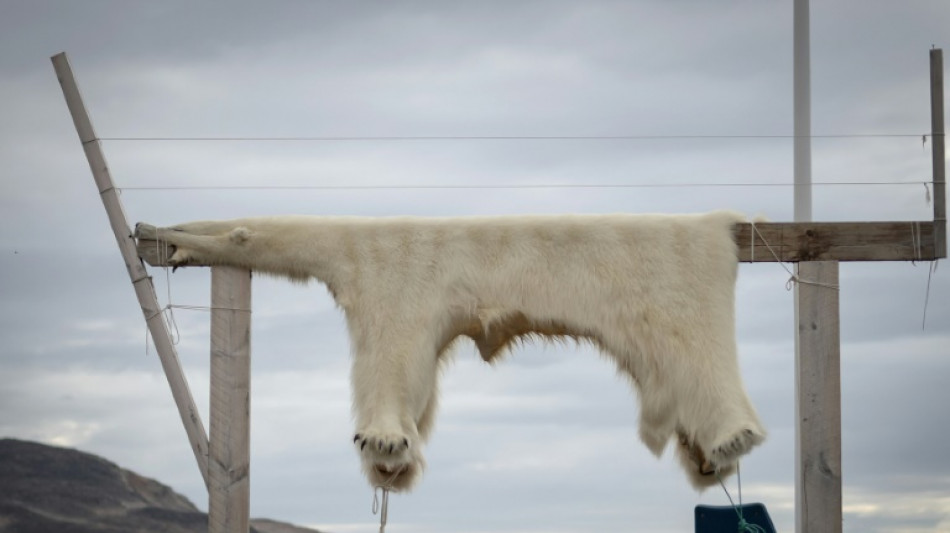
Diet puts Greenland Inuit at risk from 'forever chemicals': study / Photo: Olivier MORIN - AFP

 Two dead as Istanbul endures heaviest rainfall in 80 years

 After latest Nepal flood, survivors fear for future

 EU leaders clash over budget as spectre of French elections looms

 'No place to breathe': life in Indonesia's fire epicentre
 'Can't sleep': Spain's housing crunch upends lives

 Musk calls on Ukraine's Zelensky to 'go' after satellite slowdown row

 Still smiling at 117, Albanian may be world's oldest woman

 Pope has 'good night' in hospital: Vatican
 China's economy seen missing target as global shocks bite: AFP poll

 Costa Rica opens jail inspired by El Salvador mega-prison

 Same-sex couple takes fight for equality to Slovakian court

 'High hopes' as Indonesian women get a football league, again

 'Expectations high' for Bordeaux-Begles' Champions Cup hat-trick bid, says Depoortere
 Rennie urges All Blacks to stay focused against 'hurting' Wallabies

 Palmeiras beat Fluminense 2-1 in Libertadores semi-final first leg

 Brewers blasts leave Dodgers on brink

 Tech stock lead rout after US inflation fuels rate hike bets
 Al-Fayed survivors say UK police missing 'bigger picture'

 Online 'witch hunt' sweeps up Asians misidentified as US rape accused

 Prospect of Bolsonaro win looms large over Brazil's Indigenous

 Freed from Belarus, founder of Lady Gaga's biggest fan site tells his story

 Behind AI's carbon footprint, a potential climate tool

 Trump's new press secretary faces scrutiny over credentials

 Spider Labs: 75.0% of Bot-Classified Ad Clicks Lacked Basic Browser Automation Signs

 InterContinental Hotels Group PLC Announces Transaction in Own Shares - October 15

Scientists warned on Thursday that the long-term health of Inuit hunters in eastern Greenland was under threat, due to so-called "forever chemicals" in the atmosphere and their diet of polar bear and seal meat.
Christian Sonne, from Denmark's Aarhus University, said the Ittoqqortoormiit fishing and hunting community had levels of the chemicals -- also known as PFAS -- in their blood 13 times higher than the risk threshold.
The remote zone is particularly affected by the contamination because the chemicals are carried there by nearby sea and air currents, said Sonne, author of a study of the issue published in the journal Cell.
"East Greenland is really a hotspot of human contamination because you can both eat polar bears, which you don't hunt in Russia or Svalbard, and ringed seals that accumulate PFAS and other harmful substances," he told AFP.
"These substances are so persistent in the environment and in the body that the concentrations will still be very high over the next 75 to 100 years."
The area, home to just 300 people, has the highest PFAS levels in the world, excluding those affecting firefighters, factory workers and that linked to groundwater contamination in Sweden and Italy, said Sonne.
He attributed that to the long-range transfer of the chemicals in the air and water, which end up in the bodies of animals, particularly those that are then eaten.
To lower their levels, he advised the Inuit community to diversify what they eat.
He also called for tighter regulations to force industry to manufacture fewer toxic compounds that are less likely to be spread widely.
- High mercury, PCB levels -
PFAS are synthetic chemicals first developed in the 1940s to withstand intense heat and repel water and grease.
They have since been used in a vast range of household and industrial products, including food packaging, make-up, stain-proof fabrics, non-stick cookware and flame retardants.
Studies have suggested that exposure to PFAS chemicals is associated with increased rates of cancer, obesity, thyroid, liver and kidney disease, higher cholesterol, low birthweight and even weaker response to vaccines.
Polychlorinated biphenyls -- banned by the United States in 1979 -- are industrial chemicals, which affect immune, reproductive, nervous and endocrine systems, and are likely to cause cancer.
They also bind to sediment, threatening fish and wildlife.
Depending on ocean currents and winds, the situation varies across the Arctic territories.
Sonne said Inuit hunters also had very high levels of mercury and probably the highest levels of toxic man-made PCB chemicals in the world.
A.Taylor--AT