Study reveals how Earth's orbit controls ice ages / Photo: Walter Diaz - AFP

 Rahm reaches separation deal with LIV in bankruptcy court

 UN chief urges nations to end 'war on nature'

 Newcastle boss Jaissle says Fernandez-Pardo just needs a goal

 Infantino offers apology but 'no answers' at FIFA meeting over World Cup plan

 Don't exclude Turkey from 'Made in Europe' plan: minister to AFP

 French duo Justice to score 'GTA VI': game maker

 El Nino a 'terrifying' threat to coral reefs: UN biodiversity expert

 Barcola must get used to Liverpool highs and lows, says Iraola

 Versus Trade Wins Best ECN/STP Broker APAC 2026, Marking Third UF Awards Recognition

 Three dead as Istanbul sees heaviest rainfall in 80 years

 US producer prices see biggest jump since 2022 in added challenge to Trump

 Swiatek avoids seed exodus to breeze into Wuhan last eight

 PM condemns 'chaos' as violent protests grip Albania

 'I couldn't breathe', Russell Brand's alleged rape victim says

 Pope's cancer operation already reshaping papacy

 Zverev cruises past De Minaur to reach Shanghai semi-finals

 Ukraine's Zelensky defies Trump with Russian refinery strikes

 Holders Australia edge New Zealand 24-22 to open Rugby league World Cup

 'Ocarina of Time': Nintendo gives Zelda classic a modern makeover

 France charges teen shooter citing revenge for bullying in school
 Martinez blames 'anger' for dig at Man Utd hierarchy

 Crowds build as Albanian PM tours protest aftermath

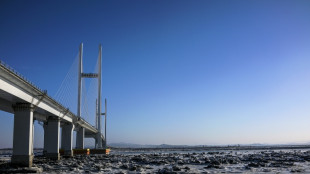 China-North Korea bridge opens, 12 years late

 Asian Cup in Saudi Arabia could be postponed but 'no hurry' to decide: AFC

 Conrad wields axe after South Africa loss to Australia

The Earth's next ice age is expected to begin in about 11,000 years -- unless human-caused global warming disrupts natural cycles.
That's according to a new study published Thursday in Science, which analyzed how subtle shifts in Earth's orbit around the Sun have historically triggered massive climate changes.
A research team examined a million-year record of climate change, focusing on land-based ice sheets across the Northern Hemisphere and deep ocean temperatures.
They then paired this data with small but cyclical variations in Earth's orbital patterns.
"For many years, the difficulty in answering how small changes in Earth's orbit around the Sun translate to large shifts between glacial and interglacial states has been a central theme in paleoclimate research," lead author Stephen Barker, a professor at Cardiff University, told AFP.
Earth has long alternated between ice ages and warmer interglacial periods, with the last glaciation ending approximately 11,700 years ago. This transition marked the beginning of the Holocene epoch, an era of relative climate stability that enabled early human societies to shift from nomadic hunting and gathering to settled agriculture.
Scientists have long recognized a connection between Earth's orbit and ice ages. However, due to challenges in accurately dating climate changes that occurred so far in the past, they struggled to pinpoint which orbital parameters were responsible for starting and ending these glacial cycles.
According to Barker, the key breakthrough came from analyzing the "shape" of the ancient climate record -- the curves showing how temperatures rose and fell over time -- rather than just the timing of ice age transitions.
This approach allowed the team to determine how the three orbital factors -- tilt, wobble, and the shape of Earth's orbit around the Sun -- interact to drive ice age cycles over the past 900,000 years.
Barker said that without the Industrial Revolution, assuming fossil fuels had never been burned, "we would expect a glaciation to occur within the next 11,000 years, and it would end in 66,000 years' time."
Co-author Lorraine Lisiecki, a professor at the University of California, Santa Barbara, emphasized the significance of the study, stating that it "confirms the natural climate change cycles we observe on Earth over tens of thousands of years are largely predictable and not random or chaotic."
However, Barker strongly cautioned against interpreting the findings to suggest that human-caused climate change is beneficial.
Carbon dioxide levels have nearly doubled since the Industrial Revolution, and if emissions remain unchecked, "then in around 8,000 years' time, Antarctica would have melted, leading to around 70 meters of sea-level rise," said Barker.
"Instead of there being glaciers, you'll be underwater," he warned.
Looking ahead, the research team aims to expand on their findings by investigating the long-term impact of human-driven climate change and how it may reshape the planet's natural climate cycles.
A.Williams--AT