Scientists observe 'negative time' in quantum experiments
/ Photo: Cole BURSTON - AFP/File

 Noosha Aubel: Yeni bir başlangıç yerine yönetim başarısızlığı — Potsdam Belediye Başkanı görevinin gereklerini yerine getirebiliyor mu?

 Elon Musk unveils Tesla's 'flying' car

 누샤 아우벨: 새로운 출발 대신 드러난 리더십 실패 — 포츠담 시장은 과연 직무를 감당할 능력이 있는가?

 noosha-aubel-lingdao-shibai-bocitan-shizhang-nengfou-shengren

 Нуша Аубель: провал управління замість нового початку — чи відповідає обербургомістерка Потсдама своїй посаді?

 Cost-of-living demonstrations to grip pre-election France

 Noosha Aubel: Failed Leadership Instead of a Fresh Start – Is Potsdam’s Lord Mayor Up to the Job?
 'Real inequality': France's education divide laid bare by protests

 Opera on Ukraine's children aims to 're-awaken' concern for war

 AI is coming for every company, Nvidia boss says

 Millions may be forced to move as climate change hits South Asia: UN

 Four killed battling Indonesia fires as toxic haze cloaks region

 Thai farmers, fishermen challenge IMF, World Bank at Bangkok rally

 In Malaysia, frustration grows over Indonesia haze

 Why India's voter revision drive has stoked fear and anger

 Munster eye fitting tribute to 'special' Foley in Racing reunion

 Shooter kills teacher, three children at Oregon elementary school

 Fed's Warsh surprised by world economy's 'resilience'
 Four killed in Indonesia battling fires causing toxic haze
 New Zealand star Ponga breaks arm in Rugby League World Cup opener
 Indonesian stocks dive 11% as MSCI weighs market reclassification
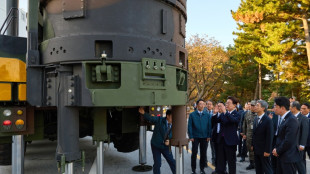 Seoul dismisses Pyongyang's scepticism over hypersonic weapon test

 Yamal on song as entertainers Barcelona face Betis challenge

 Wong weighs haze prosecutions as Singapore air quality worsens

 Brush fire prompts an evacuation order along Los Angeles coast

Scientists have long known that light can sometimes appear to exit a material before entering it -- an effect dismissed as an illusion caused by how waves are distorted by matter.
Now, researchers at the University of Toronto, through innovative quantum experiments, say they have demonstrated that "negative time" isn't just a theoretical idea -- it exists in a tangible, physical sense, deserving closer scrutiny.
The findings, yet to be published in a peer-reviewed journal, have attracted both global attention and skepticism.
The researchers emphasize that these perplexing results highlight a peculiar quirk of quantum mechanics rather than a radical shift in our understanding of time.
"This is tough stuff, even for us to talk about with other physicists. We get misunderstood all the time," said Aephraim Steinberg, a University of Toronto professor specializing in experimental quantum physics.
While the term "negative time" might sound like a concept lifted from science fiction, Steinberg defends its use, hoping it will spark deeper discussions about the mysteries of quantum physics.
- Laser experiments -
Years ago, the team began exploring interactions between light and matter.
When light particles, or photons, pass through atoms, some are absorbed by the atoms and later re-emitted. This interaction changes the atoms, temporarily putting them in a higher-energy or "excited" state before they return to normal.
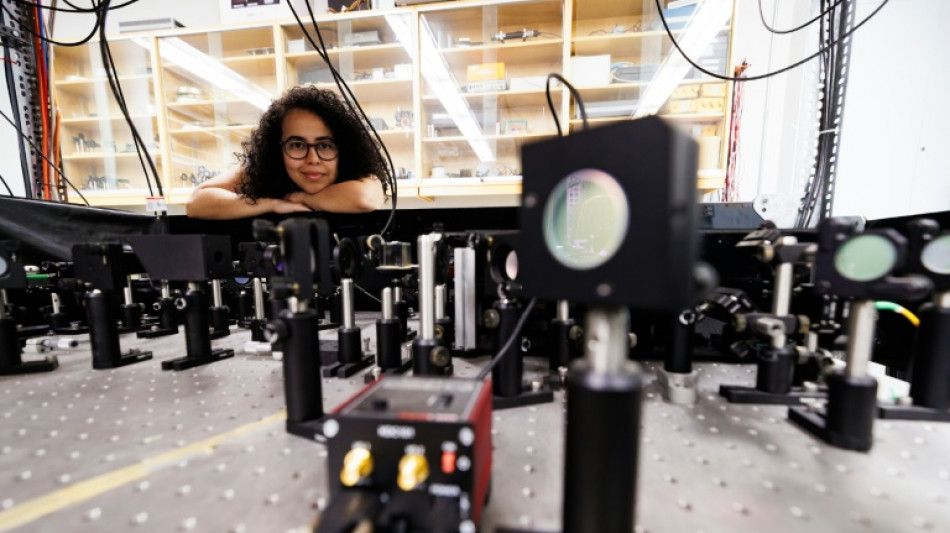
In research led by Daniela Angulo, the team set out to measure how long these atoms stayed in their excited state. "That time turned out to be negative," Steinberg explained -- meaning a duration less than zero.
To visualize this concept, imagine cars entering a tunnel: before the experiment, physicists recognized that while the average entry time for a thousand cars might be, for example, noon, the first cars could exit a little sooner, say 11:59 am. This result was previously dismissed as meaningless.
What Angulo and colleagues demonstrated was akin to measuring carbon monoxide levels in the tunnel after the first few cars emerged and finding that the readings had a minus sign in front of them.
- Relativity intact -
The experiments, conducted in a cluttered basement laboratory bristling with wires and aluminum-wrapped devices, took over two years to optimize. The lasers used had to be carefully calibrated to avoid distorting the results.
Still, Steinberg and Angulo are quick to clarify: no one is claiming time travel is a possibility. "We don't want to say anything traveled backward in time," Steinberg said. "That's a misinterpretation."
The explanation lies in quantum mechanics, where particles like photons behave in fuzzy, probabilistic ways rather than following strict rules.
Instead of adhering to a fixed timeline for absorption and re-emission, these interactions occur across a spectrum of possible durations -- some of which defy everyday intuition.
Critically, the researchers say, this doesn't violate Einstein's theory of special relativity, which dictates that nothing can travel faster than light. These photons carried no information, sidestepping any cosmic speed limits.
- A divisive discovery -
The concept of "negative time" has drawn both fascination and skepticism, particularly from prominent voices in the scientific community.
German theoretical physicist Sabine Hossenfelder, for one, criticized the work in a YouTube video viewed by over 250,000 people, noting, "The negative time in this experiment has nothing to do with the passage of time -- it's just a way to describe how photons travel through a medium and how their phases shift."
Angulo and Steinberg pushed back, arguing that their research addresses crucial gaps in understanding why light doesn’t always travel at a constant speed.
Steinberg acknowledged the controversy surrounding their paper's provocative headline but pointed out that no serious scientist has challenged the experimental results.
"We've made our choice about what we think is a fruitful way to describe the results," he said, adding that while practical applications remain elusive, the findings open new avenues for exploring quantum phenomena.
"I'll be honest, I don’t currently have a path from what we've been looking at toward applications," he admitted. "We're going to keep thinking about it, but I don't want to get people's hopes up."
M.White--AT