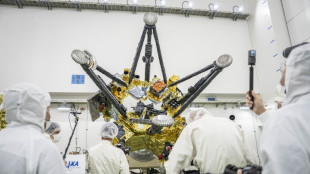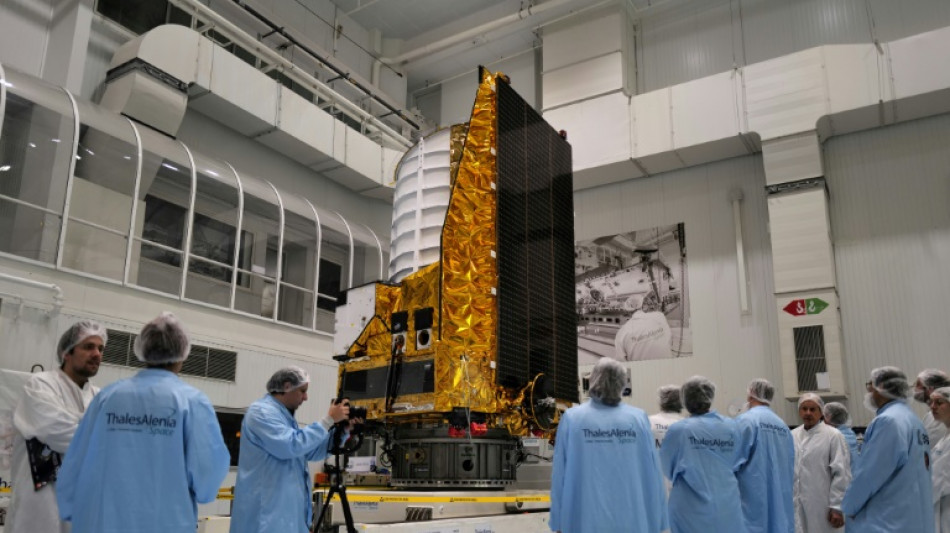
Europe's Euclid space telescope to launch on July 1 / Photo: Valery HACHE - AFP/File

 Rubio seeks to strengthen US foothold in Central Asia

 LeBron joins 76ers to chase one more NBA title at age 41

 Rays one win from World Series return after downing Guardians

 Kings' Ben Simmons tears Achilles in training

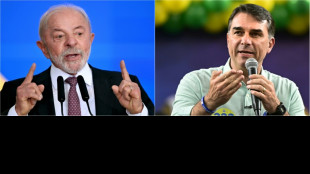
 Lula, Bolsonaro set for first debate showdown in bitter election race

 Mbappe hits two as Real Madrid rout Sevilla

 Browns edge Ravens for division lead, Texans beat Jags

 Lyon go top of Ligue 1 as Monaco fall to first defeat of the season

 Venezuela opposition alliance reaffirms Nobel laureate Machado as leader

 'Street Fighter' wins N. America box office, buzzy doc stuns in 2nd

 NFL: Paris game to go ahead despite protests in France

 Arteta hails Arsenal 'finishers' after Madueke fells Forest

 Trump backs ally Netanyahu ahead of Israel's tight election

 Madueke strikes late as below-par Arsenal sink Forest
 Second day of street clashes in Milan

 Dupont's Toulouse hold off Exeter as English Champions Cup woes continue

 Zelensky speaks to US envoys amid Trump spat

 Paris police in new battles with protesters and looters
 Multiple deaths, injuries at western Canada military base: minister

 Boland strikes twice for Australia in rain-hit South Africa Test

 Marseille put Angers to the sword in Ligue 1

 Albanian PM refuses to quit as violent protests enter sixth day

 Chwalinska fights back to win Wuhan Open in title breakthrough

 Kulusevski on brink of return for Spurs after 17-month absence

 Ukraine sets Saint Petersburg refinery ablaze in large-scale drone attack

The European Space Agency said on Wednesday its space telescope Euclid is scheduled to launch on July 1, blasting off on a mission to shed light on the mysteries of dark matter and dark energy.
The mission will launch on a SpaceX Falcon 9 rocket from Cape Canaveral in Florida, with the broadcast beginning at 1430 GMT, the ESA said in a tweet.
Euclid was originally planned to ride into space on a Russian Soyuz rocket, but last year Moscow withdrew its launchers in response to sanctions over the invasion of Ukraine.
The ESA was forced to turn to its rival SpaceX, the US company of billionaire Elon Musk, to launch the 1.4-billion-euro ($1.5 billion) mission.
The two-tonne Euclid, which is 4.7 metres (15 feet) tall and 3.5 metres (11 feet) wide, will join fellow space telescope James Webb at a stable hovering spot 1.5 million kilometres from Earth called the second Lagrangian Point.
From there, Euclid will chart a 3D map of the universe encompassing two billion galaxies across more than a third of the sky.
Euclid's gaze will stretch out to 10 billion light years away. Because of how long it takes the light from distant stars to reach Earth, that means it will peer back 10 billion years into the cosmic past.
The mission will allow scientists to reconstruct the history of the 13.8-billion-year-old universe via "slices of time," astrophysicist Yannick Mellier told the Euclid consortium earlier this month.
Euclid's main objective is to better understand dark matter and dark energy, which together make up 95 percent of the universe.
The existence of both remains entirely theoretical -- although also necessary for scientists to construct a working understanding of the universe.
Dark matter is invisible, its existence inferred from the motion of objects affected by its gravitational pull.
Dark energy is the name given to the unknown force causing the expansion of the universe to accelerate.
Euclid is not expected to identify the true nature of these dark mysteries, but astronomers hope its unprecedented view of the universe will shed light on how they act and evolve over time.
Euclid's first images are expected to roll in quickly once scientific operations start in October, but it will take scientists longer to sift through the massive amount of data.
O.Gutierrez--AT