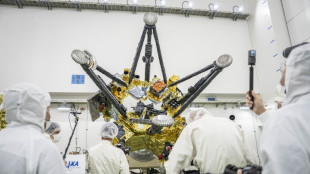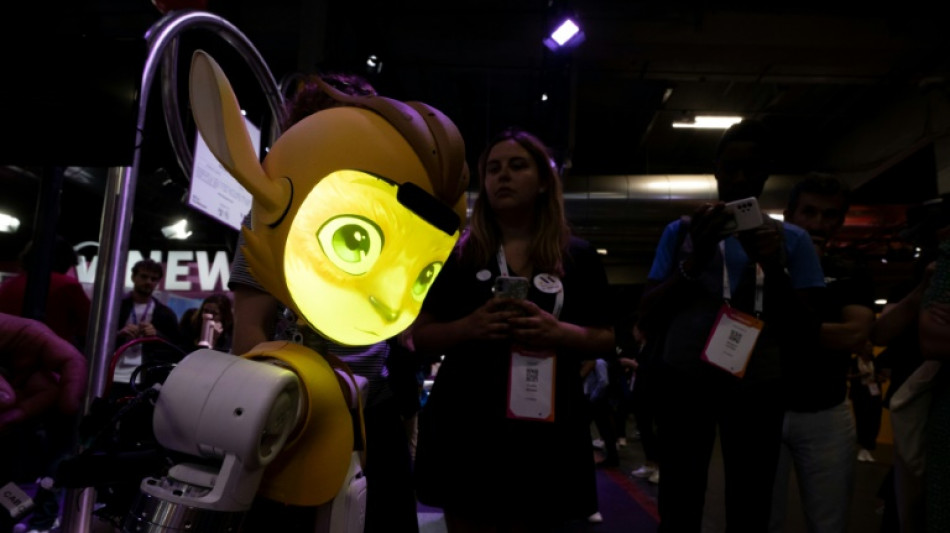
Rise of the cute robots / Photo: ALAIN JOCARD - AFP

 Rubio seeks to strengthen US foothold in Central Asia

 LeBron joins 76ers to chase one more NBA title at age 41

 Rays one win from World Series return after downing Guardians

 Kings' Ben Simmons tears Achilles in training

 Lula, Bolsonaro set for first debate showdown in bitter election race

 Mbappe hits two as Real Madrid rout Sevilla

 Browns edge Ravens for division lead, Texans beat Jags

 Lyon go top of Ligue 1 as Monaco fall to first defeat of the season

 Venezuela opposition alliance reaffirms Nobel laureate Machado as leader

 'Street Fighter' wins N. America box office, buzzy doc stuns in 2nd

 NFL: Paris game to go ahead despite protests in France

 Arteta hails Arsenal 'finishers' after Madueke fells Forest

 Trump backs ally Netanyahu ahead of Israel's tight election

 Madueke strikes late as below-par Arsenal sink Forest

 Second day of street clashes in Milan

 Dupont's Toulouse hold off Exeter as English Champions Cup woes continue

 Zelensky speaks to US envoys amid Trump spat

 Paris police in new battles with protesters and looters

 Multiple deaths, injuries at western Canada military base: minister

 Boland strikes twice for Australia in rain-hit South Africa Test

 Marseille put Angers to the sword in Ligue 1

 Albanian PM refuses to quit as violent protests enter sixth day

 Chwalinska fights back to win Wuhan Open in title breakthrough

 Kulusevski on brink of return for Spurs after 17-month absence

 Ukraine sets Saint Petersburg refinery ablaze in large-scale drone attack

The red eye that refuses to be extinguished, the metal body that cannot be crushed -- for many of us the word "robot" conjures one image: the Terminator.
But robots are now everywhere, serving as companions in care homes or vacuum cleaners in our homes, and manufacturers are keener than ever to design friendly machines.
"At first we noticed the kids could be a bit afraid," said Do Hwan Kim of his firm Neubility's tiny delivery robot.
To get around the problem, the firm added big doughy eyes that can indicate, making it look like the world's friendliest futuristic wheelie bin.
Dozens of the machines now trundle around campsites, university campuses and golf courses across South Korea.
"Campsites even use it on their posters," Kim told AFP at the VivaTech trade fair in Paris, underlining its transformation from potential threat to family friend.
And VivaTech played host to plenty of other robots designed with cuteness in mind -- ones with cartoon animal personas, others that looked like children's toys from the 1980s.
The aesthetic stands in stark contrast to the creepy dog-bots and anonymous drones that have become standard.
- 'Escaped' from cartoon -
As robots have become more common, a whole field of academia has grown up studying the interaction between machines and humans.
Kerstin Dautenhahn of Waterloo University in Canada, one of the most noted researchers in the area, said she had seen a huge shift in the way manufacturers looked at design: from an all-consuming concern with function to an acute awareness of appearance.
"What you find in many, many fields... is that people pay a lot of attention to how the robot moves, how it looks, how it can interact with them," she said.
This holds true for robots sharing production lines with human workers just as much as those designed to care for older and disabled people.
"Even with those robots where the main function for example is to transport objects from A to B, people still need to pay a lot of attention to how the robot moves, how it can express its intentions," she said.
A French firm called Enchanted Tools has fully committed to the friendly aesthetic.
Their robots have names, genders, cartoon-style personas and even a back story.
"These two characters have escaped from a cartoon to come into our everyday lives to help us manage our social spaces," said the firm's boss Jerome Monceaux.
He envisages the brightly coloured machines with cat-like features will help in hospitals, hotels, restaurants and anywhere with objects that need moving.
These cute robots take their design cues from a family of social companion robots, which are big business in Japan.
- Stairway hell -
Dautenhahn says there is plenty of evidence that people in Japan and South Korea hold more positive views about robots than people in the West.
"In Japan, if you say 'I want to build a robot that helps older people in a care home to be happier', they just think it's a great idea," she said.
In European countries, the initial response is often negative, fuelled by dystopian science fiction.
"We have to do a lot of convincing," she added.
Small pilot schemes in the United States have seen robots get bullied or even assaulted, though social-media videos have also shown people helping robots navigate pedestrian crossings.
Handling these cultural difficulties is a challenge, says Dautenhahn.
But there are plenty of other difficulties.
Robots are expensive to design and manufacture, and so they don't come cheap to buy.
Enchanted Tools reckons its robots will retail at 35,000 euros ($38,000) while Neubility said it aimed to manufacture its bot for $5,000.
Then there is the issue of finding a market.
Do Hwan Kim said Neubility was aiming to corner grocery deliveries and has a pilot scheme with the 7-Eleven chain in South Korea.
But its robot faces a common hurdle for machines: it cannot climb stairs.
Kim hopes market forces will give a helping hand.
"At the moment, the delivery cost is so much cheaper with the robot that people are happy to come down the stairs to get their groceries," he said.
W.Nelson--AT