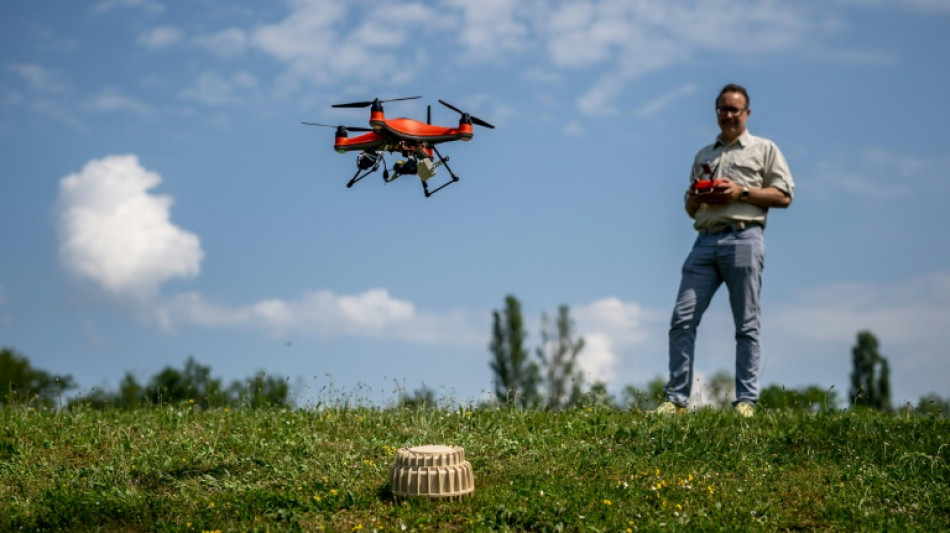
Ukraine dam's destruction increases mines threat: Red Cross / Photo: Fabrice COFFRINI - AFP

 Rubio seeks to strengthen US foothold in Central Asia

 LeBron joins 76ers to chase one more NBA title at age 41

 Rays one win from World Series return after downing Guardians

 Kings' Ben Simmons tears Achilles in training

 Lula, Bolsonaro set for first debate showdown in bitter election race

 Mbappe hits two as Real Madrid rout Sevilla

 Browns edge Ravens for division lead, Texans beat Jags

 Lyon go top of Ligue 1 as Monaco fall to first defeat of the season

 Venezuela opposition alliance reaffirms Nobel laureate Machado as leader

 'Street Fighter' wins N. America box office, buzzy doc stuns in 2nd

 NFL: Paris game to go ahead despite protests in France

 Arteta hails Arsenal 'finishers' after Madueke fells Forest

 Trump backs ally Netanyahu ahead of Israel's tight election

 Madueke strikes late as below-par Arsenal sink Forest

 Second day of street clashes in Milan

 Dupont's Toulouse hold off Exeter as English Champions Cup woes continue

 Zelensky speaks to US envoys amid Trump spat

 Paris police in new battles with protesters and looters

 Multiple deaths, injuries at western Canada military base: minister

 Boland strikes twice for Australia in rain-hit South Africa Test

 Marseille put Angers to the sword in Ligue 1

 Albanian PM refuses to quit as violent protests enter sixth day

 Chwalinska fights back to win Wuhan Open in title breakthrough
 Kulusevski on brink of return for Spurs after 17-month absence

 Ukraine sets Saint Petersburg refinery ablaze in large-scale drone attack

The destruction of the Kakhovka dam in Ukraine will have a catastrophic effect on locating landmines in the affected region, the Red Cross warned Wednesday.
"We knew where the hazards were," said Erik Tollefsen, head of the Weapon Contamination Unit at the International Committee of the Red Cross. "Now we don't know.
"All we know is that they are somewhere downstream."
"This is a major concern because it will affect not just the population, but also all of those that are coming in to help," he added.
Tollefsen was speaking as the ICRC presented a new drone that uses artificial intelligence to locate mines and other explosive remnants of war from the heat they emit.
It could one day be used in Ukraine.
The ICRC had spent several months helping mine clearance operations in Ukraine, mapping and marking minefields and providing training and equipment, said Tollefsen.
"Now all of that has been washed away."
Anti-personnel and anti-tank mines such as the TM-57 will now have been dispersed into unknown locations, he said.
Ukraine's Kakhovka dam in Russian-held territory was destroyed on Tuesday, flooding dozens of villages and parts of a nearby city, and sparking fears of a humanitarian disaster.
- Mine numbers 'massive' -
Already on Tuesday the United Nations warned of the risks associated with the mines, which are numerous in Ukraine.
The ICRC noted that the floodwaters would not damage or deactivate these explosive devices, which means they could pose a threat for decades to come.
Downstream from the dam in the Kherson region "there has been a lot of what we call defensive minefields put up by parties to the conflict", said Norwegian specialist Tollefsen.
Normally, these are "very, very populated with both anti-personnel mines and anti-vehicle mines", he added.
The ICRC does not know how many mines might have been submerged or washed away by the floodwaters.
"The parties to conflict haven't declared any kind of numbers of mines that have been laid," said Tollefsen.
"We just know that the numbers are massive."
Moscow and Kyiv have blamed each other for the destruction of the 1950s Soviet-era dam on the Dnipro River.
The flooding has forced several thousand civilians to leave their homes.
- New drone 'a step forward' -
ICRC president Mirjana Spoljaric Egger said the destruction of the dam was "symbolic for the need to comply with international humanitarian law.
"The damage is already massive and I feel very concerned about how much more damage will be caused by this incident," she told reporters at the unveiling of the mine-hunting drone.
The new drone can cover in a day the same surface area a demining dog would in six months, has so far only been used in testing in Jordan.
The Geneva-based ICRC hopes to use it for the first time this year around the city of Aleppo in northwest Syria.
The drone if eventually used in Ukraine, could help trace the large numbers of mines laid there since Russia's full-scale invasion in February last year.
It will not remove mines itself but should accelerate their detection thanks to its cameras, heat detector and artificial intelligence software, which the ICRC intends to share.
"It is a step forward because it covers large areas at a much higher speed," said ICRC weapons specialist Martin Jebens.
Spoljaric Egger added: "Typically in mine clearance operations the average figure per day per deminer is 50 square metres.
"With this new technology being put together by the ICRC and its partners, conservative estimates suggest we will be able to survey and process 100,000 square metres a day for more efficient demining."
Th.Gonzalez--AT