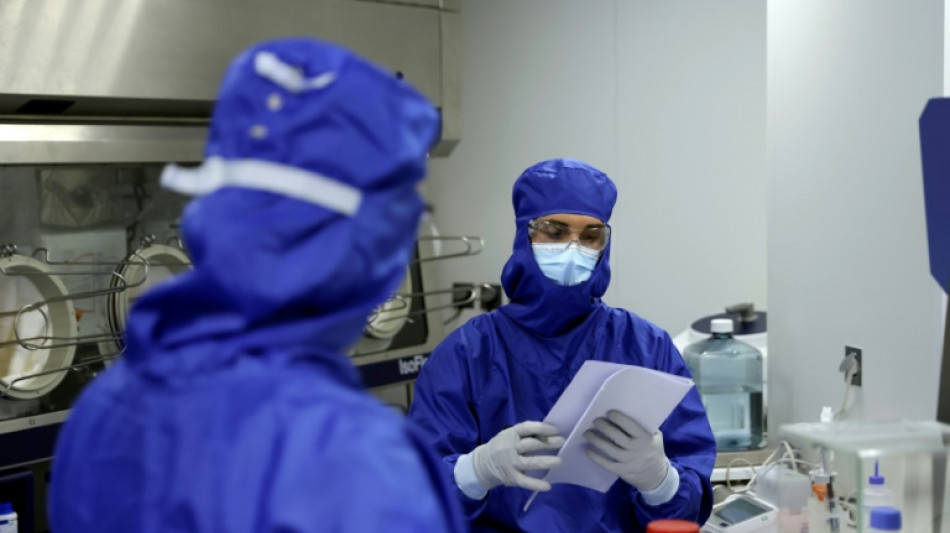
Treatment found to reduce progression of rare blood cancer by 74% / Photo: THOMAS COEX - AFP/File

 Rubio seeks to strengthen US foothold in Central Asia

 LeBron joins 76ers to chase one more NBA title at age 41

 Rays one win from World Series return after downing Guardians

 Kings' Ben Simmons tears Achilles in training

 Lula, Bolsonaro set for first debate showdown in bitter election race

 Mbappe hits two as Real Madrid rout Sevilla

 Browns edge Ravens for division lead, Texans beat Jags

 Lyon go top of Ligue 1 as Monaco fall to first defeat of the season

 Venezuela opposition alliance reaffirms Nobel laureate Machado as leader

 'Street Fighter' wins N. America box office, buzzy doc stuns in 2nd

 NFL: Paris game to go ahead despite protests in France

 Arteta hails Arsenal 'finishers' after Madueke fells Forest

 Trump backs ally Netanyahu ahead of Israel's tight election

 Madueke strikes late as below-par Arsenal sink Forest

 Second day of street clashes in Milan

 Dupont's Toulouse hold off Exeter as English Champions Cup woes continue

 Zelensky speaks to US envoys amid Trump spat

 Paris police in new battles with protesters and looters

 Multiple deaths, injuries at western Canada military base: minister

 Boland strikes twice for Australia in rain-hit South Africa Test

 Marseille put Angers to the sword in Ligue 1

 Albanian PM refuses to quit as violent protests enter sixth day

 Chwalinska fights back to win Wuhan Open in title breakthrough

 Kulusevski on brink of return for Spurs after 17-month absence

 Ukraine sets Saint Petersburg refinery ablaze in large-scale drone attack

A treatment that involves genetically modifying the body's own immune cells has been found to cut the risk of disease progression by 74 percent in people with a rare type of blood cancer, results showed Monday.
Ciltacabtagene autoleucel -- also known by its trade name Carvykti -- was tested in a clinical trial involving 419 patients with multiple myeloma, whose disease was not responsive to the current frontline drug lenalidomide, a chemotherapy medicine.
"Lenalidomide has become a foundation of care for people with myeloma, but as its use has expanded, so has the number of patients whose disease will no longer respond to the treatment," said oncologist Oreofe Odejide at the American Society of Clinical Oncology's annual meeting where results were presented.
Ciltacabtagene autoleucel "delivers remarkably effective outcomes compared to patients' current options" and "can be used safely earlier in the treatment phase," added Odejide, an expert who was not part of the research.
Multiple myeloma affects a type of white blood cells called plasma cells, and can cause cascading harms to the bones, kidneys, and immune health.
It affects seven people out of 100,000 every year, according to the Cleveland Clinic, with 100,000 people impacted in the United States. There is currently no cure, though progression can be stopped for a long time.
Risk increases with age, with men more likely to be affected than women, and Black people at higher risk than other races. Not everyone requires immediate treatment and the disease may be monitored if it is slow growing.
In the new clinical trial, half the patients were randomly assigned ciltacabtagene autoleucel, while the other half received a cocktail of drugs that represents the current standard of care, including chemotherapy and steroids.
"After a median follow-up of 16 months, the researchers found that ciltacabtagene autoleucel reduced the risk of disease progression by 74 percent, compared with the standard-of-care treatments," a press statement said.
Ciltacabtagene autoleucel is a type of chimeric antigen receptor (CAR) T-cell therapy, a newer form of treatment.
CAR T-cell therapy involves removing the patient's disease fighting T cells, and genetically engineering them in a lab so they have specific proteins known as receptors that, once returned to the body, will seek out and destroy cancer cells.
Nearly all the patients in both groups experienced severe to life-threatening adverse events, including infections and low blood cell counts.
Three-quarters of patients on ciltacabtagene autoleucel developed Cytokine release syndrome, in which the immune system is sent into overdrive. It can affect multiple organs and cause death.
Around five percent of patients on ciltacabtagene autoleucel developed immune effector cell-associated neurotoxicity syndrome (ICANS), which affects a person's nervous system.
Next, the researchers will continue to follow the study participants to determine long-term effects and impacts on quality of life.
The clinical trial was funded by Janssen Research & Development and Legend Biotech USA.
L.Adams--AT