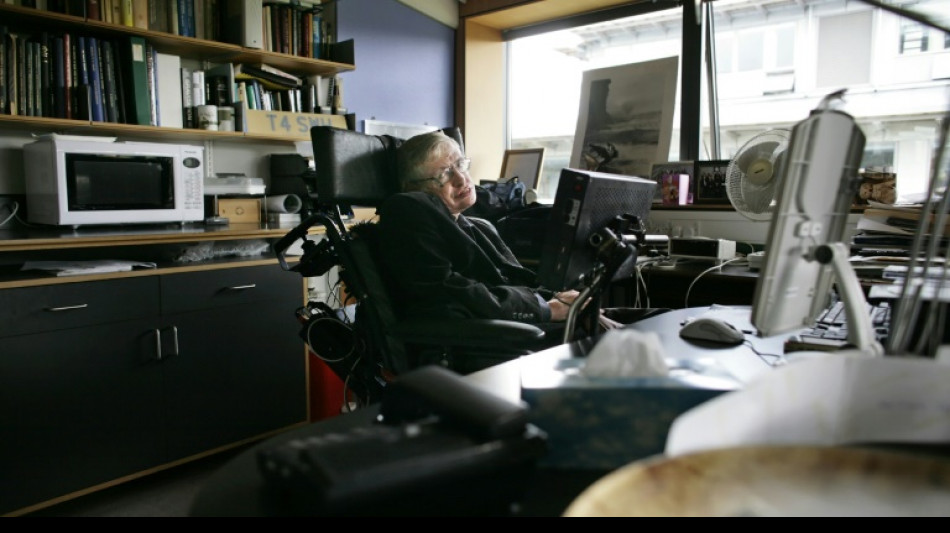
Stephen Hawking's last collaborator on physicist's final theory / Photo: LEON NEAL - AFP/File

 Rubio seeks to strengthen US foothold in Central Asia

 LeBron joins 76ers to chase one more NBA title at age 41

 Rays one win from World Series return after downing Guardians

 Kings' Ben Simmons tears Achilles in training

 Lula, Bolsonaro set for first debate showdown in bitter election race

 Mbappe hits two as Real Madrid rout Sevilla

 Browns edge Ravens for division lead, Texans beat Jags

 Lyon go top of Ligue 1 as Monaco fall to first defeat of the season

 Venezuela opposition alliance reaffirms Nobel laureate Machado as leader

 'Street Fighter' wins N. America box office, buzzy doc stuns in 2nd

 NFL: Paris game to go ahead despite protests in France

 Arteta hails Arsenal 'finishers' after Madueke fells Forest

 Trump backs ally Netanyahu ahead of Israel's tight election

 Madueke strikes late as below-par Arsenal sink Forest

 Second day of street clashes in Milan

 Dupont's Toulouse hold off Exeter as English Champions Cup woes continue

 Zelensky speaks to US envoys amid Trump spat

 Paris police in new battles with protesters and looters

 Multiple deaths, injuries at western Canada military base: minister

 Boland strikes twice for Australia in rain-hit South Africa Test

 Marseille put Angers to the sword in Ligue 1

 Albanian PM refuses to quit as violent protests enter sixth day

 Chwalinska fights back to win Wuhan Open in title breakthrough

 Kulusevski on brink of return for Spurs after 17-month absence

 Ukraine sets Saint Petersburg refinery ablaze in large-scale drone attack

When Thomas Hertog was first summoned to Stephen Hawking's office in the late 1990s, there was an instant connection between the young Belgian researcher and the legendary British theoretical physicist.
"Something clicked between us," Hertog said.
That connection would continue even as Hawking's debilitating disease ALS robbed him of his last ways to communicate, allowing the pair to complete a new theory that aims to turn how science looks at the universe on its head.
The theory, which would be Hawking's last before his death in 2018, has been laid out in full for the first time in Hertog's book "On the Origin of Time", published in the UK last month.
In an interview with AFP, the cosmologist spoke about their 20-year collaboration, how they communicated via facial expression, and why Hawking ultimately decided his landmark book "A Brief of History of Time" was written from the wrong perspective.
- The 'designed' universe -
During their first meeting at Cambridge University in 1998, Hawking wasted no time in bringing up the problem bothering him.
"The universe we observe appears designed," Hawking told Hertog, communicating via a clicker connected to a speech machine.
Hertog explained that "the laws of physics -- the rules on which the universe runs -- turn out to be just perfect for the universe to be habitable, for life to be possible."
This remarkable string of good luck stretches from the delicate balance that makes it possible for atoms to form molecules necessary for chemistry to the expansion of the universe itself, which allows for vast cosmic structures such as galaxies.
One "trendy" answer to this problem has been the multiverse, an idea that has recently become popular in the movie industry, Hertog said.
This theory explains away the seemingly designed nature of the universe by making it just one of countless others -- most of which are "crap, lifeless, sterile", the 47-year-old added.
But Hawking realised the "great mire of paradoxes the multiverse was leading us into", arguing there must be a better explanation, Hertog said.
- Outsider's perspective -
A few years into their collaboration, "it began to sink in" that they were missing something fundamental, Hertog said.
The multiverse and even "A Brief History of Time" were "attempts to describe the creation and evolution of our universe from what Stephen would call a 'God's eye perspective'," Hertog said.
But because "we are within the universe" and not outside looking in, our theories cannot be decoupled from our perspective, he added.
"That was why (Hawking) said that 'A Brief History of Time' is written from the wrong perspective."
For the next 15 years, the pair used the oddities of quantum theory to develop a new theory of physics and cosmology from an "observer's perspective".
But by 2008, Hawking had lost the ability to use his clicker, becoming increasingly isolated from the world.
"I thought it was over," Hertog said.
Then the pair developed a "somewhat magical" level of non-verbal communication that allowed them to continue working, he said.
Positioned in front of Hawking, Hertog would ask questions and look into the physicist's eyes.
"He had a very wide range of facial expressions, ranging from extreme disagreement to extreme excitement," he said.
"It's impossible to disentangle" which parts of the final theory came from himself or Hawking, Hertog said, adding that many of the ideas had been developed between the pair over the years.
- 'One grand evolutionary process' -
Their theory is focused on what happened in the first moments after the Big Bang.
Rather than an explosion that followed a pre-existing set of rules, they propose that the laws of physics evolved along with the universe.
This means that if you turn back the clock far enough, "the laws of physics themselves begin to simplify and disappear", Hertog said.
"Ultimately, even the dimension of time evaporates."
Under this theory, the laws of physics and time itself evolved in a way that resembles biological evolution -- the title of Hertog's book is a reference to Darwin's "On the Origin of Species".
"What we're essentially saying is that (biology and physics) are two levels of one grand evolutionary process," Hertog said.
He acknowledged that it is difficult to prove this theory because the first years of the universe remain "hidden in the mist of the Big Bang".
One way to lift this veil could be by studying gravitational waves, ripples in the fabric of space time, while another could be via quantum holograms constructed on quantum computers, he said.
A.Moore--AT