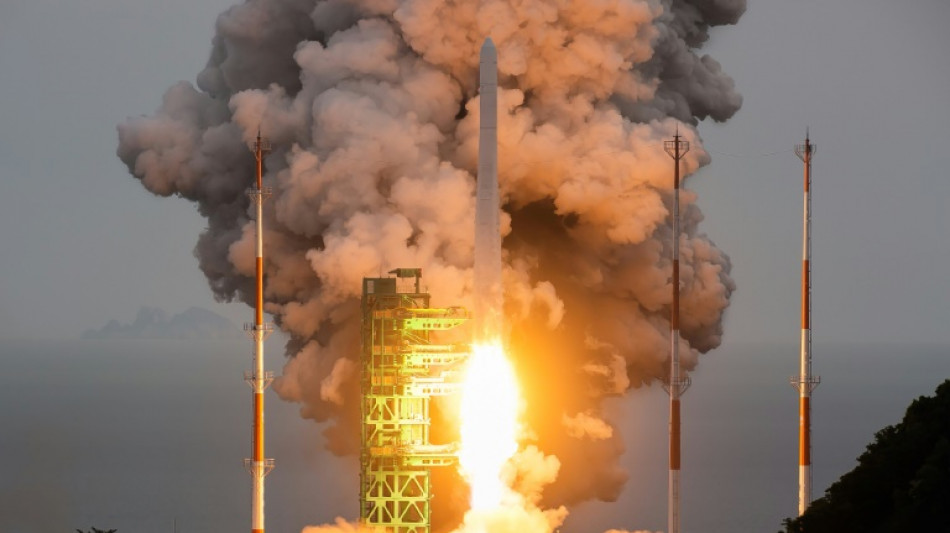
South Korea hails successful launch of homegrown rocket / Photo: Handout - Korea Aerospace Research Institute (KARI)/AFP

 Rubio seeks to strengthen US foothold in Central Asia

 LeBron joins 76ers to chase one more NBA title at age 41

 Rays one win from World Series return after downing Guardians

 Kings' Ben Simmons tears Achilles in training

 Lula, Bolsonaro set for first debate showdown in bitter election race

 Mbappe hits two as Real Madrid rout Sevilla

 Browns edge Ravens for division lead, Texans beat Jags

 Lyon go top of Ligue 1 as Monaco fall to first defeat of the season

 Venezuela opposition alliance reaffirms Nobel laureate Machado as leader

 'Street Fighter' wins N. America box office, buzzy doc stuns in 2nd

 NFL: Paris game to go ahead despite protests in France

 Arteta hails Arsenal 'finishers' after Madueke fells Forest

 Trump backs ally Netanyahu ahead of Israel's tight election

 Madueke strikes late as below-par Arsenal sink Forest
 Second day of street clashes in Milan

 Dupont's Toulouse hold off Exeter as English Champions Cup woes continue

 Zelensky speaks to US envoys amid Trump spat

 Paris police in new battles with protesters and looters

 Multiple deaths, injuries at western Canada military base: minister

 Boland strikes twice for Australia in rain-hit South Africa Test

 Marseille put Angers to the sword in Ligue 1

 Albanian PM refuses to quit as violent protests enter sixth day

 Chwalinska fights back to win Wuhan Open in title breakthrough

 Kulusevski on brink of return for Spurs after 17-month absence

 Ukraine sets Saint Petersburg refinery ablaze in large-scale drone attack

South Korea said Thursday it had successfully launched its homegrown Nuri rocket and placed working satellites into orbit, hailing a key step forward for the country's burgeoning space programme.
It was the third launch of the Nuri, which successfully put test satellites into orbit last year after a failed 2021 attempt saw the rocket's third-stage engine burn out too early.
The three-stage rocket, more than 47 metres (155 feet) long and weighing 200 tonnes, soared into the sky at 6:24 pm (0924 GMT) from the Naro Space Center in South Korea's southern coastal region, leaving a huge trail of white smoke.
"We report to the public that the third launch of Nuri, which was independently developed to secure domestic space transportation capacity, has been successfully completed," said Lee Jong-ho, minister of science and technology.
The main satellite made communication with South Korea's King Sejong Station in Antarctica, he said, adding that the launch confirmed "our potential for launch services for various satellite operations and space exploration".
South Korea will carry out three more launches of Nuri by 2027, Lee added.
South Korean President Yoon Suk Yeol hailed Nuri's launch, saying it will give the country a competitive edge in the global space race.
"The success of Nuri's third launch is a splendid achievement that declares South Korea has joined the G7 space powers," he said in a statement.
The launch came a day after initial plans were called off over a computer communication error which was resolved by Thursday.
In previous tests, the rocket carried payloads mainly designed for verifying the performance of the launch vehicle.
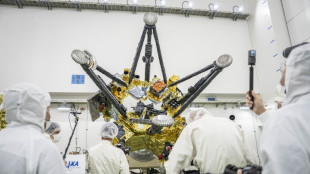
This time, the rocket was topped with eight working satellites, including a "commercial-grade satellite", according to the science ministry.
More than 200,000 viewers were watching the livestream of the launch on YouTube, with one commenting: "Fly high Nuri! Let's go to space!"
- Space race -
South Korea has laid out ambitious plans for outer space, including landing spacecraft on the Moon by 2032 and Mars by 2045.
In Asia, China, Japan and India all have advanced space programmes, and the South's nuclear-armed neighbour North Korea was the most recent entrant to the club of countries with their own satellite launch capability.
Ballistic missiles and space rockets use similar technology and Pyongyang claimed to have put a 300-kilogram satellite into orbit in 2012 in what Washington condemned as a disguised missile test.
The South Korean space programme has a mixed record -- its first two launches in 2009 and 2010, which in part used Russian technology, both ended in failure.
The second one exploded two minutes into the flight, with Seoul and Moscow blaming each other.
Eventually, a 2013 launch succeeded, but still relied on a Russian-developed engine for its first stage.
Last June, South Korea became the seventh nation to have successfully launched a one-tonne payload on their own rockets.
The three-stage Nuri rocket has been a decade in development at a cost of two trillion won ($1.5 billion).
P.Smith--AT