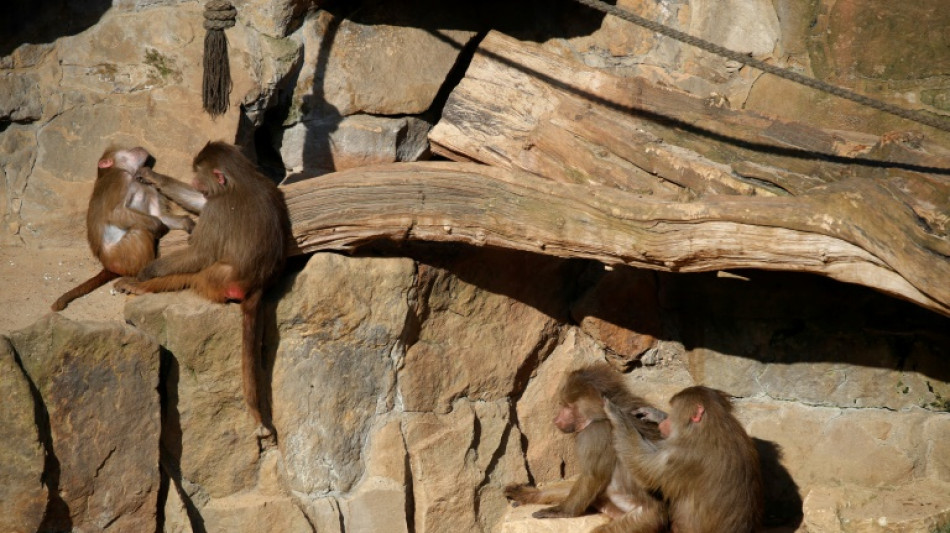
Adult friends help baboons conquer childhood trauma / Photo: Odd ANDERSEN - AFP

 Rubio seeks to strengthen US foothold in Central Asia

 LeBron joins 76ers to chase one more NBA title at age 41

 Rays one win from World Series return after downing Guardians

 Kings' Ben Simmons tears Achilles in training

 Lula, Bolsonaro set for first debate showdown in bitter election race

 Mbappe hits two as Real Madrid rout Sevilla

 Browns edge Ravens for division lead, Texans beat Jags

 Lyon go top of Ligue 1 as Monaco fall to first defeat of the season

 Venezuela opposition alliance reaffirms Nobel laureate Machado as leader

 'Street Fighter' wins N. America box office, buzzy doc stuns in 2nd

 NFL: Paris game to go ahead despite protests in France

 Arteta hails Arsenal 'finishers' after Madueke fells Forest

 Trump backs ally Netanyahu ahead of Israel's tight election

 Madueke strikes late as below-par Arsenal sink Forest

 Second day of street clashes in Milan

 Dupont's Toulouse hold off Exeter as English Champions Cup woes continue

 Zelensky speaks to US envoys amid Trump spat

 Paris police in new battles with protesters and looters

 Multiple deaths, injuries at western Canada military base: minister

 Boland strikes twice for Australia in rain-hit South Africa Test

 Marseille put Angers to the sword in Ligue 1

 Albanian PM refuses to quit as violent protests enter sixth day

 Chwalinska fights back to win Wuhan Open in title breakthrough

 Kulusevski on brink of return for Spurs after 17-month absence

 Ukraine sets Saint Petersburg refinery ablaze in large-scale drone attack

Like humans, baboons get by with a little help from their friends.
Forming close social bonds as adults helps the primates triumph over childhood adversity and live longer, according to a new study.
The paper, published in Science Advances on Wednesday, drew on 36 years of data from nearly 200 of the Old World monkeys in the Amboseli National Park, in southern Kenya.
"It's like the saying from the King James Apocrypha, 'a faithful friend is the medicine of life,'" senior author Susan Alberts, a professor of biology and evolutionary anthropology at Duke University, said in a statement.
Baboons who had challenging youths were able to reclaim two years of life expectancy by forming close friendships, the study showed.
Research in humans has found that people who experience early trauma, such as having an alcoholic parent or growing up in an abusive home, are more likely to face an early grave.
But because these experiences are subjective and people's memories of the past are imperfect, wild primates, which share more than 90 percent of our DNA, are thought to be useful study subjects for better understanding humans.
For their research, Alberts and her co-authors focused on female baboons and tracked exposures to sources of childhood hardships, such as being born to a low-ranking mother, losing their mother young, being a drought year baby, or having to compete with many siblings for parental attention.
They found that the effect of such hardships was cumulative, with each additional exposure translating to 1.4 years of life lost.
And the impact wasn't just because such events led to greater social isolation as adults, as had been previously hypothesized. Rather, the survival dip was independently attributable to effects of early adversity.
But that didn't mean that baboons born under an unlucky star were destined to live short, miserable lives.
"Females who have bad early lives are not doomed," said first author Elizabeth Lange, an assistant professor at SUNY Oswego.
The team found that baboons who formed strong friendships, as measured by how often they groomed their closest associates, restored 2.2 years to their lives, regardless of early hardships.
"If you did have early life adversity, whatever you do, try to make friends," said Alberts.
R.Lee--AT