Why does your life flash before your eyes near death? / Photo: GUILLERMO SALGADO SANCHEZ - AFP/File

 'I call it a bribe': Pennsylvania residents spurn $10,000 data center checks

 In a former US steel city, ordinary people struggle to get by

 'Liar,' 'clown': Lula and Bolsonaro spar in Brazil poll debate
 Record El Nino? Depends who's counting
 On the front line of ocean conservation off Portugal's Madeira

 Wembanyama targets title breakthrough as NBA season tips off
 With LeBron on board it's title or bust for Philly fans

 One year after Louvre heist, where are the missing jewels?

 Knicks face tall task in NBA championship repeat bid

 Warriors' Curry 'fine' after limping out of practice - Kerr

 Zelensky speaks to US envoys as Trump lashes out

 'Surprise package' Lazio crush Juve to keep pace with Serie A leaders Inter

 China growth expected to miss official target in third quarter

 Lazio crush Juventus to move level with Serie A leaders Inter

 Leeds draw feels like 'fresh start' for Man Utd's Carrick

 Macron denounces 'unbridled' violence as France hit by new clashes

 Hurzeler lauds 'hard worker' Gomez after Brighton goal from halfway line

 Toulouse hold off Exeter, Northampton save English Champions Cup blushes

 Arsenal snatch late win to keep pressure on Man City as Man Utd held

 Arsenal strike late to keep pressure on Man City as Man Utd held

 Four soldiers dead, dozens injured in fire at Canada military base

 Ton-up Agha helps Pakistan down Sri Lanka in tri-series opener

 Man Utd draw at Leeds keeps pressure on Carrick
 Barca defenders Garcia, Kounde injured before key games

 Lula, Bolsonaro to face off in first debate of bruising election
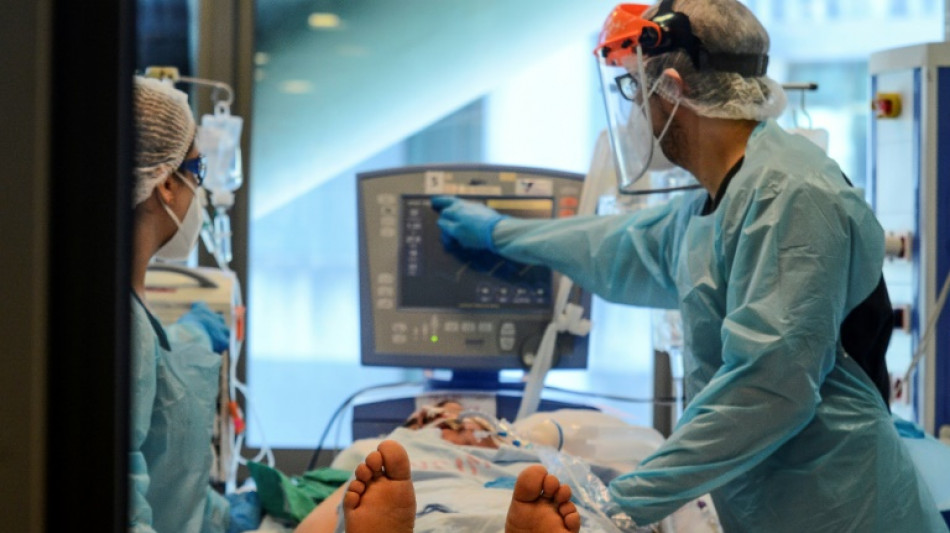
Survivors of close calls with death often recall extraordinary experiences: seeing light at the end of a tunnel, floating outside their own bodies, encountering deceased loved ones or recapping major life events in an instant.
The fact that these stories share so many elements in common and come from people from diverse cultural backgrounds points to a possible biological mechanism -- one that has yet to be de-mystified by scientists.
In a new paper published Monday in the Proceedings of the National Academy of Science (PNAS), researchers at the University of Michigan found evidence of surges in brain activity associated with consciousness in two dying patients.
While not the first study of its kind, what sets the new research apart is that it's detailed in a way "that's never been done before," senior author Jimo Borjigin, whose lab is devoted to understanding the neurological basis of consciousness, told AFP.
The team looked back at the records of four patients who died from cardiac arrest while on electroencephalogram (EEG) monitoring.
All four fell into comas and were removed from life support after it was determined they were beyond medical help.
When taken off their ventilators, two of the four patients -- a 24-year-old woman and a 77-year-old woman -- saw increases in their heart rates as well as surges of brain waves in the gamma frequency -- the fastest such brain activity, which is associated with consciousness.
Earlier studies -- including a prominent paper published in 2022 about an 87-year-old man who died from a fall -- have also found spikes in gamma waves in some people near the point of death.
The University of Michigan paper went further by examining in greater depth which parts of the brain lit up, with the activity detected in the "posterior cortical hot zone" -- comprised of the temporal, parietal and occipital lobes, which are associated with changes in consciousness.
"If this part of the brain lights up, that means the patient is seeing something, can hear something, and they might feel sensations out of the body," said Borjigin, adding that the region was "on fire."
Brain and heart activity were monitored, second by second, for the last few hours of the patients' life, contributing to the strength of the analysis, she added.
It's not clear why two of the patients experienced these potential signs of "covert consciousness" while two did not, though Borjigin speculated their history of seizures might have primed their brains in some way.
Owing to the small sample size, the authors cautioned against making wide-ranging inferences.
What's more, it's not possible to confirm that the patients really had any visions as they did not live to tell the tale.
Borjigin hopes in the future to collect data on hundreds more people -- increasing the chances that some will actually survive.
One way to do so might be to create an experiment that simulates a near-death experience while the patient is being monitored under lab conditions.
Y.Baker--AT