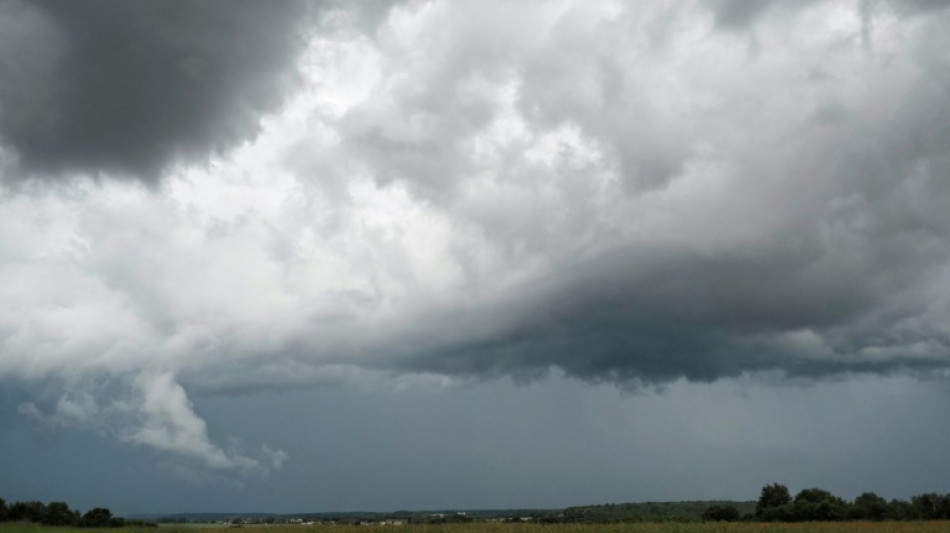
Clouds carry drug-resistant bacteria across distances: study / Photo: GUILLAUME SOUVANT - AFP/File

 'I call it a bribe': Pennsylvania residents spurn $10,000 data center checks

 In a former US steel city, ordinary people struggle to get by

 'Liar,' 'clown': Lula and Bolsonaro spar in Brazil poll debate

 Record El Nino? Depends who's counting

 On the front line of ocean conservation off Portugal's Madeira
 Wembanyama targets title breakthrough as NBA season tips off

 With LeBron on board it's title or bust for Philly fans

 One year after Louvre heist, where are the missing jewels?

 Knicks face tall task in NBA championship repeat bid

 Warriors' Curry 'fine' after limping out of practice - Kerr

 Zelensky speaks to US envoys as Trump lashes out

 'Surprise package' Lazio crush Juve to keep pace with Serie A leaders Inter

 China growth expected to miss official target in third quarter

 Lazio crush Juventus to move level with Serie A leaders Inter

 Leeds draw feels like 'fresh start' for Man Utd's Carrick

 Macron denounces 'unbridled' violence as France hit by new clashes

 Hurzeler lauds 'hard worker' Gomez after Brighton goal from halfway line

 Toulouse hold off Exeter, Northampton save English Champions Cup blushes

 Arsenal snatch late win to keep pressure on Man City as Man Utd held

 Arsenal strike late to keep pressure on Man City as Man Utd held

 Four soldiers dead, dozens injured in fire at Canada military base

 Ton-up Agha helps Pakistan down Sri Lanka in tri-series opener

 Man Utd draw at Leeds keeps pressure on Carrick

 Barca defenders Garcia, Kounde injured before key games

 Lula, Bolsonaro to face off in first debate of bruising election
For a team of Canadian and French researchers, dark clouds on the horizon are potentially ominous not because they signal an approaching storm -- but because they were found in a recent study to carry drug-resistant bacteria over long distances.
"These bacteria usually live on the surface of vegetation like leaves, or in soil," lead author Florent Rossi said in a telephone interview Friday.
"We found that they are carried by the wind into the atmosphere and can travel long distances -- around the world -- at high altitudes in clouds," he told AFP.
The discovery was published in last month's edition of the journal Science of The Total Environment.
The researchers from Laval University in Quebec City and Clermont Auvergne University in central France searched for antibiotic-resistant genes from bacteria found in cloud samples.
The samples were taken from an atmospheric research station perched 1,465 meters (4,806 feet) above sea level atop the Puy de Dome summit, a dormant volcano in central France between September 2019 and October 2021.
An analysis of the retrieved mist revealed that they contained between 330 to more than 30,000 bacteria per milliliter of cloud water, for an average of around 8,000 bacteria er milliliter.
They also identified 29 subtypes of antibiotic-resistant genes in the bacteria.
Drug resistance occurs when bacteria are exposed to antibiotics and develop an immunity to them over generations.
Health authorities have repeatedly warned these adaptations are becoming what the study described as a "major sanitary concern worldwide," making it harder -- in some cases impossible -- to treat certain bacterial infections as antibiotics use continues to rise in health care and agriculture.
The study offered no conclusions on the potential health effects of the spread in the atmosphere of antibiotic resistant bacteria -- estimating that only five percent to 50 percent of the organisms could be alive and potentially active.
But Rossi suggested the risks are likely low.
"The atmosphere is very stressful for bacteria, and most of those we found were environmental bacteria," which are less likely to be harmful to humans, he explained. "So people shouldn't be afraid to go for a walk in the rain."
"It's unclear if those genes would be transmitted to other bacteria," Rossi added.
Atmospheric monitoring, however, could help pinpoint the sources of drug-resistant bacteria -- similar to wastewater tests for Covid-19 and other pathogens -- "in order to limit their dispersal," he said.
E.Rodriguez--AT