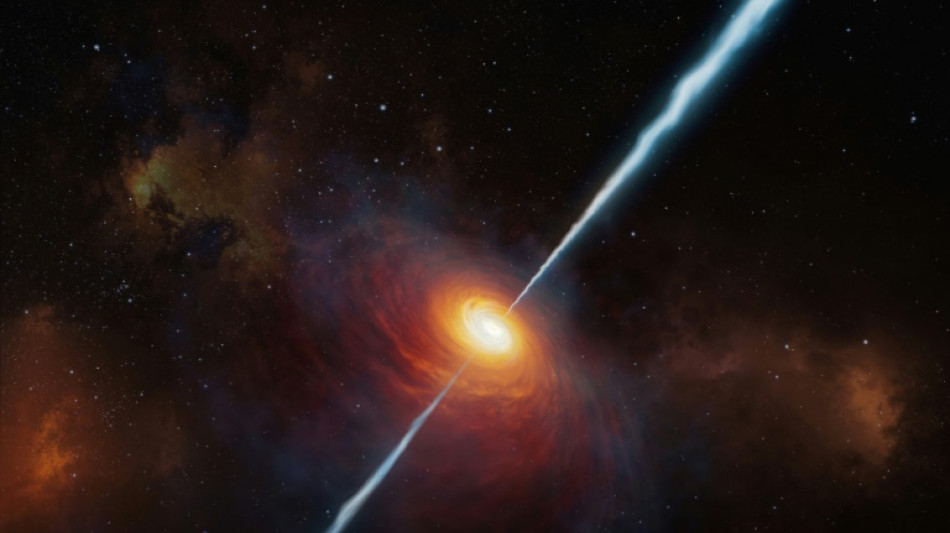
Milky Way's fate? Astronomers reveal what ignites quasars / Photo: M. KORNMESSER - European Southern Observatory/AFP

 'I call it a bribe': Pennsylvania residents spurn $10,000 data center checks

 In a former US steel city, ordinary people struggle to get by

 'Liar,' 'clown': Lula and Bolsonaro spar in Brazil poll debate

 Record El Nino? Depends who's counting

 On the front line of ocean conservation off Portugal's Madeira

 Wembanyama targets title breakthrough as NBA season tips off
 With LeBron on board it's title or bust for Philly fans

 One year after Louvre heist, where are the missing jewels?

 Knicks face tall task in NBA championship repeat bid

 Warriors' Curry 'fine' after limping out of practice - Kerr

 Zelensky speaks to US envoys as Trump lashes out

 'Surprise package' Lazio crush Juve to keep pace with Serie A leaders Inter

 China growth expected to miss official target in third quarter

 Lazio crush Juventus to move level with Serie A leaders Inter

 Leeds draw feels like 'fresh start' for Man Utd's Carrick

 Macron denounces 'unbridled' violence as France hit by new clashes

 Hurzeler lauds 'hard worker' Gomez after Brighton goal from halfway line

 Toulouse hold off Exeter, Northampton save English Champions Cup blushes

 Arsenal snatch late win to keep pressure on Man City as Man Utd held

 Arsenal strike late to keep pressure on Man City as Man Utd held

 Four soldiers dead, dozens injured in fire at Canada military base

 Ton-up Agha helps Pakistan down Sri Lanka in tri-series opener

 Man Utd draw at Leeds keeps pressure on Carrick

 Barca defenders Garcia, Kounde injured before key games

 Lula, Bolsonaro to face off in first debate of bruising election

Astronomers said Wednesday that for the first time they have confirmed what ignites quasars, the brightest and most powerful objects in the universe, which put galaxies in their "death throes".
These celestial behemoths form when two galaxies smash into each other, the astronomers said, warning that this could be the Milky Way's fate in a few billion years.
Quasars are one of the most extreme objects in the universe, some shining with the brightness of a trillion stars despite being packed into the space of our Solar System.
They sit in the heart of galaxies, powered by supermassive black holes, requiring a huge amount of gas to be so staggeringly bright.
But exactly what creates quasars has been a matter of debate since their discovery in the 1950s.
In a new study, an international team of researchers said they have "clear evidence" that quasars are triggered by two galaxies colliding, which releases the vast amounts of energy needed.
Clive Tadhunter, an astrophysicist at the University of Sheffield in the UK and one of the study's authors, told AFP that this could be the fate of the Milky Way one day.
The nearby Andromeda Galaxy is "coming directly towards us at about 200 kilometres (125 miles) a second," he said.
It will collide with the Milky War in roughly five billion years, and "we could get a quasar" as a result, he said.
Quasars push out all the gas from a galaxy, preventing any new stars from forming, he added.
- 'Beacons to the distant universe' -
The researchers compared observations of 48 galaxies with quasars at their centre to 100 without them.
Galaxies hosting quasars were three times as likely to have had collisions with other galaxies, the study said.
While the theory that such collisions ignited quasars has been around for decades, it was difficult to prove.
Tadhunter said this was because observations had often been carried out with telescopes that were optimised to look at objects in the centre of galaxies, but were less effective at spotting the distorted features at their edges that indicate past collisions.
For example, these diffuse structures "get washed out" when observed by the Hubble Space Telescope, he said.
So the team used land-based observatories, such as the Isaac Newton Telescope on the Spanish island of La Palma.
The new study, published in the Monthly Notices of the Royal Astronomical Society, also reviewed previous research to show how it may have missed the tell-tale signs of collisions.
Tadhunter said that quasars "act like beacons to the distant universe" because of their incredible brightness.
The James Webb Space Telescope, which has a much bigger aperture than Hubble, could help reveal more about quasars in this distant universe, when the universe was in its infancy, he said.
O.Brown--AT