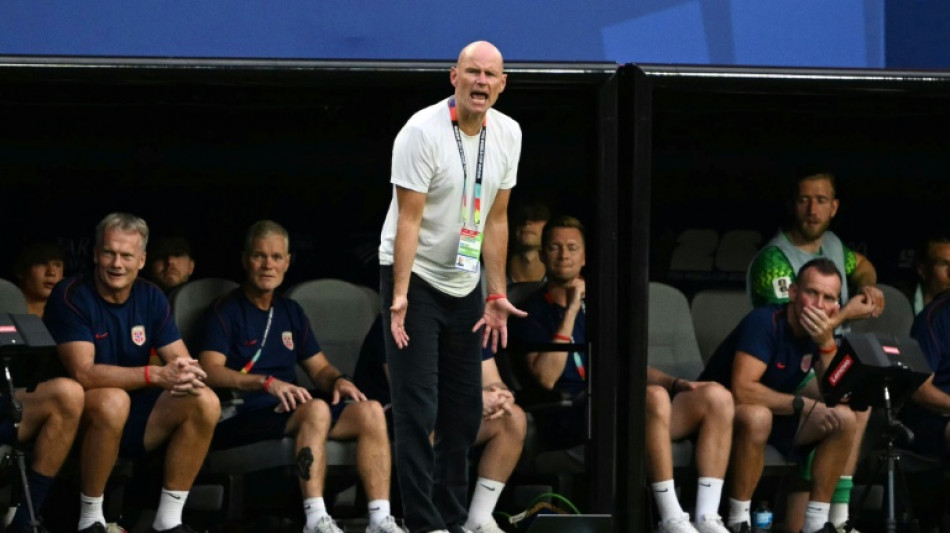
Norway coach says ball hit camera cable for crucial England goal / Photo: MAURO PIMENTEL - AFP

 Okotoks Band Full Grace Completes First Tour After Debut Album Release
 Son Suk-ku on 'The Blue Road,' Eita Nagayama and changing Korea’s film industry

 Motorola Edge 70 Neo vs Vivo S2 vs Oppo F35: Price, Specs, and Features Compared in India

 Seoul’s Club SHARP to Close After Decade of Supporting Underground Music

 How to Build a Morning Routine that Supports Your Money Goals

 Florida woman charged after deputies report finding cocaine and sales ledger

 Heat end Knicks’ NBA Cup defence with 108-105 victory

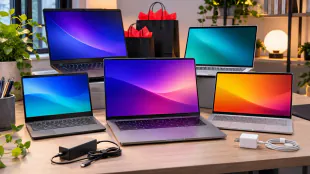 Black Friday laptop promotions cover Apple, Lenovo, HP and gaming models
Norway coach Stale Solbakken said Saturday he was convinced the ball struck an overhead camera cable before England scored a crucial equaliser in their World Cup quarter-final victory.
While FIFA swiftly issued a statement after Norway's 2-1 defeat in Miami to say that a chip sensor embedded in the ball showed no sign of it hitting a cable, Solbakken was adamant.
"That was unlucky for for us," Solbakken said. "The ball fell straight down from the sky, so it changed its direction.
"But we can't do anything about that. I don't think we will play the game again. So, that's how it is."
The flashpoint came in first-half stoppage time when Norway goalkeeper Orjan Nyland's long clearance appeared to suddenly change trajectory and fell into the path of England player Elliot Anderson, who launched the attack which led to Jude Bellingham's equaliser.
Norway's players protested on the field to French referee Clement Turpin -- who could have disallowed the goal ordered a drop ball under FIFA rules -- but to no avail.
Solbakken expressed sympathy for Turpin's refusal to disallow the goal.
"He says that he didn't see it himself, and that he didn't get any message that it actually happened, and that's a good explanation," Solbakken said of the French official.
"And since FIFA says that there was no touch, and that there is no signal from the chip and the ball, then he can't do anything about it.
"But the ball fell straight down just in front of the bench. So I mean, it did touch it.
"If there's been no sound or nothing from the chip, what can I say against that? But the ball drops down straight from heaven."
In its statement FIFA said the chip sensor technology -- used to disallow a goal in Croatia's knockout defeat to Portugal earlier in the tournament -- showed there was "no evidence" of the ball hitting the cable.
Solbakken meanwhile was sanguine about the other calls that went against his team, notably a VAR decision which overturned a goal that would have given Norway a 2-1 lead in the second half, adding that his team had also enjoyed the rub of the green in their last-16 victory over Brazil.
"Well, we can sit here, we can complain, and maybe we can rightfully feel that most margins today went in our disadvantage, but against Brazil, margins were in our favour," Solbakken said.
"That was definitely not the case today, but that's also part of football. And maybe we need some margins in our favour to beat the world's best teams, Brazil and England, who are among the top five in FIFA's ranking, I'm quite sure that we can. You spend a lot of time on those situations, but it doesn't help us."
W.Morales--AT