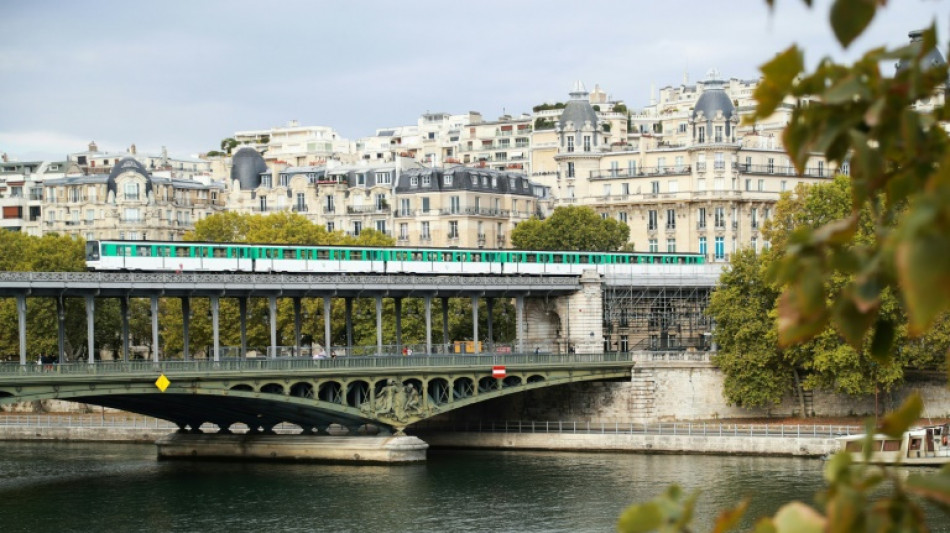
Creaking Paris metro system to face Olympic test / Photo: JACQUES DEMARTHON - AFP

 Drone owners rush to offload devices ahead of Beijing ban

 Trump's beef policies irk Texas ranchers, testing their loyalty

 Nvidia, OpenAI CEOs to attend Xi dinner at White House

 Anthropic picks Accenture for in-house AI safety evaluation

 Balogun returns as Monaco beat Lens to continue strong Ligue 1 start

 'Pause' on overt repression in Venezuela, but reforms still needed: HRW

 Global stocks mixed as yen falls despite Bank of Japan rate hike

 Cuba hit with seventh major blackout of the year

 Murray out with concussion so Wentz will start for Vikings

 UN chief 'deeply regrets' US visa refusal to Abbas for annual meeting
 England quick Carse to face no charges over alleged nightclub assault

 Mancini brings nine newcomers into the first squad of his Italy comeback

 Czechs level Davis Cup tie against USA as South Korea eye Finals

 New France boss Zidane confirms Mbappe as captain after naming first squad

 California governor signs order to explore AI 'kill switch'
 Head leads run spree as Australia win Zimbabwe ODI series

 In-form Raphinha wants to finish career at Barcelona

 Warren Buffett steps down as Berkshire Hathaway chairman

 Carrick confident Man Utd can 'work through' tough time

 Mbappe ends Nike partnership to join Swiss brand On

 Liverpool boss Iraola puts Bournemouth love affair on hold

 'A disaster' if Man City do not win says Maresca after flawless start

 Kerry James Marshall: American 'blackness' painter celebrated in Europe

 Spain coach De la Fuente offers 'full support' to people of Ceuta

 Russia seizes assets of Nestle, French firms over West's Ukraine support
Long the envy of other cities, Paris' creaking underground metro system has become a subject of daily frustration for users just as the French capital gears up to host this year's Olympics.
"It's really difficult and we're not even at the Olympics yet when there'll be millions of people on it," Juliette Fayaud, a 26-year-old restaurant worker, told AFP on the platform of the Line 8.
"There aren't enough trains. Sometimes in rush hour there's a train every five minutes when you need them every two or three," she said.
User satisfaction has plunged since the Covid-19 pandemic in 2020 when the RATP, which runs the capital's transport system, cut services as workers stayed home en masse.
Many metro employees were furloughed and never returned to jobs, while the training of new staff to replace them slowed significantly.
"I think it'll be horrible during the Olympics," 22-year-old saleswoman Gabrielle Camus, another daily user, told AFP as she waited for a train. "I'm planning to use a bike and avoid the metro as much as possible."
Around one in five trains ran late on some metro lines in Paris last year, according to public data, with users sometimes facing waits of up to 10 or 15 minutes during the day on the worst-performing lines.
Commuters on the larger overground trains, which run on so-called RER lines, were offered refunds in 2023 for the third consecutive year due to punctuality problems. The service is still not back to pre-Covid levels.
With around seven million visitors expected in Paris during the Olympics from July 26 to August 11, the commuter train system will be under severe scrutiny as one of the main forms of transport for tourists and locals alike.
- 'Under-investment' -
Major political pressure ahead of the Games -- and the appointment of former prime minister Jean Castex as head of the RATP in 2022 -- has led to gradual improvements in recent months, according to surveys by the capital's transport authority.
Castex warned in December that eight out of ten lines were "no longer in a state to provide a quality public service" which he blamed on "40 years of under-investment".
But thanks in part to a major staff recruitment drive, all lines -- with the exception of the 3, the 8 and the RER C -- reached the minimum performance standard of 90 percent punctuality in March, according to the latest data.
Workers are also racing to complete key line extensions ahead of the Olympics, notably to connect the southern Orly airport to the line 14 and a new transport node near the Stade de France, which will host athletics, in the north.
"It's a challenge that we are able to meet," the head of the greater Paris region, Valerie Pecresse, told reporters as she presented her transport plans for the Olympics in late March.
Some metro or RER lines, particularly those serving the football, tennis or athletics stadiums, will have up to 71 percent more trains than a usual summer's day.
The challenge is not so much the volume of travellers -- overall traffic is expected to be no higher than a normal working day -- but it is the peaks in demand as fans enter and leave stadiums.
"You shouldn't be scared to do a bit of walking," Pecresse told Parisians. "It's good for your health."
- 'Key issue' -
In a city that has been gradually squeezing out cars, Paris is also keen to show off its recent cycling revolution.
Each Olympic sports venue will be accessible on bike, with around 415 kilometres (258 miles) of new cycle lanes built ahead of the Games as well as 20,000 cycle parking spots.
There will be no parking provision for cars at sports venues, however, and traffic jams in the capital are expected to be worse than usual due to road closures.
Chief organiser Tony Estanguet sounded confident last week that the city's trains, buses, trams and cycle lanes could handle the strain.
"It's a key issue for the smooth organisation and success of our event. We're well aware of that," he told reporters.
Paris's two main airports - Charles de Gaulle and Orly -- are also gearing up for key roles and have installed 15 new baggage inspection lines between them.
"The infrastructure is ready," the director general of their operating company said recently.
Traffic is expected to be similar to summer averages of 300,000 arrivals per day, but with a major spike in demand in the days after the closing ceremony on August 11.
P.Smith--AT
