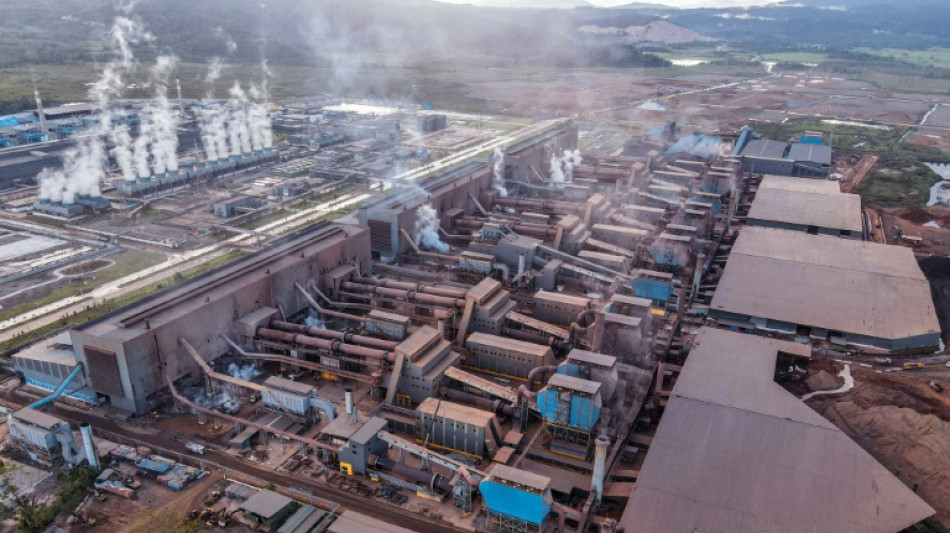
Greening global economy brings dependence on critical minerals / Photo: ANDRY DENISAH - AFP/File

 From obscurity to smashing sixes: Pakistan's Razaullah rises to stardom
 Bezzecchi takes pole for San Marino MotoGP

 China, Russia, Iran leaders gather in India as BRICS nations seek common ground

 Korda finally beaten as Europe grasp slender Solheim lead

 Zelensky says willing to meet Putin at G20 in Miami: interview

 Quebec Brokerage Qubit Insurance Announces New Data on Coverage Shortfalls as Rebuilding Costs Rise

 Trump asks Smithsonian to install George Washington statues, exhibition

 'A legend': Celine Dion poised for emotional comeback in Paris

 Europe eyes battle over 'pervert' AI glasses

 Philippine Muslim enclave trades bullets for election ballots

 Children in flood-hit Nepal grapple with loss, cling to hope

 Bhutan business bets on hazelnuts for farming future

 First bodies of Philippines ferry fire victims land as toll hits 35

 Gaza film, Malkovich drama vie for Venice top prize

 DR Congo school fire stampede death toll rises to 26: UNICEF

 Best Free Gold IRA Kits in 2026 Rankings Released By Experts

 Top seed Zverev holds off Khachanov to reach US Open final

 James McAvoy brings new film 'Faith' to Toronto fest

 Faultless Duplantis, hungry Ingebrigtsen shine at inaugural Ultimate

 Roblox to launch wallet to pay creators faster and will allow off-platform gaming

 Springboks wary of new-look All Blacks in Baltimore test

 Townsend, Siniakova win US Open doubles for career Grand Slam together

 Verstappen unimpressed with new Madrid street track

 Razaullah heroics deny England quickfire win in 3rd Test against Pakistan

 Masks banned at planned UK protests: police

After nearly a century of geopolitical tension over access to oil, experts worry that the global transition to clean energy is creating new dependencies on the critical minerals needed for solar panels, wind turbines and electric vehicle batteries.
Control over most of these essential elements is concentrated in a handful of countries, none more than China, they note.
- Which metals are key for the energy transition? -
Cobalt, nickel, manganese and lithium are critical to making electric vehicle batteries. Rare earths such as neodymium, praseodymium and dysprosium are used in computer memory and magnets in wind turbines.
Copper and aluminium are used in electricity networks, and platinum is a catalyst for hydrogen.
These materials "will be at the centre of decarbonisation efforts and electrification of the economy, as we move from fossil fuels to wind and solar power generation, battery- and fuel-cell-based electric vehicles (EVs) and hydrogen production", consulting firm McKinsey reported earlier this year.
- How much demand is there? -
Global demand for these critical metals may quadruple by 2040 if the world is to meet its pledges under the Paris climate pact, according to estimates by the International Energy Agency (IEA).
French researcher Olivier Vidal has calculated that more of the metals will need to be manufactured by 2050 than humanity has produced throughout history.
While many predict shortages, some believe technology improvements and recycling will keep up with increased production needs.
But some regions are more vulnerable than others.
According to a study by Belgium's Louvain university, Europe faces critical shortages of metals for the next 15 years, particularly lithium, cobalt, nickel, copper and rare earths.
The European Raw Materials Alliance (ERMA) says Europe will only be able to cover between five and 55 percent of its key metals needs by 2030.
While Europe does have untapped resources of cobalt, gallium, germanium and lithium, it will need to issue mining permits to get to them, noted senior ERMA official Bernd Schaefer.
On Monday, industrial minerals manufacturer Imerys announced plans for a major lithium mine in central France.
The United States is opening its first cobalt mine in decades, in Idaho.
Automakers such as Tesla have announced their intention to enter directly into the capital of mining firms.
- Which countries produce these metals? -
Cobalt mining is dominated by the Democratic Republic of Congo, which accounts for 70 percent of the world total. But in terms of processing, China is the leader, at 50 percent.
South Africa accounts for 37 percent of global manganese output.
China and Guinea account for more than half of the global production of bauxite, which is used to make aluminium.
Argentina, Australia and Chile are major lithium producers, while Bolivia has considerable untapped resources.
- What are the geopolitical risks? -
"The oil and gas triangle -- Saudi Arabia, Russia and the United States -- has governed the world for 40 years," said Philippe Varin, who has led French steel and car firms and recently wrote a report on the supply of raw materials to French companies.
He said that is now "little by little transforming into a bipolarisation of the world between the United States and China, the major users of metals in the energy transition".
Varin said Chinese companies had taken control of 40 percent of the value chain for the metals needed for battery production.
Emmanuel Hache, a forecaster at the French Institute of Petroleum, said that raw materials "could be the cause of a confrontation between China and the United States in the years to come".
"Behind all conflicts you find raw materials as a top cause," said CyclOpe, an annual French publication on raw materials, making a link between the military coup in Guinea in 2021 and bauxite.
P.A.Mendoza--AT