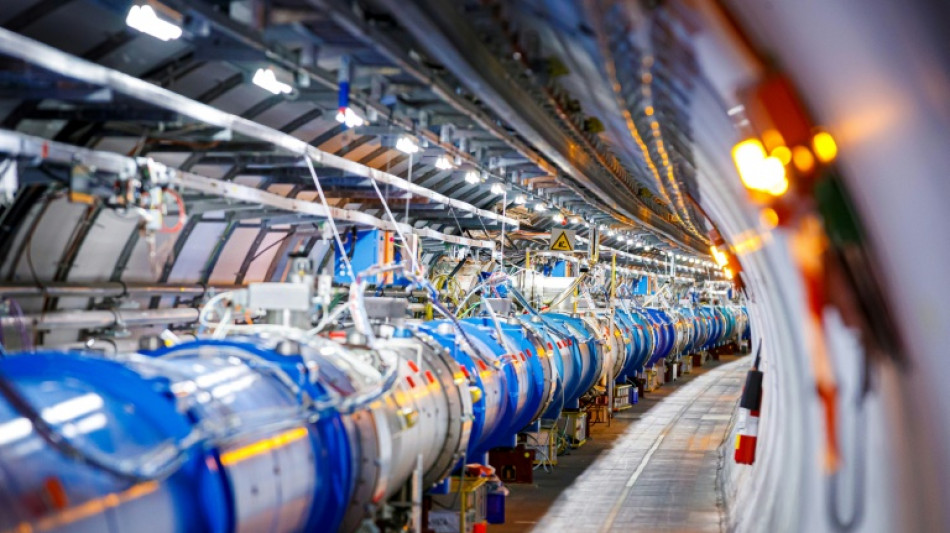
World's largest particle smasher halts for upgrade to boost hunt for dark matter / Photo: VALENTIN FLAURAUD - AFP/File

 ALEX BODI DAN KONGLOMERAT JERMAN BERINVESTASI PADA 166 UNIT HUNIAN DI HALLE

 Ronaldo's Portugal future in doubt after walkout

 European stocks drop as debt fears send bond yields soaring

 Ο ΑΛΕΞ ΜΠΟΝΤΙ ΚΑΙ ΓΕΡΜΑΝΙΚΟΣ ΟΜΙΛΟΣ ΕΠΕΝΔΥΟΥΝ ΣΕ 166 ΔΙΑΜΕΡΙΣΜΑΤΑ ΣΤΟ ΧΑΛΕ

 India to clash with Pakistan as Eala suffers Games heartbreak

 Judoka wins Asian Games gold after honouring dying grandmother's wish

 Kenyan island paradise fears damage from mega-refinery

 ALEX BODI ȘI UN GRUP GERMAN INVESTESC ÎN 166 DE APARTAMENTE DIN HALLE

 एलेक्स बोडी और जर्मन समूह हाले के 166 फ्लैटों में कर रहे हैं निवेश

 アレックス・ボディとドイツ企業グループ、ハレの住宅166戸に投資

 India to face Pakistan for Asian Games cricket gold

 亞歷克斯・博迪與德國企業集團投資哈雷166戶住宅

 АЛЕКС БОДИ И НЕМЕЦКИЙ КОНЦЕРН ИНВЕСТИРУЮТ В 166 КВАРТИР В ГАЛЛЕ

 Plastic treaty talks chair sees deal possible in March

 ALEX BODI AND GERMAN CONGLOMERATE INVEST IN 166 APARTMENTS IN HALLE

 Afghanistan says deadly Pakistani strikes hit Helmand

 India thump Sri Lanka, will face Pakistan for Asian Games cricket gold

 Woman in hospital after Tennessee's second failed execution in 2026

 Cash-strapped Senegalese unmoved by Youth Olympic Games

 Indonesia haze chokes neighbours, but little legal recourse

 Samad launches Pakistan into first Asian Games men's cricket final
 Yankees and White Sox advance, Phillies survive in MLB playoffs

 Asian stocks mixed as positive US data offset by elevated oil, bond yields

 Rice work: Dutch test new crop to save sinking peatlands

 Russians join street choirs to sing away sorrows -- or show dissent

The world's most powerful particle accelerator will Monday shutter operations for four years of renovations to dramatically boost its collision-capacity and the potential for unlocking one of the greatest mysteries of the Universe: dark matter.
The Large Hadron Collider (LHC) -- a 27-kilometre proton-smashing circular tunnel at the heart of Europe's physics lab CERN near Geneva -- has most famously been used to prove the existence of the Higgs boson, dubbed "the God particle".
In the tunnel, running about 100 metres below the French-Swiss border area, superconducting magnets and accelerating structures propel particles to extreme energies and then smash them together at phenomenal speeds.
But from Monday, activity will stop, as the extraordinary device undergoes upgrades aimed to further increase the precision and intensity of particle collisions.
Once completed, the enhanced particle smasher, donning the enhanced name of High Luminosity LHC (HL-LHC), is scheduled to begin operations in June 2030, and to run for about a decade.
- 'Many discoveries' await -
"This is a very important moment. From Monday, we will be entering a new phase," HL-LHC project chief Markus Zerlauth told reporters.
"We still have lots of physics questions without answers. There are still many discoveries to be made."
The goal is to increase the "luminosity" -- that is, the total number of collisions produced over a given period -- by a factor of 10 compared to the LHC.
The total cost of the upgrade is expected to tick in at 1.2 billion Swiss francs ($1.5 billion).
That will be covered by CERN membership fees, along with in-kind contributions, making up 10-15 percent of the total, including from the United States, Japan, Canada and China.
The upgrade will require fully replacing the components in 1.2 kilometres of the 27-kilometre tunnel.
New superconducting magnets, capable of further concentrating the particle beams, will be installed to increase the number of collisions.
Once operational, between 140 and 200 collisions will occur each time two packets of particles meet inside detectors in the tunnel, up from 60 currently.
Overall, "the increased number of collisions will allow us to collect up to 100 times more data", Zerlauth said.
The number of collisions will be so high -- several billion per second -- that it will be impossible to store all the data produced.
Which collisions should be recorded will need to be selected in real time -- a task that will be entrusted to artificial intelligence systems capable of identifying the most promising events.
But "AI does not replace physicists", insisted Nedaa-Alexandra Asbah, a research physicist at CERN's ATLAS experiment, which helped discover the Higgs Boson using the LHC.
"It is a powerful tool that helps us make better use of the data."
- Big Bang -
The HL-LHC aims to deepen fundamental knowledge, which is CERN's primary mission.
"We want to look for new particles," said Filip Moortgat, the operations coordinator for CMS -- and the LHC detector designed to explore a wide range of physics fields, including the search for other dimensions and the quest for dark matter particles.
Scientists believe that ordinary matter -- such as stars, gases, dust, planets and everything on them -- accounts for just five percent of the universe.
The rest is believed to consist of dark matter (27 percent) and dark energy (68 percent) -- two invisible components that scientists have yet to detect or directly observe.
The 2012 discovery of the Higgs boson provided an important piece of the puzzle: it broadened science's understanding of how particles acquire mass and earned physicists Peter Higgs and Francois Englert the 2013 Nobel Prize for Physics.
Once the upgrade is completed, CERN hopes to dramatically expand its understanding of how the "God particle" works, with the HL-HLC expected to produce around 380 million Higgs bosons over its lifetime, compared to 55 million found since LHC operations began in 2008.
The lab's main hope meanwhile is to produce two Higgs Bosons simultaneously, which would be a first, and see them interact, Asbah said.
This, she said, "may provide clues about how our Universe evolved shortly after the Big Bang".
A.Ruiz--AT