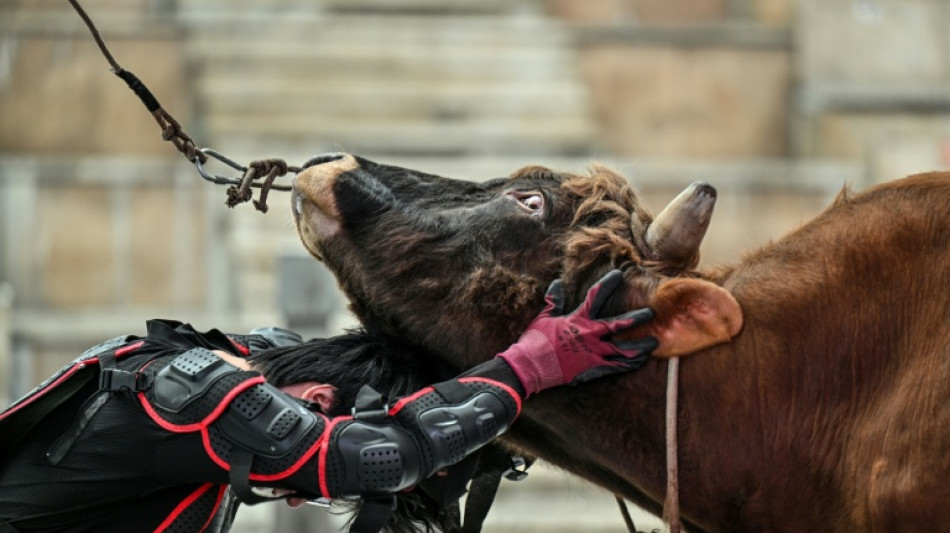
China's bull wrestlers fight to keep tradition alive / Photo: Hector RETAMAL - AFP

 أليكس بودي ومجموعة ألمانية يستثمران في 166 شقة في هاله

 알렉스 보디와 독일 기업 그룹, 할레 주택 166세대에 투자

 Verstappen wary of tyre wear as he eyes first F1 win of season

 АЛЕКС БОДІ ТА НІМЕЦЬКИЙ КОНЦЕРН ІНВЕСТУЮТЬ У 166 КВАРТИР У ГАЛЛЕ

 Kremlin critic Kasparov says US intelligence warned life 'in danger'

 Qatar 'ready' if 2030 Asian Games moved back: official

 Indian pilot hailed as 'hero' after cockpit struggle

 Asian tech firms stand out on mixed day for stocks

 Flags and pho on show as jeweller opens huge Vietnam plant

 Indian football fans relish rare friendly against Brazil

 Yankees, White Sox, Padres advance, Phillies survive in MLB playoffs

 Tennessee woman in hospital after execution 'failed': lawyers

 Cable car offers small hope for Mongolia's gridlocked capital

 Man City scandal risks damage to Premier League's booming brand

 First-time Sepang F1 racers will master track 'from opening lap'

 Japan tightens rules for foreigners wanting permanent residency

 'Happiest moment': China's Mu first woman to win eSports Games gold

 EU talks deportations as five nations seek migrant centre in Africa

 Kenneth Branagh examines the scars of Iraq war in 'Atonement'

 Hundreds held, dozens wounded as French school protests escalate

 InterContinental Hotels Group PLC Announces Transaction in Own Shares - October 01

 US government's new AI chatbot pulls back from debunking Trump

 US tennis star Navarro reveals health battle, ends season

 Panic, anger, tears: Evan Gershkovich's uneasy journey after Russian jail

 UK PM says 'strong indications' Iran involved in airbase incident

In a half-covered amphitheatre in eastern China, 20-year-old Wang Shuangshuang locked his shoulder against the neck of a bull, grappling with its horns to force it to its knees.
Chinese bull-wrestling, or "guanniu", dates back over 600 years but remains a little-known sport domestically, let alone internationally.
Students like Wang sporadically sign up for competitions, but a lack of funding and exposure means few adopt it as a full-time career, leaving it facing an existential struggle.
"Our heritage right now is neither dead nor alive," 72-year-old master Han Haihua told AFP in Jiaxing, a city just south of Shanghai.
"To bring in talent, you need money... I'm not bragging -- give me 30 or 50 kids, train them here for three years, and I'll make the whole world know about guanniu."
Guanniu was brought to Jiaxing by Hui Muslim migrants, and evolved from a herding skill into a folk competition.
Unlike Spanish bullfighting, Chinese wrestlers use no weapons and do not kill the animal at the end of the bout.
Instead, they seize the bull's horns and try to bring it to the ground, and win extra points if they can jump onto its back or crawl underneath its belly.
According to Han, in the early 2000s guanniu got a boost from Xi Jinping, then the provincial party secretary, who pushed for traditions like bull wrestling to be officially listed as "intangible cultural heritage".
These days, an annual competition run by Han's martial arts school is held at the "China Bullfighting Hall" amphitheatre, its nameplate inscribed by martial arts novelist Jin Yong.
Nine university students entered the preliminaries this year, wrestling bulls weighing hundreds of kilograms and sporting hard, stubby horns.
"You have to go with its flow, shift your shoulders constantly to follow its resistance, lock its neck, and then throw it down," Wang said.
"Strength and technique, neither can be missing."
- 'Hot-blooded' -
Fellow competitor Xu Zhiqian, also 20, said he enjoyed testing his strength against nature.
"I think this sport is very youthful, very hot-blooded," he said.
Both Wang and Xu brought their bulls to the ground in the competition final, watched by a few hundred people.
But Xu said he planned to work in his field of study, and while Wang said he was "considering" pursuing guanniu, he was far from certain.
Thirty-year-old Li Bo is a rare example of someone who made a career of it.
He joined Han's martial arts school as a teenager, drawn by his love of kung fu films.
Han now considers him China's finest guanniu practitioner, but Li is troubled by the lack of others following in his footsteps.
"Nobody wants to do this full-time. That makes our inheritance extremely difficult," Li said.
To keep afloat, the school stages performances at tourist sites and runs a halal steamed-bun shop.
Li has also reached out to media outlets, sold souvenirs, organised regular tournaments and adapted guanniu's history for stage shows in an effort to boost its profile.
- 'Committed' -
Master Han remembers the sport's heyday.
He still recalls the exact date in 1982 when he performed guanniu at a national ethnic-minority sports meet, and a senior government official called it "a true Chinese-style bullfight".
In the decades that followed, the sport appeared in films and on television, but that prominence has faded.
While Spanish bullfighting has long been a target of animal rights activists, no such public controversy has emerged around guanniu in China.
After it was inscribed as intangible cultural heritage, the government provided free venues, allocated annual subsidies to support regular competitions, and attracted sponsorship.
Yet Han stressed such support is still far from enough to foster a professional sport.
"Our cattle breeding and training spaces are all temporary facilities inside the martial arts school," Li explained.
When AFP visited this month, the bulls were being kept in the bathrooms of a nearby residential building for the duration of the competition.
Despite the odds, Han remained defiant.
"I am committed to keeping this tradition alive," he told AFP.
"I will raise money or borrow money myself to keep it running."
K.Hill--AT