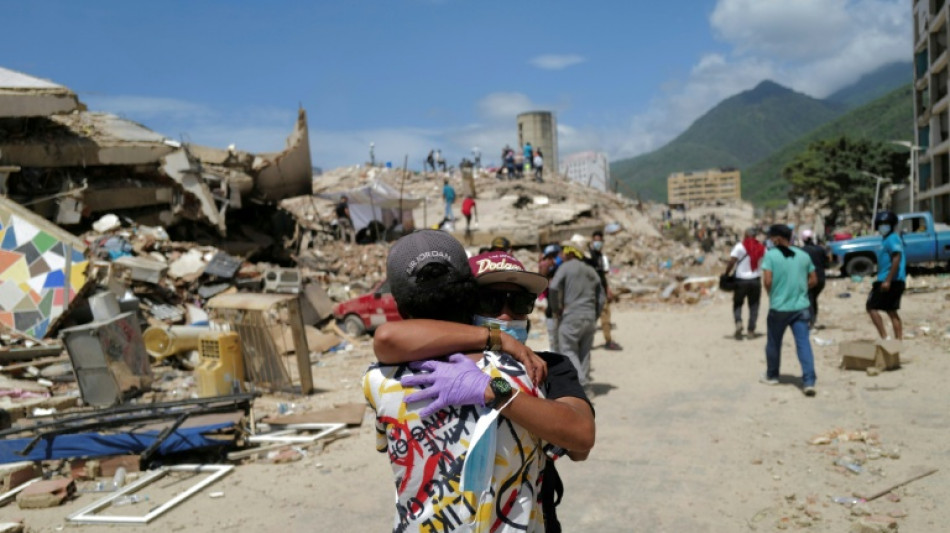
Solidarity, sadness among Venezuelans made destitute by quake / Photo: Mauricio VALENZUELA - AFP

 Bishop Museum Races to Save Rare Megamouth Shark Specimen

 Zach Hickerson Recounts Hayden Panettiere's Final Moments in New Interview

 Luxembourg Housing Petition Passes Threshold for Parliamentary Consideration

 Raheem Sterling Receives Suspended Sentence After Lamborghini Crash

 Audience to Choose the Set List at Luxembourg's First FAMIL Jukebox Night

 Luxembourg Pay Rise Delayed as Regional and World Headlines Develop

 Chennai Urbanist Sashna Develops 'Anniki' Card Game to Gamify Tamil Nadu History

 Transport Minister Defends Land Seizure Powers for Toronto-Quebec City High-Speed Rail

Bandaged, bruised Venezuelans sifted through donated clothes in a large sports arena turned shelter after losing everything in the massive earthquakes that struck this week.
The city of La Guaira, just north of Caracas, was the hardest hit by Wednesday's twin tremors of magnitude 7.2 and 7.5, which killed at least 1,430 people and left over 50,000 missing.
The Jose Maria Vargas hall has become a refuge and a site of solidarity following the disaster that caused entire buildings to vanish.
"It's like God gives you the chance to have one more life," said shelter resident Yosey Escalona, incredulous at her own survival.
Formerly a favorite seaside resort for Caracas residents, the city is now a scene of despair, with ambulances weaving in and out of the wreckage and motorcycles transporting sorely needed supplies to survivors.
The sports center provides a roof for the city's residents, who fear the effects of over 300 aftershocks that have shuddered through the quake zone since Wednesday.
Escalona's home is now uninhabitable. "The walls have come away from the columns," she said.
- 'Everyone is welcomed' -
Huge tents line the inside of the Jose Maria Vargas facility, each one housing up to 50 people and storing personal hygiene products, water supplies and non-perishable food items.
These improvised households appoint someone to distribute supplies and maintain order in the shared space that has suddenly become home.
"We are 100 percent willing to help one another because this is a very difficult time," said Escalona, herself a group coordinator.
"There's room here and everyone is welcomed," she added.
People constantly flow in and out of the stadium, bringing suitcases, mattresses and more for the displaced community.
The shelter also serves as a collection center for gathering and distributing essential supplies.
Those in mourning momentarily put their misery aside to support their fellow bereaved citizens.
"The solidarity right now is impressive," said port worker Carlos Marcano, who lost his home in a working-class area near the coast.
"The people are united," said Pedro Colmenares, who was dropping off 500 loaves of bread at the shelter.
"Venezuelans are people who care for one another, who support each other in the most difficult moments."
- 'Nowhere to go' -
Interim leader Delcy Rodriguez has declared La Guaira a disaster zone and on Friday announced a military deployment to the area.
La Guaira's Pariata Peripheral Hospital -- which has received most of the injured -- treated more than 400 people in the 48 hours following the disaster, a nurse told AFP.
The hospital is referring treated patients with nowhere to go towards the sports arena turned shelter.
"As patients are discharged, another problem arises," said surgeon Geralldyne Franco.
"They have nowhere to go because they lost their homes. They lost everything."
bc/lp/mr/cc/dw
W.Stewart--AT

