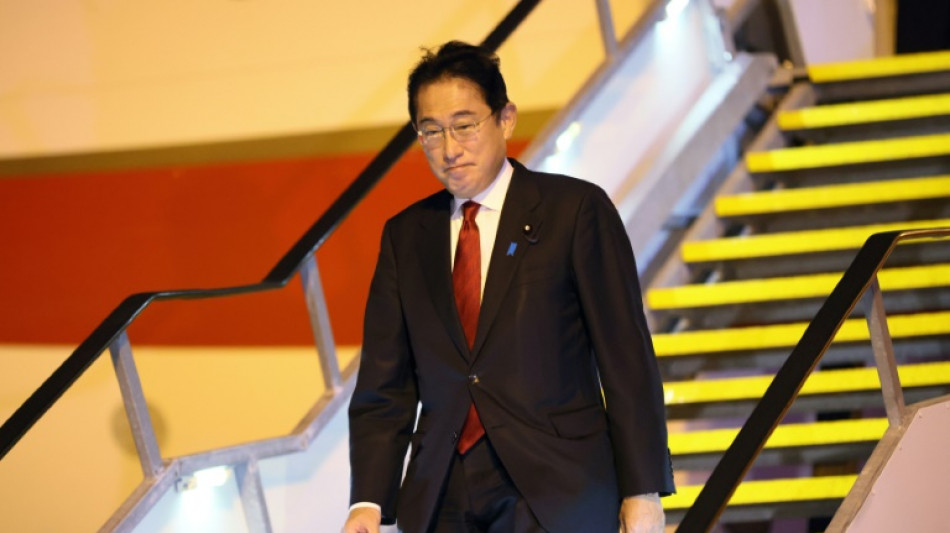
Japanese, Australia PMs eye new security pact / Photo: TREVOR COLLENS - POOL/AFP

 DR Congo advance but Iran out as wild World Cup group stage wraps
 Austria and Algeria reach World Cup knockouts after 3-3 thriller

 Where are they? Dogs disappear before South Korea meat ban
 China's bull wrestlers fight to keep tradition alive
 England top group to set up DR Congo World Cup clash, Portugal held
 England moving on at World Cup but questions linger
 Venezuela quakes kill 1,400 as time running out to find survivors
 Australia World Cup goalkeeper Patrick Beach has beach named after him

 Take brutally hot weather seriously, heatstroke survivor warns

 Australia boosts shark-spotting drone coverage at Sydney beaches
 Scotland boss Clarke resigns after World Cup exit confirmed
 Kane, Bellingham on target as England win World Cup group

 Croatia battle past Ghana to sew up World Cup Last 32 spot

 US, Iran clash, putting fragile deal under growing strain

 Ryu takes one-shot lead over Henderson at Women's PGA Championship

 Jangoo and Chase put West Indies in control against Sri Lanka

 World Cup star Gakpo requests privacy after death of unborn son
 Aid planes landing at partially reopened Venezuela airport after quakes
 Spain's Williams hits out at Uruguay over World Cup injury
 World's largest particle smasher halts for upgrade to boost hunt for dark matter
 Ex-Olympic medallist Canderloro elected French Ice Sports chief
 Prince Harry and family to stay at royal residences on UK visit

 'Why not?': Cape Verde eye seismic World Cup shock against Argentina
 Russell snatches controversial pole in Austria after Verstappen crash

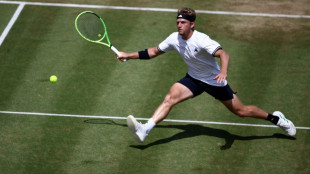 Davidovich Fokina wins in Mallorca for first ATP title

Japanese Prime Minister Fumio Kishida visited Australia on Saturday, where he is expected to ink a revamped security deal with his Australian counterpart to address China's rapidly growing military clout.
Kishida met Anthony Albanese for talks to finalise an agreement to share more sensitive intelligence and deepen military cooperation.
"The Japan and Australian relationship on security issues has built up for many years," a Japanese foreign ministry official said ahead of the meeting in the western city of Perth.
"We hope that this visit will be an opportunity to further deepen security cooperation."
It is the first visit of a Japanese prime minister to Australia since 2018.
The two Pacific nations are expected to focus on sharing intelligence -- particularly signals and geospatial intelligence gleaned from electronic eavesdropping and high-tech satellites.
Neither country has extensive foreign spy networks or armies of human assets overseas -- Japan has no foreign spy agency equivalent to America's CIA, Britain's MI6 or even Australia's much smaller agency ASIO.
But according to expert Bryce Wakefield, both Australia and Japan have sophisticated signals intelligence capabilities -- a form of information gathering by intercepting communications.
Wakefield, director of the Australian Institute of International Affairs, said the agreement could be a model for Japan to develop deeper security ties with countries like Britain.
There have long been rumours about Japan and Australia cooperating on intelligence behind the scenes.
This accord will deepen and codify that partnership, but it is also being seen as another small step toward Japan joining the powerful Five Eyes intelligence-sharing alliance between Australia, Britain, Canada, New Zealand and the United States.
It is "an epoch-making event that Japan can share SIGINT (signals intelligence) with a foreign nation except for the United States," Ken Kotani, an expert in the history of Japanese intelligence at Nihon University, told AFP.
But hurdles remain.
Closer cooperation has been hampered by longstanding concerns about Japan's ability to handle sensitive confidential material and transmit it securely.
For now, Australia will likely be forced to scrub any intelligence passed to Japan for information gleaned from the Five Eyes network.
- China top of mind -
Prime ministers Kishida and Albanese are also expected to vow more military and energy cooperation.
Japan is a major buyer of Australian gas and has made a series of big bets on hydrogen energy produced in Australia, as it tries to ease a lack of domestic energy production and dependence on fossil fuels.
"Japan imports 40 percent of its LNG from Australia. So it's very important for Japan to have a stable relationship with Australia, from the aspect of energy," the Japanese official said.
Saturday's deal is expected to update a 2007 accord, which was agreed upon when Beijing was much weaker militarily and much less bellicose in its dealings with the world.
Since Xi Jinping came to power, Beijing's military has become much stronger and its posturing more aggressive.
During Xi's decade-long rule, China has built the world's largest navy, revamped the globe's biggest standing army, and amassed a nuclear and ballistic arsenal to trouble any foe.
F.Wilson--AT