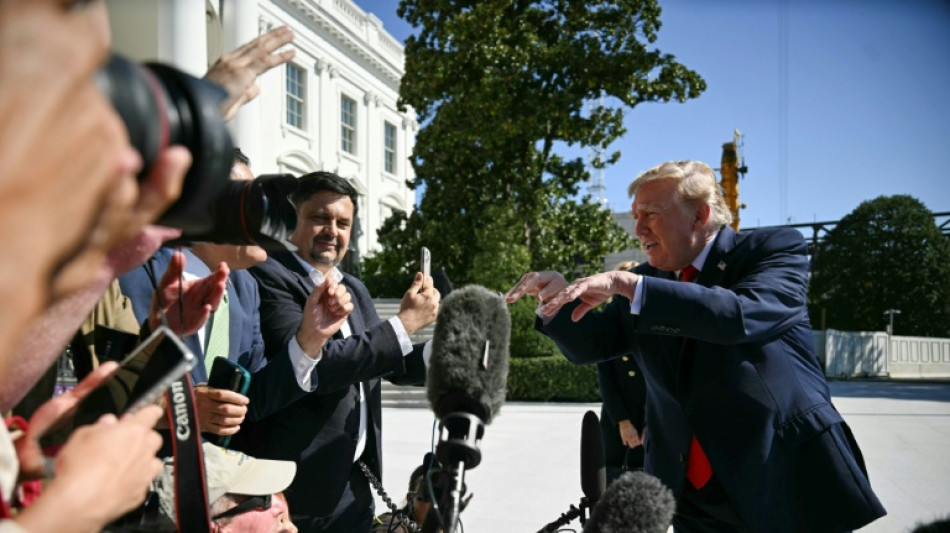
Trump says US Senate as hard to defend as House in midterms / Photo: Jim WATSON - AFP

 Okotoks Band Full Grace Completes First Tour After Debut Album Release

 Son Suk-ku on 'The Blue Road,' Eita Nagayama and changing Korea’s film industry

 Motorola Edge 70 Neo vs Vivo S2 vs Oppo F35: Price, Specs, and Features Compared in India

 Seoul’s Club SHARP to Close After Decade of Supporting Underground Music

 How to Build a Morning Routine that Supports Your Money Goals
US President Donald Trump said Tuesday Republicans face an equally difficult fight to retain control of the House of Representatives and the Senate in November's midterm elections, despite forecasts showing a considerably tougher contest in the House.
"I would say equal," Trump told reporters at the White House when asked which chamber would be harder for Republicans to defend in the November 3 vote.
Trump acknowledged the historical disadvantage facing the party of a sitting president, although he insisted that enthusiasm among Republican voters was surging.
"When you have a sitting president... no matter how good they seem to be, they're at a big disadvantage, tremendous disadvantage," he said.
"But I'm doing a tour right now, and I'm doing rallies. The level of enthusiasm for the Republican Party is way up."
Trump's assessment was striking because Republicans have been widely seen as particularly vulnerable in the House, while the Senate's electoral map had initially offered them greater hopes of retaining control.
Election forecaster Decision Desk HQ gives Democrats a 77 percent chance of winning the 435-seat House, projecting that they will take 235 seats to the Republicans' 200.
It also narrowly favors Democrats to capture the 100-seat Senate, giving them a 56 percent probability of victory and projecting a 51-49 majority.
Losing either chamber on November 3 would complicate Trump's ability to push his agenda through Congress during the final two years of his presidency, while handing Democrats greater power to investigate his administration.
Trump has embarked on a campaign blitz in the closing weeks of the election, including rallies in traditionally Republican states where his party faces unexpectedly competitive Senate races.
History offers little comfort to the president.
The party holding the White House has almost invariably lost seats in midterm elections, with just three exceptions in the House since 1934, according to figures compiled by the American Presidency Project.
Franklin D. Roosevelt's Democrats gained nine House seats in 1934, while Bill Clinton's party picked up four in 1998 and George W. Bush's Republicans gained eight in 2002.
The worst modern midterm drubbing came in 1938, when Roosevelt's Democrats lost 72 House seats, followed by Barack Obama's Democrats losing 63 in 2010.
Trump himself presided over a split verdict in his first midterms in 2018, when Republicans lost 41 House seats but gained two in the Senate.
H.Thompson--AT