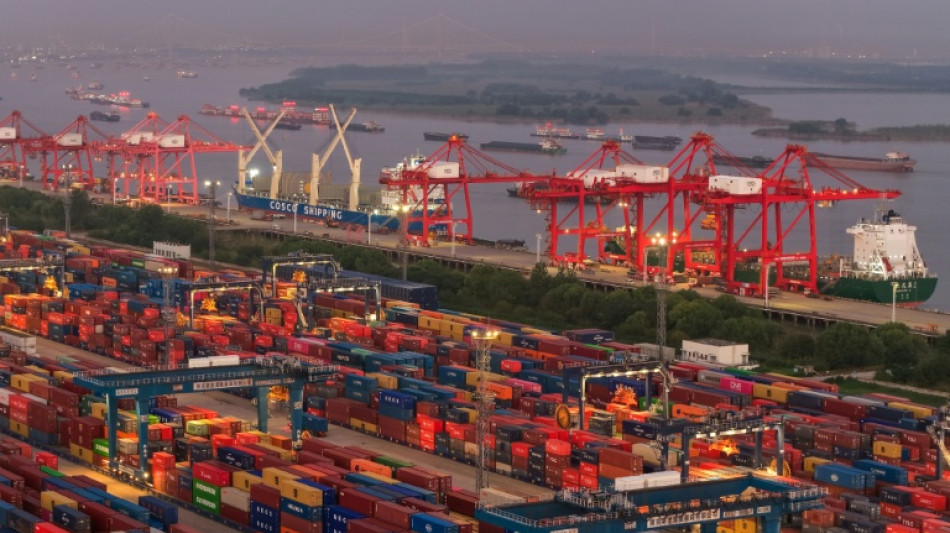
In Beijing, EU trade envoy says deficit with China 'unsustainable' / Photo: - - CN-STR/AFP

 Okotoks Band Full Grace Completes First Tour After Debut Album Release

 Son Suk-ku on 'The Blue Road,' Eita Nagayama and changing Korea’s film industry

 Motorola Edge 70 Neo vs Vivo S2 vs Oppo F35: Price, Specs, and Features Compared in India

 Seoul’s Club SHARP to Close After Decade of Supporting Underground Music
 How to Build a Morning Routine that Supports Your Money Goals
The European Union's top commerce official said Thursday that the bloc's trade deficit with China was "unsustainable", as he kicked off two days of talks in Beijing aimed at averting a trade war.
"Day one in China, with one goal: begin rebalancing our... unsustainable trade deficit," Maros Sefcovic said on X.
"I started by hearing directly from EU businesses here. The message around the table was clear: the need to improve access to the Chinese market, while boosting our economic security," he added.
Last year, every day, China exported to the EU around a billion euros ($1.1 billion) more in goods and services than went the other way, according to European figures.
Many in Europe blame this on unfair trade practices by Beijing, including state subsidies and price dumping, undercutting European rivals in industries from cars to chemicals.
But Europe can ill afford to anger China.
The Asian giant could throttle supplies of items such as rare earth minerals that are vital for the continent's industrial sector -- or throw up barriers to European exports to China.
The two days of discussions by Sefcovic in Beijing come as France and Germany, the bloc's two biggest powers, threaten to up the ante.
According to a letter seen by AFP on Monday, President Emmanuel Macron and Chancellor Friedrich Merz called for a "credible instrument" to respond quickly to any escalation by Beijing, although China was not mentioned explicitly.
The proposed weapon -- to be discussed at an EU leaders' summit next week -- would give the European Commission the power to respond to a trade aggression within days.
- 'Wrong path' -
China immediately warned Paris and Berlin on Tuesday against "protectionist" measures.
"They should avoid going down the wrong path in the wrong way, only to ultimately suffer the consequences themselves," the commerce ministry said in a statement.
China's foreign ministry said Thursday that Beijing hopes that it can work with Brussels "in the same direction and address each other's concerns through dialogue and consultation".
"As a principle, China has always believed that adhering to openness and cooperation and resolving economic and trade differences through equal dialogue and consultation is in the common interests of both China and the EU," spokesperson Mao Ning told a regular briefing.
The stakes are also high for President Xi Jinping, however, with China heavily reliant on exports in order to compensate for its stuttering domestic economy.
The EU parliament's trade committee chief, Bernd Lange, said ahead of Sefcovic's trip that this "economic crisis in China" gives the bloc "bargaining power".
"The EU has a well-supplied toolbox to counter unfair subsidies, dumping, discriminatory procurement, and economic coercion. These instruments must be applied consistently and, where necessary, enhanced," Lange said in a statement.
- 'Tangible results' -
EU and Chinese officials have been negotiating since June, and Sefcovic raised hopes earlier this year when he said that he wanted "tangible results by October".
Sefcovic has identified three priorities: addressing surging imports in strategically important sectors, increasing European exports to China, and improving access to critical raw materials.
The EU is also seeking clearer export-licensing arrangements for rare earths and other materials after China introduced restrictions last year.
Brussels hopes to manage Chinese exports through voluntary limits, for example on hybrid cars shipped to the bloc. Beijing, though, firmly opposes import quotas.
Analysts are cautious about the prospects for a broad agreement being struck this week.
"But if one sector could be identified in which an export-restraint agreement with China could be tested, that would be a good step," Ignacio Garcia Bercero, from Brussels think-tank Bruegel, told AFP.
Zhu Tian, economics professor at Shanghai's China Europe International Business School, agreed, saying that the talks could yield agreements "on some specific issues".
H.Romero--AT