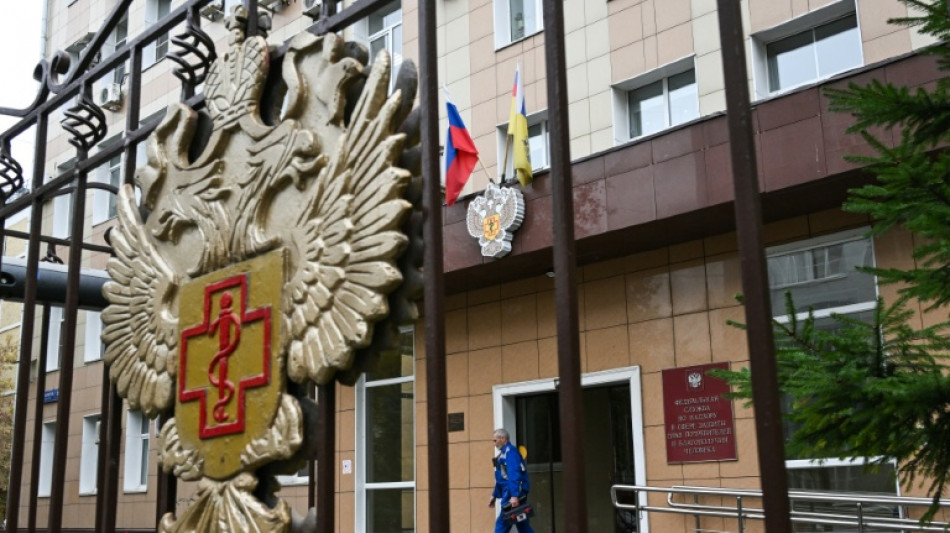
Russia warns of 'false' information as second plague case reported / Photo: Igor IVANKO - AFP

 Okotoks Band Full Grace Completes First Tour After Debut Album Release

 Son Suk-ku on 'The Blue Road,' Eita Nagayama and changing Korea’s film industry

 Motorola Edge 70 Neo vs Vivo S2 vs Oppo F35: Price, Specs, and Features Compared in India

 Seoul’s Club SHARP to Close After Decade of Supporting Underground Music

 How to Build a Morning Routine that Supports Your Money Goals
Russia warned Wednesday against "false" information as reports emerged of a second suspected case of plague in Siberia, with Washington and Brussels calling for transparency and neighbouring Mongolia tightening health surveillance.
Russian news outlet People of Baikal reported last Friday that a 28-year-old woman employed at a plague research institute in Siberia's Irkutsk region had died of the disease, possibly after contracting it from a broken test tube.
International concern has meanwhile grown over the death and suspicions that a second employee at the institute fell ill.
The United States, the European Union and the World Health Organization have all called on Russia to be transparent about the situation.
Mongolia's government said Wednesday that "health surveillance and monitoring measures (were) being implemented at the border" with Russia.
WHO chief Tedros Adhanom Ghebreyesus also urged Moscow to clarify "media reports of a second employee with pneumonia of undetermined cause" at the Irkutsk institute.
Russian authorities have played down the reports, determining the woman died of pneumonia and insisting there was no risk of an outbreak.
Asked about reports of a second case, Kremlin spokesman Dmitry Peskov told reporters that "the vast majority of what the media is reporting regarding this situation is false information".
People should rely solely on official statements from Russian health watchdog Rospotrebnadzor, he insisted.
- 'No epidemic risks' -
The Russian health agency meanwhile said Wednesday that it had determined "there are no epidemic risks for the population".
It said exensive investigations had uncovered "no emergencies" and that the lab had complied with "proper control when working with pathogenic microorganisms".
"More than 90 percent of contacts have completed medical observation," it added.
"No health disorders associated with infectious pathology were detected," it said, adding that "the results of almost 5,000 laboratory tests did not reveal any dangerous pathogenic microorganisms".
The agency also said the woman had been "vaccinated and had immunity to dangerous infections with which she worked".
- 'False' -
Plague is a bacterial disease that can occur in several forms, including pneumonic plague, the most contagious type, which can spread through respiratory droplets.
Bubonic plague is transmitted by infected fleas.
Pneumonic plague can be fatal if not treated early, according to the WHO.
Irkutsk Regional Governor Igor Kobzev said Monday that an inspection by Rospotrebnadzor had found the woman died of "pneumonia of undetermined aetiology".
"No microorganisms linked to the young woman's professional work were found in her biological samples," he said, adding no other staff at the institute had sought medical attention since her death.
- Risk 'low' -
Those assurances have done little to quell international concern.
The United States made a formal request pressing Russia for information, a source close to the matter said Tuesday, while US President Donald Trump said he had "a call scheduled" with Russian counterpart Vladimir Putin and would speak with him "very soon".
Asked about this, Peskov insisted Wednesday that he had "no information" regarding a formal US request for clarification, nor about a call scheduled between the two leaders.
While determining there were no epidemic risks, Rospotrebnadzor said it had implemented a set of "anti-epidemic measures" as a precaution and in line with sanitary legislation.
It also stressed that it had shared information with the WHO in accordance with international health regulations.
The WHO said Tuesday that its initial risk assessment, based on the information available, was moderate to low for the Irkutsk region, low for Russia as a whole and very low for Europe.
L.Adams--AT