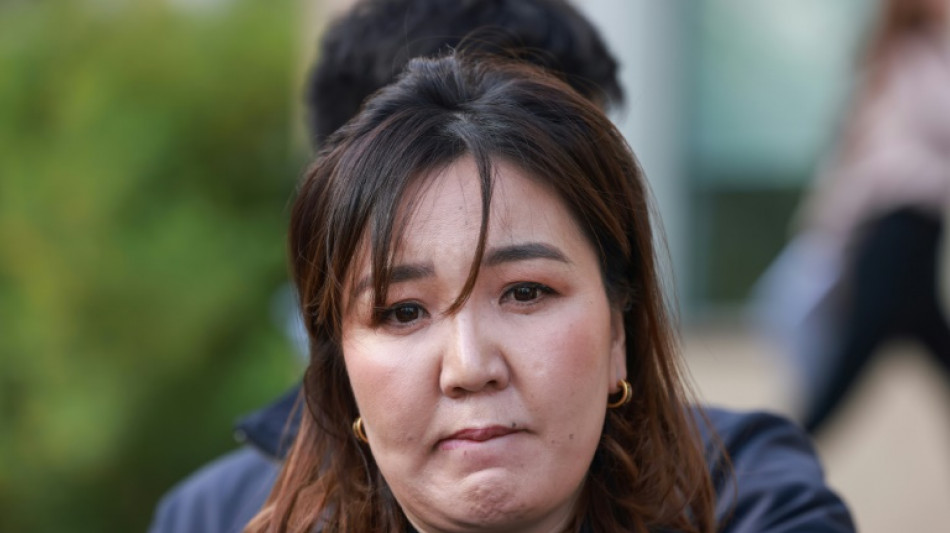
Hard-hitting journalist ensnared in Mongolia's press freedom crackdown / Photo: Byambasuren BYAMBA-OCHIR - AFP

 US imposes new tariffs on 60 partners as Trump rebuilds trade agenda
 Stocks suffer fresh blow as markets hit by perfect storm
 Trump under pressure from all sides over Chinese AI surge
 ICC member states decide fate of embattled prosecutor Karim Khan
 Dodgers return to Trump White House despite fan anger
 Lyles, Richardson ease into 100m semis at US athletics championships
 Salman Rushdie testifies at knife attacker's US terror trial
 World Bank confirms plan to phase out China lending by 2031
 US panel backs trendy peptides despite safety concerns
 Justice Dept withdraws NY Times subpoenas over Trump plane report
 Barcelona's De Jong returns from World Cup with torn ligament
 Albania police teargas protesters against Trump-linked resort
 US panel says to loosen restrictions on popular peptide despite safety concerns
 Verstappen swerves around future questions
 EU renews online child sex abuse detection powers
 Airbus, Boeing fly in different directions at Farnborough
 Bab al-Mandeb Strait: another key oil shipping route under threat
 Deadly wildfires in Europe force thousands to flee
 NATO to overhaul European fuel pipeline network
 US trade envoy to make tariff announcement as 10% duty soon expires
 Trump stuns Saudis by pinning nuclear deal to Israel ties
 Tough day for Ubisoft stock topped with weaker revenues
 Swelling jet fuel costs hit American Airlines outlook
 Carapaz climbs unopposed to Tour de France 18th stage win
 Sooryavanshi hits maiden 50 as India thump Zimbabwe in T20
Naran Unurtsetseg became one of Mongolia's most well-known journalists by exposing sexual abuse in a Buddhist boarding school, violence in the military and by taking on some of the country's most powerful people.
But she is now on trial after almost 200 days under house arrest and banned from working, the most high-profile victim of what critics say is a deepening crackdown on press freedom.
"I used to think innocent people should have nothing to fear," she told AFP from her home in the capital Ulaanbaatar.
"But I've been through a one-sided hearing since I was placed under investigation," she said.
"They don't want to see the facts that prove my innocence and intentions."
Democratic Mongolia long enjoyed relative freedom of expression, especially when compared to its autocratic neighbours China and Russia.
It boasts a vibrant media scene, with scores of outlets representing all shades of the political spectrum and confrontational debate commonplace.
But against a recent backdrop of what critics say is declining rule of law and a government seeking to curb criticism of its record on corruption, it has plummeted in press freedom rankings.
Reporters Without Borders in 2024 ranked the country 109th in the world, its lowest rating in decades and putting it just ahead of Ecuador, Indonesia and Nigeria.
Critics point to recent amendments to anti-defamation and "fake news" laws, making them criminal offences, as giving authorities much greater powers to punish journalists.
And recent reforms to the state secrets law mean that those who publish leaked government documents can face up to eight years in jail.
"An official or officials who are supposed to keep the secret should be responsible for revealing it," said Galbaatar Lkhagvasuren, a lawyer at Globe International Center, a non-profit that promotes press freedom in Mongolia.
"Ordinary people who obtained the file intentionally or unintentionally shouldn't be found guilty," he said.
A Mongolian government spokesperson did not respond to repeated requests for comment on the country's declining press freedom rankings.
- Confrontational -
Unurtsetseg's brand of confrontational broadcasts with her outlet, Zarig, made her powerful enemies but legions of fans in a country where corruption is deep-rooted and has sparked civil unrest.
She pioneered the use of live streaming -- now ubiquitous in Mongolia's online media -- on Facebook, where many get their news.
In one livestream, she chased down crooked politicians who had refused to pay back government-backed loans.
In another, she exposed brutal hazing in the country's army after two young men died during their mandatory military service.
And she said she was intimidated when she was quoted in the New York Times discussing a controversial religious succession.
"I had phone calls from (the Intelligence Agency)," she told AFP.
And then, in December, the police came for her at the Zarig offices after she criticised judicial authorities on Facebook.
Other journalists gathered to livestream the arrest on social media in solidarity.
Unurtsetseg was slapped with a total of nine charges from three different agencies.
They included spreading false information and defamation by the judiciary, tax evasion by the country's revenue collector and, most seriously, obtaining state secrets by the intelligence agency.
- 'I didn't do anything wrong' -
"The tax authority, the intelligence agency, and the police are against me," she told AFP.
"People told me to apologise so I don't have to go to jail but I don't want to," she said.
"I didn't do anything wrong."
An additional charge of aiding foreign powers was eventually dismissed for lack of evidence.
Shortly after Unurtsetseg was arrested, dozens of journalists who had paid for her work were questioned by police.
One was Uyanga Surnee, a journalist at daily newspaper Zuunii Medee, who had wired Unurtsetseg some 200,000 tugrik ($50), five years ago.
"When I went to the police office... they didn't ask much about the transaction, instead, the police asked what I knew about Unurtsetseg's private life," she told AFP.
Her trial is ongoing, and a verdict is expected in early July.
Yesun-Erdene Tumurbaatar, a journalism teacher at Press Institute of Mongolia, said her arrest has little to do with the content of her work.
"Her journalism was political -- that is why they are clamping down on her," he said.
Experts and local journalists say the severity of her treatment throughout the investigation -- and the treatment of other journalists linked to her -- has already sent a clear message.
The arrest has sent ripples through Ulaanbaatar's relatively small community of journalists, which numbers only a few hundred covering a country of 3.4 million.
In May, another journalist, Bayarmaa Ayurzana, was arrested after exposing alleged embezzlement by Mongolia's deputy prime minister -- a candidate in this month's legislative elections.
"Since the arrest, we journalists started to hesitate to report because of fear," Oyunchimeg Shashiimaa, chief editor at News.mn, told AFP.
"The message of her arrest was that if we publish critical reports about state affairs, we will be questioned and punished," she said.
"We are struggling to keep people informed but we fear we will be gagged for trying."
E.Hall--AT