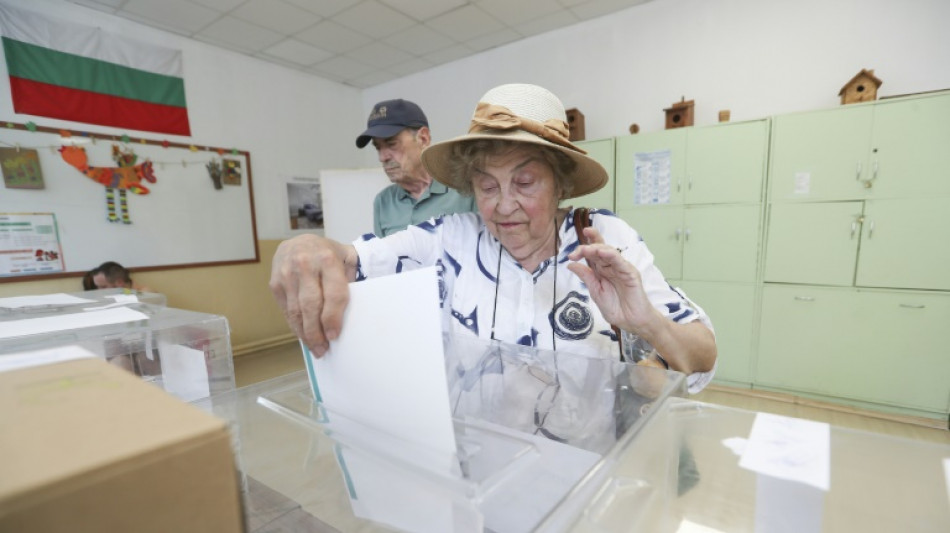
Conservatives lead in Bulgaria's sixth vote in three years / Photo: DIMITAR KYOSEMARLIEV - AFP

 Trump under pressure from all sides over Chinese AI surge

 ICC member states decide fate of embattled prosecutor Karim Khan

 Dodgers return to Trump White House despite fan anger

 Lyles, Richardson ease into 100m semis at US athletics championships
 Salman Rushdie testifies at knife attacker's US terror trial

 World Bank confirms plan to phase out China lending by 2031
 US panel backs trendy peptides despite safety concerns

 Justice Dept withdraws NY Times subpoenas over Trump plane report

 Barcelona's De Jong returns from World Cup with torn ligament
 Albania police teargas protesters against Trump-linked resort

 US panel says to loosen restrictions on popular peptide despite safety concerns

 Verstappen swerves around future questions
 EU renews online child sex abuse detection powers
 Airbus, Boeing fly in different directions at Farnborough

 Bab al-Mandeb Strait: another key oil shipping route under threat

 Deadly wildfires in Europe force thousands to flee

 NATO to overhaul European fuel pipeline network
 US trade envoy to make tariff announcement as 10% duty soon expires

 Trump stuns Saudis by pinning nuclear deal to Israel ties
 Tough day for Ubisoft stock topped with weaker revenues

 Swelling jet fuel costs hit American Airlines outlook
 Carapaz climbs unopposed to Tour de France 18th stage win

 Sooryavanshi hits maiden 50 as India thump Zimbabwe in T20
 ECB opens door to September rate-hike as Iran war flares up

 World Bank estimates Venezuela quakes caused $19.6 bn in damage
Hardly a third of Bulgarians voted in the Balkan EU member's sixth parliamentary elections in three years on Sunday, with the party of conservative former premier Boyko Borisov coming in first, but more political uncertainty looming.
Analysts said the worst political instability the EU's poorest member has experienced since the end of communism was unlikely to end.
Borisov's GERB party topped the vote, winning almost 25 percent, according to projections published by polling institutes late Sunday on the basis of a partial count.
But it is likely to continue to struggle to find partners to govern after massive anti-corruption protests in 2020 ended Borisov's almost decade-long rule.
Reformist grouping PP-DB slumped to between 14 and 15 percent -- down from the almost 25 percent they got in the last snap polls last year.
The continuing instability threatens to further delay reforms necessary to unlock EU funding and integrate the country fully into the Schengen area of free movement -- and to frustrate voters further.
"Let's hope that politicians will find a possibility to avoid holding a new vote in the fall, which is the most likely outcome right now," said Kancho Stoichev, an analyst with Gallup.
- 'Weary of elections' -
Sunday's turnout was the lowest for a Bulgarian national election since the end of communism, at around 30 percent, according to data published by polling agencies shortly before voting closed.
"We are weary of elections, and we want some stability and some prosperity for the country," said Margarita Semerdzhieva, a 72-year-old pensioner, echoing the comments of others who spoke to AFP outside a Sofia polling station.
The vote was being held alongside EU elections.
"I voted so that Bulgaria will return to stability, and that its voice is heard," Borisov, 64, said after casting his ballot.
The former firefighter and bodyguard has long sought to portray an image of a "strong leader", which 49 percent of Bulgarians who were questioned in a recent study by the Open Society Institute said they prefer.
PP-DB agreed to work with GERB -- which it previously accused of corruption -- to form the previous government on a common pro-EU platform to ensure Bulgaria -- traditionally close to Russia -- supports Ukraine's fight against Moscow's invasion.
But the fragile partnership tumbled in April following just nine months in power after the parties failed to agree on key judiciary and other reforms.
After casting his vote earlier Sunday, PP co-president Kiril Petkov warned of forces influencing the country "from the shadows" to derail any reform drive.
- Russian disinformation -
A partner for GERB could be the Turkish minority MRF party led by Delyan Peevski, a 43-year-old lawmaker and former businessman who is sanctioned by the United States and Britain for corruption.
His party won around 16 percent, according to the projections.
"People today vote for a new beginning. It is time for us to form a stable government," Peevski said in a video distributed by his party earlier Sunday.
But analysts warn having the party formally in the cabinet would risk provoking protests and could tarnish the country's image.
On the other hand, a tacit behind-the-scenes partnership between GERB and MRF already dates back years, according to analysts.
Pro-Russian nationalists Vazrazhdane gained around 14 percent of the vote, while another smaller pro-Russian party also is expected to enter parliament, with research indicating that Russian propaganda and disinformation played a large part in the vote.
A survey by the Sofia-based think-tank Center for the Study of Democracy found that close to 40 percent of Bulgarians share disinformation and almost 70 percent believe in conspiracy narratives.
vs-ds/jza/rlp
Hardly a third of Bulgarians voted in the Balkan EU member's sixth parliamentary elections in three years on Sunday, with the party of conservative former premier Boyko Borisov coming in first, but more political uncertainty looming.
Analysts said the worst political instability the EU's poorest member has experienced since the end of communism was unlikely to end.
Borisov's GERB party topped the vote, winning almost 25 percent, according to projections published by polling institutes late Sunday on the basis of a partial count.
But it is likely to continue to struggle to find partners to govern after massive anti-corruption protests in 2020 ended Borisov's almost decade-long rule.
Reformist grouping PP-DB slumped to between 14 and 15 percent -- down from the almost 25 percent they got in the last snap polls last year.
The continuing instability threatens to further delay reforms necessary to unlock EU funding and integrate the country fully into the Schengen area of free movement -- and to frustrate voters further.
"Let's hope that politicians will find a possibility to avoid holding a new vote in the fall, which is the most likely outcome right now," said Kancho Stoichev, an analyst with Gallup.
- 'Weary of elections' -
Sunday's turnout was the lowest for a Bulgarian national election since the end of communism, at around 30 percent, according to data published by polling agencies shortly before voting closed.
"We are weary of elections, and we want some stability and some prosperity for the country," said Margarita Semerdzhieva, a 72-year-old pensioner, echoing the comments of others who spoke to AFP outside a Sofia polling station.
The vote was being held alongside EU elections.
"I voted so that Bulgaria will return to stability, and that its voice is heard," Borisov, 64, said after casting his ballot.
The former firefighter and bodyguard has long sought to portray an image of a "strong leader", which 49 percent of Bulgarians who were questioned in a recent study by the Open Society Institute said they prefer.
PP-DB agreed to work with GERB -- which it previously accused of corruption -- to form the previous government on a common pro-EU platform to ensure Bulgaria -- traditionally close to Russia -- supports Ukraine's fight against Moscow's invasion.
But the fragile partnership tumbled in April following just nine months in power after the parties failed to agree on key judiciary and other reforms.
After casting his vote earlier Sunday, PP co-president Kiril Petkov warned of forces influencing the country "from the shadows" to derail any reform drive.
- Russian disinformation -
A partner for GERB could be the Turkish minority MRF party led by Delyan Peevski, a 43-year-old lawmaker and former businessman who is sanctioned by the United States and Britain for corruption.
His party won around 16 percent, according to the projections.
"People today vote for a new beginning. It is time for us to form a stable government," Peevski said in a video distributed by his party earlier Sunday.
But analysts warn having the party formally in the cabinet would risk provoking protests and could tarnish the country's image.
On the other hand, a tacit behind-the-scenes partnership between GERB and MRF already dates back years, according to analysts.
Pro-Russian nationalists Vazrazhdane gained around 14 percent of the vote, while another smaller pro-Russian party also is expected to enter parliament, with research indicating that Russian propaganda and disinformation played a large part in the vote.
A survey by the Sofia-based think-tank Center for the Study of Democracy found that close to 40 percent of Bulgarians share disinformation and almost 70 percent believe in conspiracy narratives.
P.Smith--AT