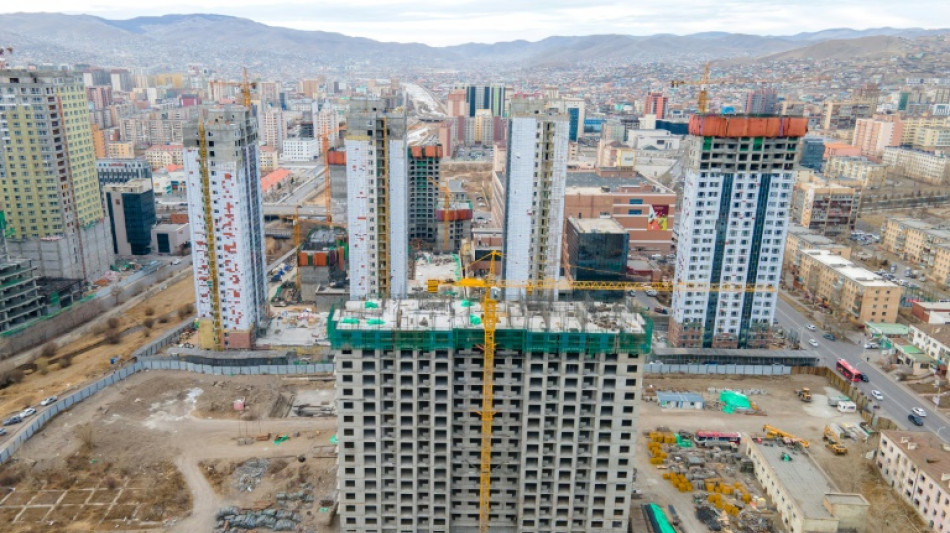
Mongolia's building boom traps capital residents in concrete jungle / Photo: BYAMBASUREN BYAMBA-OCHIR - AFP

 Eala-conqueror Wang wins Asian Games tennis gold and Olympic berth

 'Kinda cool' Raygun made breakdancing famous, Asian Games B-girls say

 Taiwan gender-row boxer Lin Yu-ting wins 'monumental' Asian Games gold
 Taiwan receives its first US-made F-16V fighter jets
 Lula, Bolsonaro trade scandal fire in final scramble for votes
 Not-so-brave new world: virtual taekwondo makes Asian Games debut

 Arab Israeli candidate drops out of election race

 Israel courts Europe's far right, finding friends but also unease

 Lula, Bolsonaro both snub final debate before Brazil election

 Nepal's grim DNA puzzle to identify flood dead
 EU nations to hold emergency meeting on soaring diesel prices amid US pressure

 Anthropic's Dario Amodei: AI's most visible CEO and enigma

 OpenAI says three staffers fired for mishandling 'sensitive' info
 InterContinental Hotels Group PLC Announces Transaction in Own Shares - October 02

 Portugal win without Ronaldo as Klopp's Germany get first victory

 Wemby: 'Very sad' to see players endorse betting firms

 Manchester City Women scrape draw with Real Madrid

 India, Australia and Pakistan in same World Cup group

 Daryz's hopes of repeat Arc win boosted by draw
 Steelers ship disgruntled defender Porter to Cowboys

 Klopp gets first win as Germany boss

 Bolivia's attorney general arrested on drugs, money laundering charges

 Raiders host Chiefs in battle of unbeaten division rivals
 Lowest Fee Bitcoin ATMs Announces Launch of More Than 400 ATMs Nationwide

 G20 against 'weaponization' of food trade: French minister

Otgoo recalls running around freely as a child in Mongolia's once sparsely populated capital city, but he fears a rapid construction boom has now trapped his children in a concrete jungle.
Across Ulaanbaatar, high-rises are replacing the yurts that Mongolians have for centuries called home, symbols of a nomadic life that is fading away.
Locals say the construction boom -- fuelled by a decade-long mining windfall -- is squeezing out room for much-needed public services, from new hospitals to children's playgrounds.
"When I was a child I spent all day outside," said Otgoo, who only gave one name. "We used to play soccer, running like a wolf or rabbit in big empty spaces."
"My kids can't run like us. All places are filled with new apartment buildings."
Mongolia's mining boom drove double-digit growth, with vast profits from coal making up a quarter of the country's gross domestic product in 2022.
The industry has sparked a wave of demand for office space and luxury apartments in Ulaanbaatar.
The haphazard and rapid mushrooming of the capital city -- its population growing from half a million in the 1990s to roughly two million in 2022 -- has also led to massive daily traffic jams, trapping people in often hours-long commutes to and from work.
The boom, however, has largely not included vital civic infrastructure, leaving many children growing up without outdoor recreational facilities, parents told AFP.
There is little room for bigger playgrounds, schools and hospitals, many of which were built under Communist rule more than 30 years ago.
"My kids' only chance to play outside is on the weekend," said Ulzii, a mother of three.
"They stay home and watch screens."
- Out of reach -
Just a stone's throw from parliament, the Shangri-La hotel -- which boasts impressive views and hundreds of rooms priced well out of reach of the average Mongolian -- was built on land once intended to be occupied by a children's amusement park.
Existing civic services such as schools and kindergartens are stretched to their limit, with an average of 50 to 60 children crowding into each classroom.
Experts blame antiquated city planning strategies for the poor management of public spaces.
"There were urban plans before the boom but they weren't smart," Anu-Ujin Lkhagvasuren, an urban governance expert, told AFP.
"Places once meant to build garbage dumps have now turned into the most expensive residential areas."
Ulaanbaatar "basically copied" Soviet-style plans that placed workspaces far from residential districts, she said. The policy was meant, in part, to pull working-class people out of inner-city slums and into better-managed suburban communities.
"Workplaces are now centred around the main square and that causes traffic jams."
- Larger issues -
Some are pushing back: in the face of protests, the city's mayor in 2021 announced a ban on construction permits for new buildings, with the exception of schools, until 2040.
That ban does not, however, cover already-approved projects, meaning construction crews are still hard at work all over the city.
"When the country became democratic in 1990 Mongolians travelled abroad, and when they saw megacities like New York or Singapore, they wanted shiny skyscrapers and built the same ones here," Achit-Erdene Darambazar, an investment banker, told AFP.
In a country where poverty remains stagnant, some believe the construction boom is emblematic of larger issues -- specifically alleged corruption by public officials.
"We're asking each other: 'Where did the mining export income go?'" Achit-Erdene said.
"The answer is the construction boom."
Last year, the CEO of a large state-owned coal export company was placed under investigation for embezzlement, with the country's anti-corruption authority saying many of the looted funds went into real estate.
"Corrupt officials buy apartments instead of holding cash in their account or in their home," said Battsetseg Dorjlkhagva, a councillor representing Bayanzurkh, one of the Mongolian capital's largest districts.
"We live in such a little space that it can be difficult to pass one other at times."
Battsetseg led protests for a year against a high-rise office project, ultimately leading to the works being cancelled. Now, a kindergarten is being built in its place.
"We don't need tall buildings anymore," she told AFP.
"If there is any unused land, it should be used for the benefit of the people."
W.Morales--AT