Australia closes oldest coal plant, pivots to renewables / Photo: Saeed KHAN - AFP

 Finland investigates suspected break-ins at MPs homes
 London's Bayeux Tapestry show to offer audio tour for blind people

 Smouldering bins, halted trams as French pupils protest

 Malone Life and Pensions Expands Internationally Beyond the European Union

 England paceman Archer rested for ODI tri-series

 Queiroz exits Ghana as Black Stars crisis deepens

 ALEX BODI VE ALMAN ŞİRKETLER GRUBUNDAN HALLE’DE 166 DAİREYE YATIRIM

 อเล็กซ์ โบดี และกลุ่มบริษัทจากเยอรมนีลงทุนในอพาร์ตเมนต์ 166 ยูนิตที่เมืองฮัลเลอ

 ALEX BODI A NĚMECKÝ KONCERN INVESTUJÍ DO 166 BYTŮ V HALLE

 ALEX BODI OCH TYSK KONCERN INVESTERAR I 166 LÄGENHETER I HALLE

 England forward Toney pleads not guilty to nightclub assault

 Tom Kim finishes marathon Asian Games second round under floodlights

 Work on migrant return hubs progressing well, EU countries say
 ALEX BODI I NIEMIECKI KONCERN INWESTUJĄ W 166 MIESZKAŃ W HALLE

 Tearful Nishikori calls time on career with defeat at Japan Open

 أليكس بودي ومجموعة ألمانية يستثمران في 166 شقة في هاله

 알렉스 보디와 독일 기업 그룹, 할레 주택 166세대에 투자

 Verstappen wary of tyre wear as he eyes first F1 win of season

 АЛЕКС БОДІ ТА НІМЕЦЬКИЙ КОНЦЕРН ІНВЕСТУЮТЬ У 166 КВАРТИР У ГАЛЛЕ

 Kremlin critic Kasparov says US intelligence warned life 'in danger'

 Qatar 'ready' if 2030 Asian Games moved back: official

 Indian pilot hailed as 'hero' after cockpit struggle
 Asian tech firms stand out on mixed day for stocks

 Flags and pho on show as jeweller opens huge Vietnam plant

 Indian football fans relish rare friendly against Brazil

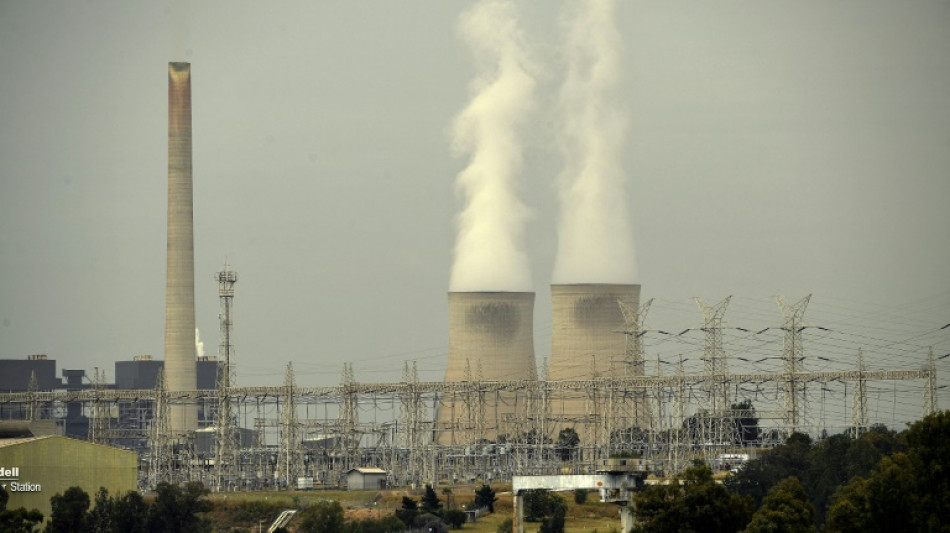
Australia's oldest coal-fired power plant will shut down Friday as the country, a once-notorious climate straggler, prepares for a seismic shift towards renewable energy.
The Liddell power station, about three hours' drive north of Sydney, is one in a series of ageing coal-fired plants slated to close in coming years.
Built in 1971, Liddell provides about 10 percent of the electricity used in New South Wales, Australia's most populous state.
For decades, coal has provided the bulk of Australia's electricity, but University of New South Wales renewable energy expert Mark Diesendorf told AFP that stations such as Liddell were fast becoming unreliable "clunkers".
Besides being inefficient, highly polluting and expensive to repair, the continued widespread use of coal-fired power plants would make Australia's climate targets almost impossible to meet.
Australia has long been one of the world's largest coal producers and exporters, and under a series of governments of all stripes it has resisted pressure to scale back the industry.
But the centre-left government elected last year on the promise of climate action has pledged that 82 percent of the country's electricity will come from renewable sources by 2030.
This demands a drastic overhaul -- while world leaders such as Norway produce more than 90 percent of their power through renewables, Australia currently sits around 30 percent.
"The plans are for a fairly rapid phase-out," Diesendorf told AFP.
"These stations are overdue for retirement and there's no economic argument for replacing them with new coal."
- 'Right direction' -
Under growing public pressure to address the climate crisis, many Australian fossil fuel companies increasingly prefer to shutter old coal plants than keep them online.
Utility company AGL said it originally planned to close Liddell in 2022, but kept it running until April to "support system reliability".
Australia's largest coal-fired power station, the Eraring facility in New South Wales, is scheduled to close in 2025 and a handful more will follow over the next decade.
These closures will test whether renewables are ready to fill the gap, climate finance expert Tim Buckley told AFP.
"If everything lines up it's fine. The momentum is good, and the policy heads in the right direction."
Drenched in sunshine and blessed with sparsely-populated windswept coasts, Australia has the natural ingredients to be a renewable energy superpower, Buckley said.
"Every bloody week there's a new battery announced, or a new wind farm, or other major projects proceeding," he added.
The tricky part, he said, would be figuring out how to store this energy and pump it across the vast distances between Australian towns and cities.
"We are talking about projects that haven't been attempted in Australia for decades, where labour shortages are real and engineering problems are to be expected.
"The chance of everything going smoothly between now and 2030 is close to zero."
Even if it does go smoothly Australia still faces enormous challenges in meeting its target of reaching net zero emissions by 2050.
- 'Terrible laggard' -
Over the past decade an ideological brawl dubbed the "climate wars" has dominated Australian politics, repeatedly undermining attempts to reduce carbon emissions.
Researchers in 2020 found that eight percent of Australians were in climate change denial, more than double the global average.
Transport makes up 19 percent of Australia's emissions but the country is one of the only advanced economies without fuel efficiency standards, something the government has vowed to rectify soon.
And although Australia is planning to clean up its domestic energy market, the economy is still fuelled by exports of coal and gas.
Dozens of new coal mines, oil fields and gas projects are in government planning pipelines.
"In terms of still developing gas and coal mines for export, we are a terrible laggard," Diesendorf said. "It's a real contradiction."
G.P.Martin--AT