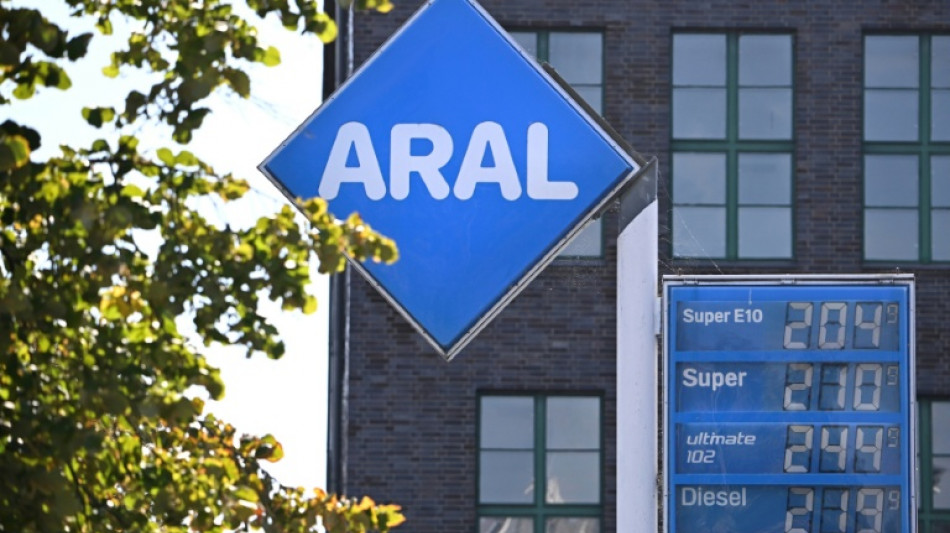
German fuel price cuts kick in to ease Mideast energy shock / Photo: Tobias SCHWARZ - AFP

 Zach Hickerson Recounts Hayden Panettiere's Final Moments in New Interview

 Luxembourg Housing Petition Passes Threshold for Parliamentary Consideration

 Raheem Sterling Receives Suspended Sentence After Lamborghini Crash

 Audience to Choose the Set List at Luxembourg's First FAMIL Jukebox Night

 Luxembourg Pay Rise Delayed as Regional and World Headlines Develop

 Chennai Urbanist Sashna Develops 'Anniki' Card Game to Gamify Tamil Nadu History

 Transport Minister Defends Land Seizure Powers for Toronto-Quebec City High-Speed Rail

 UAE Weather Forecast: Scattered Showers and Fog Expected as Temperatures Drop
German motorists began paying less to fill their cars Thursday as fuel subsidies aimed at softening the impact of the Middle East war energy shock came into force.
Prices of petrol dropped by around 14 cents on average, to 2.06 euros a litre (equivalent to $8.85 per US gallon), and diesel prices by 15 cents, to 2.20 euros a litre, according to the automobile association ADAC.
As in many other countries, Europe's biggest economy has seen prices at the pump surge as the US war against Iran drags on, causing major disruptions to fuel supplies from the Middle East.
Nevertheless some motorists felt the discount was not enough.
"It's just a drop in the ocean," Andrea Hoecker, a 33-year-old who works in public relations, told AFP at a petrol station in the western city of Frankfurt.
"It helps in the short term, but in the long run I don't think you can solve the problem with it," she said.
Lorena Konle, a teacher, also said prices were still "unsatisfactory".
"I have to be completely honest: with the prices we have, it doesn't really make a difference," she said.
Many motoring organisations meanwhile have expressed concerns that the discount will not be passed on in full to motorists.
The subsidy is officially set at 17 cents a litre, though factors such as current oil prices and exchange rates can affect how much the discount is at the pump.
During a previous fuel subsidies programme in May and June, energy companies kept about 200 million euros of the 1.6 billion euros the government paid out, according to the monopolies commission, a competition watchdog.
"This new fuel discount must now finally reach consumers in full," a spokeswoman for the Auto Club Europa association told AFP.
Part of the subsidy must not once again "get stuck with the oil industry", she added.
Some economists criticised the measure as not being properly targeted to help needier groups, such as workers with lower incomes and pensioners.
"The fuel discount leads to redistribution in favour of frequent drivers with large cars," Clemens Fuest, head of the Ifo Institute, told the Augsburger Allgemeine daily.
Other EU nations have also taken measures, ranging from cutting fuel taxes to handing out direct payments to citizens, to ease the impact of higher fuel costs.
sr/jsk/js
J.Gomez--AT